Carryover Cooking Calculator
Estimate pull temperature and resting rise from food type, weight, thickness, cooking method, heat level, starting temperature, target final temperature, rest surface, tenting, bone-in structure, fat cap, and expected carryover.
🍽Carryover cooking presets
Choose a common roast, steak, poultry, fish, or casserole situation, then fine-tune the actual thermometer reading and resting setup.
⚖Units
🥩Food, size, and temperature target
🔥Heat method, surface, tenting, bone, and fat
Carryover cooking estimate
Run the calculator to compare your expected carryover with the setup estimate.
Calculation breakdown
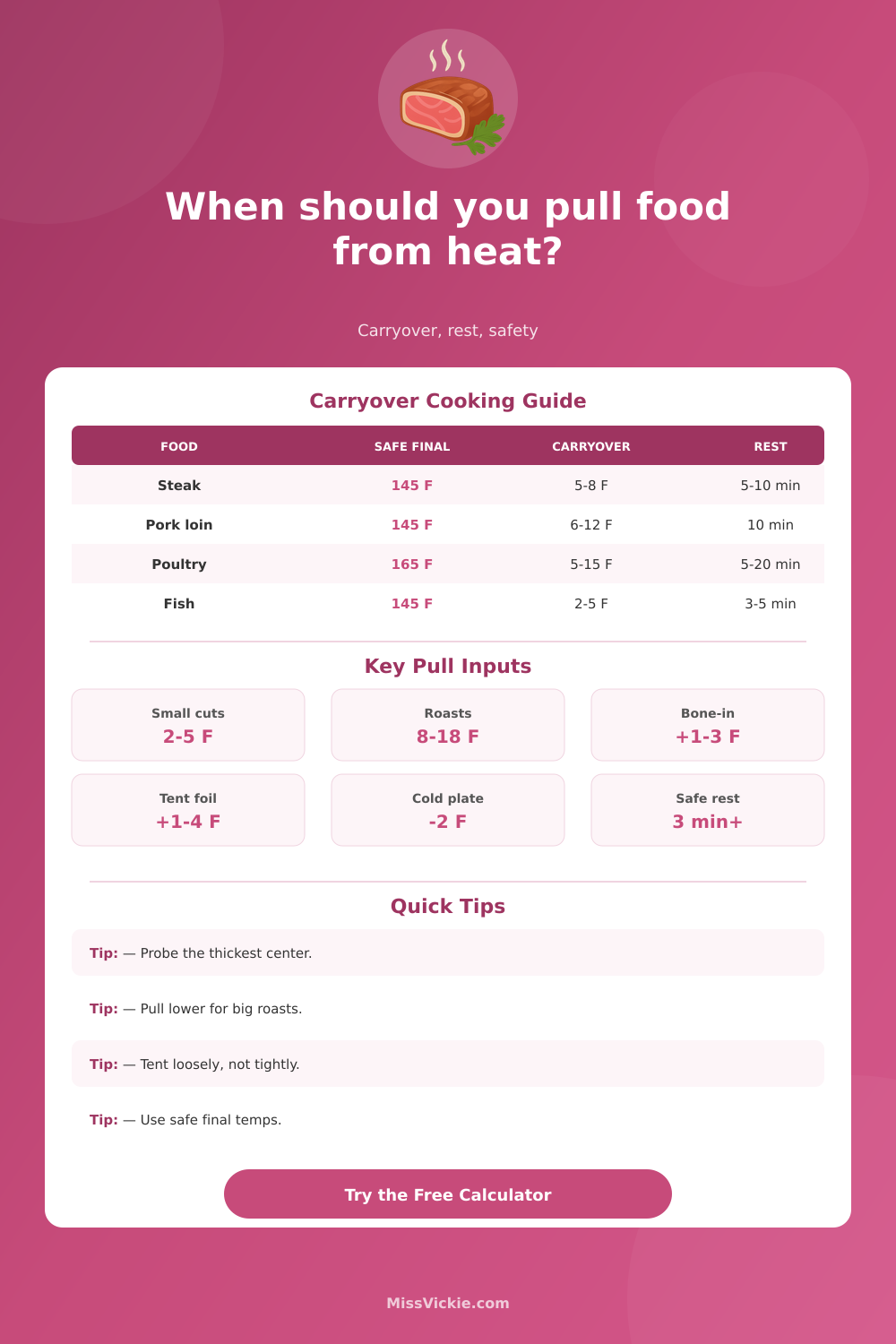
🌡Typical carryover by food and shape
Small fillets and delicate seafood rise quickly, then cool.
Thick steaks and chops keep cooking during a short board rest.
Large roasts, poultry, and fat-capped cuts hold heat longer.
Loaves, stuffing, and casseroles can climb in the hot dish.
✅Safe final temperature table
| Food type | Safe final internal temperature | Minimum rest | Carryover planning note |
|---|---|---|---|
| Beef, bison, veal, goat, lamb steaks, chops, roasts | 145°F / 63°C | 3 minutes | Plan the pull temperature below 145°F only if carryover reliably reaches at least 145°F. |
| Fresh pork, fresh ham, pork loin, pork tenderloin, pork chops | 145°F / 63°C | 3 minutes | Lean pork has modest carryover unless it is thick or tented. |
| Ground meat, sausage, meatballs, meatloaf | 160°F / 71°C | No added rest required | Dense ground mixtures can rise in the center after leaving the oven. |
| Chicken, turkey, other poultry, stuffing inside poultry | 165°F / 74°C | No added rest required | Probe the thickest breast or thigh area and avoid bone contact. |
| Fish fillets, fish steaks, whole fish | 145°F / 63°C or opaque and flakes | No added rest required | Fish carryover is small; check early and serve soon. |
| Casseroles, leftovers, reheated foods, stuffing | 165°F / 74°C | No added rest required | The dish stays hot, so carryover can be large in the center. |
🍲Carryover factors table
| Factor | Lower carryover | Higher carryover | What to adjust |
|---|---|---|---|
| Thickness | Thin fillet, steak under 1 inch | Thick chop, roast, loaf, whole bird | Thicker foods usually need a lower pull temperature. |
| Heat intensity | Low oven, smoker, sous vide sear | Broiler, hot pan, high oven, hard grill | Hot surfaces leave more heat stored in the outer layers. |
| Rest setup | Wire rack, uncovered, cool room | Hot pan, tight cover, cooler hold | Move food off hot metal if it is already near target. |
| Bone, skin, fat, pan depth | Lean boneless cut | Bone-in roast, skin-on bird, deep casserole | Insulating structure often adds 1 to 6 degrees. |
⏲Resting surface and tenting guide
| Rest choice | Typical effect | Best for | Watch point |
|---|---|---|---|
| Wire rack, uncovered | Reduces surface cooking | Steaks, chops, crisp skin | May cool faster after the peak. |
| Wood board, loose foil | Moderate carryover | Most roasts and poultry pieces | Keep foil loose so crust does not steam heavily. |
| Hot roasting pan | Adds bottom heat | Holding vegetables or pan juices | Move meat if the probe is already at target. |
| Towel and cooler | Extends carryover and hold | Large barbecue cuts and turkey | Use only after the safe final temperature is verified. |
🔎Probe and safety checks
Probe placement: Put the thermometer tip in the thickest center, away from bone, the pan, empty cavities, and large fat pockets.
Carryover peak: The center usually keeps rising for the first several minutes, then levels off before slowly cooling.
Safe final target: The calculator can estimate a pull point, but the final rested food still needs to meet its safe internal temperature.
Covered holds: Tight foil, lids, towels, and coolers can push carryover higher than a normal board rest.
Whether your meat is juicy or dry depend largely on carryover cooking. When you take a steak or roast off the heat it may seem cooked through but then as it cools down its internal temperature will still rise slightly. That’s because the heat in surrounding layers will continue to flow inward. So understanding that post-heat rise will help you avoid overcooking and achieve the level of cooking you want.
This online calculator (above) do all the math for you… If you can give it some information about your food and where it will be stored. But the trickiest part is knowing what information matters most. That’s primarily because heat is slow to move around thick pieces of food. The outer layers has lots of stored energy that moves into the rest of the food.
How to Cook Meat Perfectly
So a steak with a two-inch thickness will carry over more heat then a similarly thin piece of fillet. Similarly, larger cuts of meat weighs more, so they retain heat longer. That’s why bone-in roasts and entire birds has a lower pull temperature than their smaller counterparts from same cut. So, both thickness (and weight) matter, which is why the calculator include questions about both.
It depends on your surface temp and how you cook things. High-heat cooking create a big difference. It leaves a huge gap between the outside of the food, which will be piping-hot, and the inside, which will still be somewhat cool. When that food come out of the pan, the center will keep rising.
Sous vide foods, cooked gently, won’t have such a wide gap, and therefore have much less carryover. Same goes for how you set them up to rest, using foil helps trap the heat, while a wire rack lets heat dissipate. Fat (and bone) is insulating materials; so skin-on poultry or bone-in cuts tend to carryover a degree or two more than their leaner counterparts.
To get started, you’ll need to understand your safe end point. Whole-muscle pork and beef are considered safe cooked to 145°F, followed by a brief rest. Cook poultry to 165°F at the thickest part. Enter that target into the calculator; it will recommend a pull temperature based off expected carryover. Then verify it with an actual thermometer, as no kitchen is free from factors not included in the calculation.
First, measure the fattest part while avoiding fat and bone pockets with the probe. Remove the food and let it come to rest. Next, if it continues to climb as you remove the food, you’ve got carryover happening. If it levels out early then you know when to time things different next time.
You’re not trying to learn a chart; you are looking for a pattern which says “heat keeps moving till everything is in balance.” When that makes sense to you, use the calculator as a helpful tool instead of a guessing game. You should of used it more often to avoid mistakes.