Limoncello Simple Syrup Ratio Calculator
Balance infused alcohol volume, proof, target ABV, syrup sweetness, lemon intensity, chill dilution, bottles, and serving size for a limoncello batch that tastes bright instead of watery.
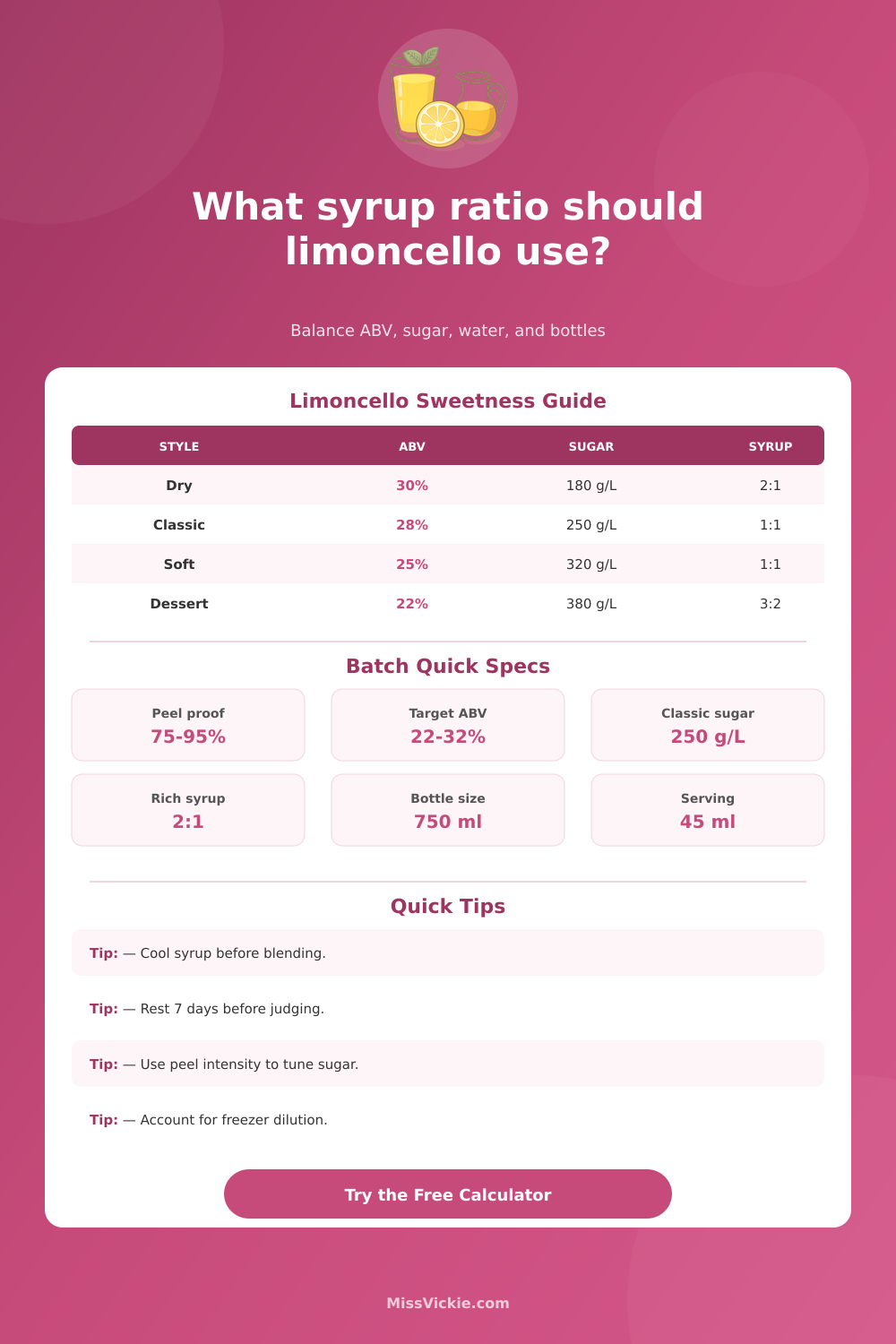
Choose a starting point for common homemade limoncello styles, then adjust the proof, sugar, syrup ratio, lemon intensity, and bottle size to match your infusion.
Limoncello Balance Breakdown
| Syrup Ratio | Water Per 100 g Sugar | Best Use | Balance Effect |
|---|---|---|---|
| 1:1 sugar to water | 100 ml water | Classic homemade limoncello | Easy dissolving syrup with gentle dilution and a familiar rounded finish. |
| 3:2 sugar to water | 67 ml water | Stronger infusions | Adds sweetness with less water, useful when target ABV is hard to reach. |
| 2:1 rich syrup | 50 ml water | Dry or high-proof batches | Keeps the batch brighter and stronger while still dissolving enough sugar. |
| 4:5 lighter syrup | 125 ml water | Very hot infusions | Dilutes more quickly, so it fits lower ABV or softer freezer sipping. |
| Finished Volume | 250 ml Bottles | 500 ml Bottles | 45 ml Servings |
|---|---|---|---|
| 1.0 liter | 4 full bottles | 2 full bottles | 22 servings |
| 1.5 liters | 6 full bottles | 3 full bottles | 33 servings |
| 2.0 liters | 8 full bottles | 4 full bottles | 44 servings |
| 3.0 liters | 12 full bottles | 6 full bottles | 66 servings |
Works best with rich syrup and bright peel oil because less water is available for sweetness.
Fits balanced sugar, 1:1 syrup, and a chilled cordial pour after the bottle rests.
Supports higher sugar and larger syrup volume, especially for intense lemon peel infusions.
Usually tastes better a little drier because mixers add more dilution and sweetness later.
Home-made limoncello sounds easy enough: just steep some lemon peels in strong booze, then sweeten it with syrup, and voila! Except that the combination of water, sugar, and alcohol define how bright (or flat) your final product will be. If you use more syrup than water, you’ll end up with lower alcohol content, and if it drops below point where the alcohol can absorbs the oils suspended, the balance is off. And if you go easy on the sugar, the bitterness of the peel take over.
Will your syrup contribute too much water? How much water are you okay giving up so that you can reach your target ABV in the bottle? And if you go easy on the sugar, the bitterness of the peel takes over. Will your syrup contribute too much water? How much water are you okay giving up so that you can reach your target ABV in the bottle? Once you select your sweet spot (and it is all about selecting your sweet spot), that’s your base line from there on out.
How to Mix Sugar, Water, and Alcohol
If you intend to serve the liqueur very cold, then the drier version will have sharper lemon oils. If you’re going for something softer, then you increase amount of sugar per liter and that rounds off the edge but also increases how much you’ve got to work with. Dissolved sugar uses some of that space so the syrup ratio becomes just as important as hitting the right sugar target.
A richer syrup have less water in it, meaning it is sweeter. This is great if your infusion began at a higher proof and you want to ensure the final liqueur doesn’t drop too low. Conversely, a lighter syrup give you more alcohol than what you may want, working better with batches where this is not an issue.
The thing nobody remembers is chill dilution, which isn’t factored into any of those numbers until it’s time for that first bottle from the freezer. This is water added by ice crystals and condensation that wasn’t accounted for on the counter. The calculator above lets you account for that, assuming a given percent at serving temperature, as does changing the lemon strength to adjust the sugar target.
More pronounced peel flavor generaly requires a slight boost in sweetness to keep it balanced, not sharp. The last volume becomes a useful plan when it’s combined with a serving size and bottle size. Now you know exactly how much to expect in full bottles as well as leftovers (and therefore uneven pours and wasted fractions of a bottle). This is useful info for stocking up a bar or making gifts!
You can choose rounding options for your servings so they round out nicely. These options provide cleaner numbers for bottles or kitchen-friendly numbers.
This is where it gets tricky: The desired sugar level contradicts the desired ABV. For example, if the amount of syrup necessary to achieve your sugar objective is larger than the amount of water needed to reach your target strength, then your final batch will be a lower ABV then intended. Options include reducing the sugar goal, changing the syrup proportion, or just going with something that’s off by a little. The calculator shows whether one of those options bring the batch back into your desired range.
For me, tasting after a week of rest is better than right out of the bottle on day one. The alcohol mellows some, the sugar blends in, and the lemon oil settles down a bit. After a few batches, each batch made with the same lemon type and spirit proof, it’s less abstract. It’s shorthand for something you know you like to taste.
You should of tried this before. It is actualy moddern. It feels more naturaly than using a luxurius recipe.