Croissant Lamination Calculator
Plan a croissant lock-in from dough weight, butter percentage, detrempe rectangle, butter temperature, fold sequence, sheeting size, trim reserve, and final triangle dimensions.
🥐Quick lamination presets
Choose a croissant production setup, then adjust the butter block, rest schedule, sheeting rectangle, and triangle cut size for your bench or sheeter.
⚖Lamination units
🧈Dough and butter lock-in
📐Folds, rest, and final sheeting
Croissant lamination results
Detailed lamination breakdown
Butter and dough are close enough in firmness for a clean lock-in.
🧊Lamination targets
Classic roll-in butter as a percent of detrempe weight.
Butter bends with the dough instead of cracking or melting.
A practical butter slab thickness for hand lamination.
Common final sheeting thickness before triangle cutting.
📋Fold style reference
| Fold style | Typical turns | Layer multiplier | Best croissant use |
|---|---|---|---|
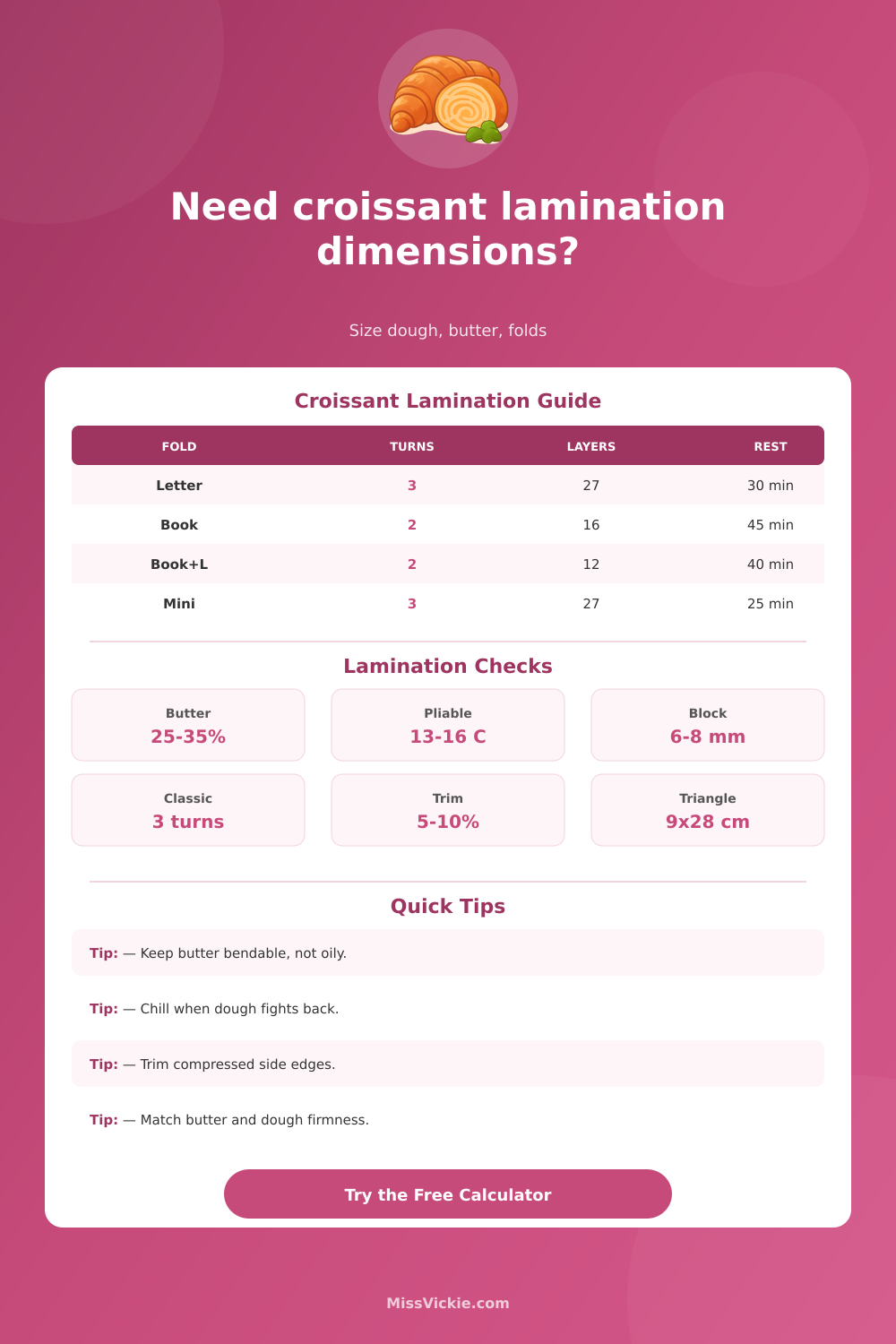
| Letter fold | 3 turns | 3 x 3 x 3 = 27 butter layers | Classic flaky croissants with dependable separation. |
| Book fold | 2 turns | 4 x 4 = 16 butter layers | Faster lamination when dough is strong and cold. |
| Book plus letter | 2 turns | 4 x 3 = 12 butter layers | Rich, open honeycomb with fewer roll-outs. |
| Half turn plus letters | 3 turns | 2 x 3 x 3 = 18 butter layers | Gentler first fold for fragile dough or warm rooms. |
🔪Triangle cutting reference
| Croissant size | Triangle base | Triangle height | Typical baked use |
|---|---|---|---|
| Mini croissant | 6-7 cm | 18-22 cm | Breakfast trays, tasting menus, and brunch baskets. |
| Standard croissant | 8-10 cm | 25-30 cm | Everyday bakery croissants with balanced curl. |
| Large croissant | 11-13 cm | 30-36 cm | Cafe display pastries and filled croissants. |
| Pain au chocolat | 8-10 cm | 12-16 cm | Rectangles wrapped around chocolate batons. |
🌡Butter temperature reference
| Butter condition | Metric range | Imperial range | Lamination adjustment |
|---|---|---|---|
| Too brittle | Below 12 C | Below 54 F | Rest briefly before lock-in or cracks may break layers. |
| Pliable | 13-16 C | 55-61 F | Ideal for matching a cool, relaxed detrempe. |
| Soft edge | 17-18 C | 63-64 F | Use flour lightly and chill sooner between turns. |
| Smearing risk | Over 18 C | Over 64 F | Chill the block before rolling or butter can leak. |
💡Croissant lamination notes
Match firmness: Butter and detrempe should bend together. A cold hard block breaks into shards, while warm butter smears into the dough.
Trim deliberately: Compressed side edges can seal layers. Reserve trim before estimating final croissant count and piece weight.
How much butter? How heavy should the dough be? What happens when they’re combined and put under pressure? Those are some of the quiet variables that lead to great croissants. Enter them into the calculator above. It will run numbers for you, so you don’t have to guess how changing one affects the other.
All of this hinges on setting your scales to Detrempe weight. For a typical small bench batch, 1kg is a good place to start, but then what? How does that dough cool off? Too hard and it cracks at the first turn; too soft, and by the time you hit second rest, layers smear into one another.
How to Use the Croissant Calculator
You must includes both temperatures (dough and butter) in calculator. They tell you if there is enough difference between the two to allow for a clean lock-in instead of potential future trouble. The same goes for butter percentage. A 25% butter content makes for a faster-proofing, lighter pastry. Using 35% will delivers deeper flavors and more dramatic separation, but it requires a slightly thicker initial block of dough and colder rests. By translating that percentage into real slab-size, you’ll be able to visualize if the rectangle you’ve designed will indeed encompass butter or have to push it to the sides.
The number of unique layers of butter depend on the fold style (how you manipulate the dough) and the number of times you turn it (the turn count). For traditional croissant shapes that maintains structure during baking, three letter folds give you twenty-seven layers. To shorten the timeline (important if your dough is resisting or the kitchen is hot), drop down to a book fold, then do a letter fold: That’s twelve layers. Use calculator to see how many layers you get and how the whole resting schedule works, then decide if you want extra chill time or more flavor.
The size of each triangle, and its final sheeting thickness, determines not just its form but also its yield. For a classic bakery croissant, right measurements are about nine by twenty-eight centimeters on a four-millimeter sheet, resulting in even curl. Drop the height and you’ll wind up with something denser but quicker to proof; make the base bigger and your pastry will open out wider then (and require another few seconds in the oven). With the tool’s help, you can predict how many pastries remains once you subtract what gets lost in trim reserve. One common error is making plans for, say, twenty croissants only to end up with seventeen because of edge waste.
Troubleshooting temperature and thickness. They flags issues in time to catch problems before the first turn. The danger level increases if butter is more than a few degrees removed from the dough. And it goes up further if the block is less than 6 millimeters thick. Why does that matter? Because it stops you mid-lamination, forcing you to make an adjustment, and preventing your layers from being compromised when you notice midway. You should of checked this earlier.
The calculator cannot taste the butter or feel how dough relaxes on your specific bench. No matter that it can’t account for how a warm room changes everything in twenty minutes. All the calculator does is take away math and let you focus on the variables that realy make a difference: matching the firmness, layer protection, and recognizing when to shave a few more seconds off the rest time or add a little more trim reserve to rescue the batch. It’s easier than calculating by hand.