Royal Icing for a Cake Calculator
Estimate royal icing for cakes by diameter, tiers, layers, border and piping coverage, flood or stiff consistency, meringue powder ratio, color gel load, spare icing, and drying time.
Choose a cake decorating plan, then adjust the cake size, piping coverage, color intensity, and consistency before calculating.
Royal Icing Batch Breakdown
| Royal Icing Use | Texture Target | Water Per 1 lb Sugar | Meringue Powder | Best Cake Detail |
|---|---|---|---|---|
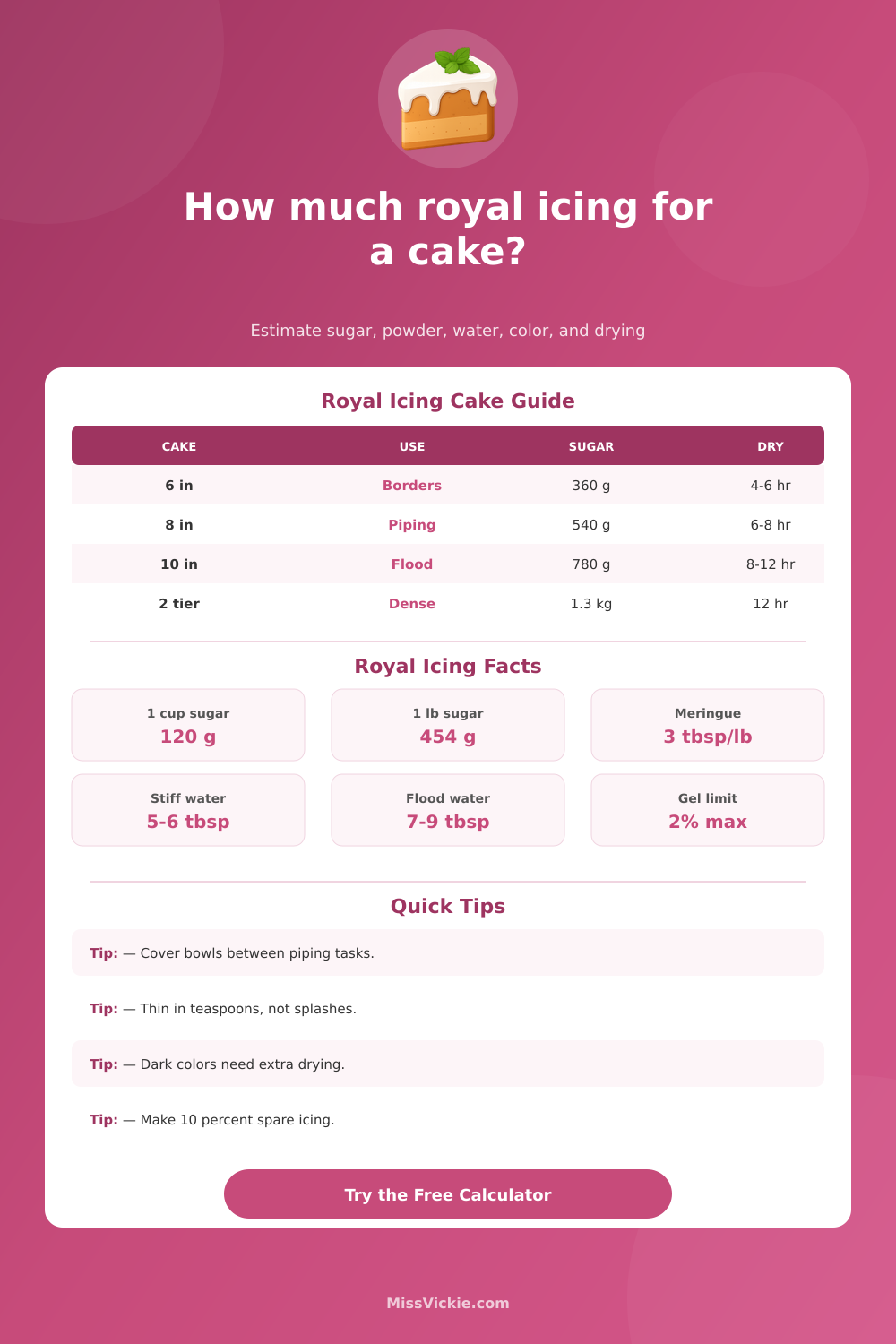
| Stiff piping | Holds sharp peaks | 5 to 6 tbsp | 3 to 3.5 tbsp | Roses, shells, Lambeth trims |
| Medium piping | Soft curl on beater | 6 to 7 tbsp | 3 tbsp | Borders, dots, lettering |
| Soft detail | Ribbon settles slowly | 7 to 8 tbsp | 2.5 to 3 tbsp | Fine lines and monograms |
| Flood panels | 10 to 15 second flow | 8 to 9 tbsp | 2.5 to 3 tbsp | Plaques and smooth fills |
| Cake Setup | Typical Sugar | Piping Length | Flood Portion | Dry Before Boxing |
|---|---|---|---|---|
| 6-inch single tier with simple border | 300 to 420 g | 40 to 70 in | 0 to 20 percent | 4 to 6 hr |
| 8-inch birthday cake with writing | 480 to 650 g | 80 to 130 in | 10 to 25 percent | 6 to 8 hr |
| 10-inch cake with stencils or plaques | 700 to 950 g | 120 to 190 in | 25 to 45 percent | 8 to 12 hr |
| Two-tier wedding cake with dense detail | 1.1 to 1.6 kg | 240 to 420 in | 10 to 35 percent | 10 to 14 hr |
No gel load. Fastest drying and crispest edges.
Small gel dose with little texture change.
Plan longer drying and slightly firmer mix.
Rest color before piping and keep water lower.
Cake Decorating relies heavily on royal icing for its ability to provide a smooth panel or crisp line that maintains its form after drying. However, knowing how much to make is the struggle: Too little, you’ll run out halfway through piping; too much, the excess will crust up by the time you’re done! Once you input your cake size and desired decoration, the calculator does the math for you; no more fumbling with ratio formula that changes based off each new design.
It isn’t just about cake size: a 6-inch round with a basic border requires much less icing then an 8-inch cake with dense scrollwork, even though they’re only a couple inches apart. It’s about the surface area being covered, but also about the amount of piping needed to complete any edges. That is why when you select your coverage style in the tool, what you’re really doing is instructing it on how many of the seen areas of the cake need to be raised as detail vs. Plain flooded work; and that actualy affects the resulting batch size more than most baker realize.
How to Use the Royal Icing Calculator
You also need consistency. You want a stiff icing for your roses, but a flood icing that’ll spread across your plaque within about ten seconds. If you choose ‘mixed’ from the drop-down, the calculator divide your concoction into two batches, leaving one thick enough for outlining and another thin enough for filling.
That’s controlled by how much water goes in, and it tweaks it depending on both the consistency selected AND the level of meringue powder used, though they acknowledge that even the same recipe behaves differently depending on the day (a.k.a. Humid days can change things. This is why there is a humidity setting to extend the estimated drying time. The other factor is color. Black (and dark shades) take longer to crust than lighter colors, because there’s more of that sticky gel involved, which takes longer to dry up.
The timing differences across color ranges are detailed in the reference tables on the page. These provide a quick guide to how much extra time you need when moving from pastels to fully saturated colors. If you realize you’re always testing a tip or re-making a color midway through your session, adjust this padding upwards.
And finally, as a quick pre-measurement check, here are some general sugar quantities for popular-sized cake: Climate also affects the amount of meringue powder used: more for a soft-set that will keep icing workable longer in dry air, less for a firm set (better at holding detail) in damp kitchens. After choosing your desired meringue level and room conditions, the calculator adjust the amounts automatically.
The outcome is not just the total weight, but also an estimate of how many piping bags you will have. This helps if you are coloring, separating batches, or have limited fridge space. Side-by-side comparisons of two similar but slightly different designs are where it gets realy useful, though. Make an eight-inch cake with full side piping and flood plaques, then do the exact same cake with just light borders. You’ll see how much more sugar goes into the fuller version and notice the extra drying time. Most folks find out that they can simplify something while still getting the look they want, because they can see exactly what the trade-off looks like before mixing up a batch.
A little thinner (or a little thicker) line, or a teaspoon of extra water, can prevent hours of rework later. Early tweaks are rewarded, so you have a good place to start with the calculator, but there’s always room for variation, after all, your own kitchen conditions and piping habits remains the final variables. But once you know how a change impacts the results, it becomes much less of a guessing game and more of one repeatable part of the decorating process.