Cornstarch to Thicken Cheesecake Calculator
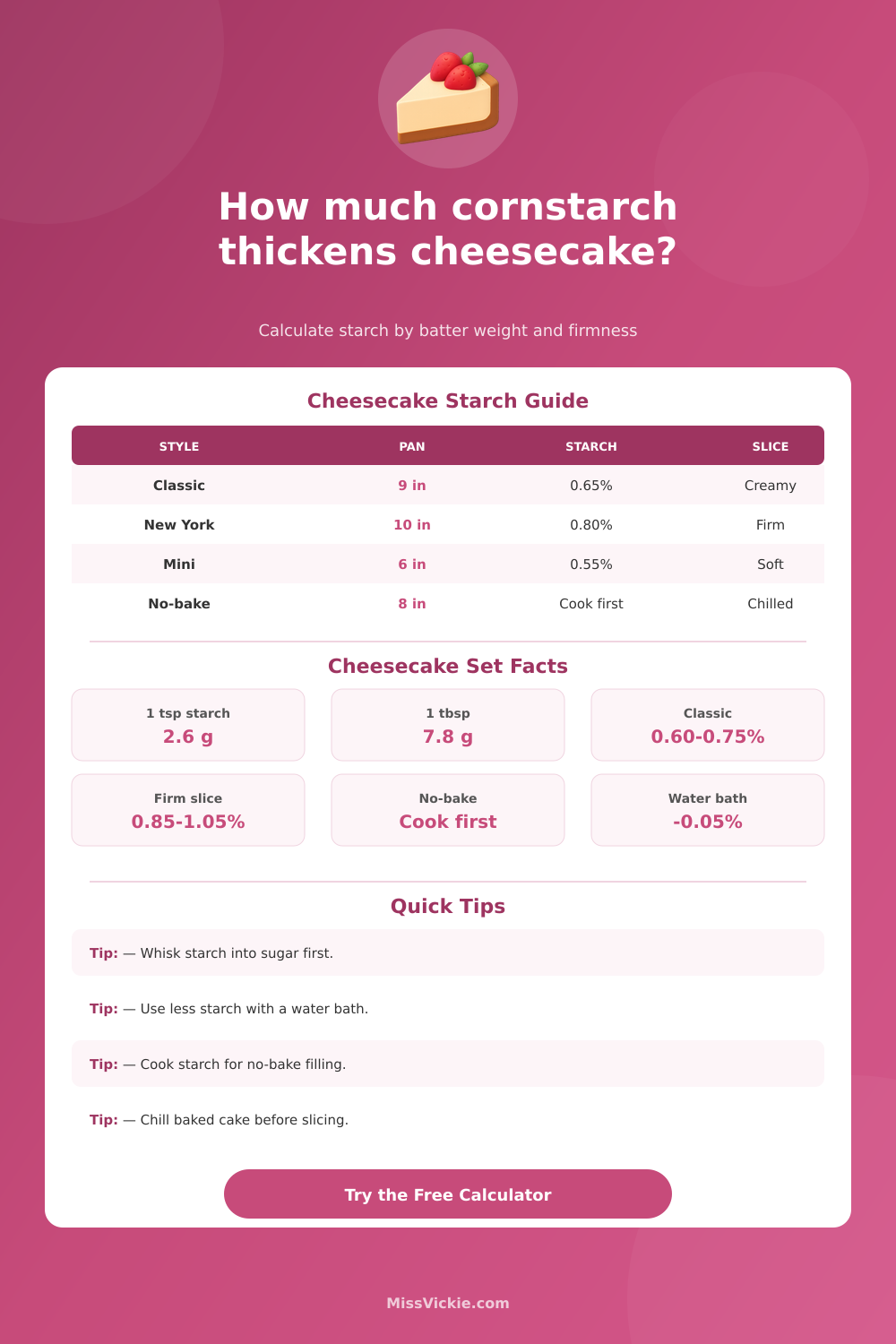
Estimate cornstarch for cheesecake batter by pan diameter, batter weight, cream cheese blocks, egg count, sour cream or liquid level, baked or no-bake method, water bath, firmness goal, and starch percentage.
Load a real cheesecake setup, then fine-tune the batter weight, dairy ratio, baking method, and firmness target before calculating.
Cheesecake Batter Breakdown
| Cheesecake Style | Good Starting Rate | Best For | Texture Note |
|---|---|---|---|
| Soft classic baked cheesecake | 0.45 to 0.60% | Water bath, lower eggs | Creamy, delicate slices |
| Standard 9-inch cheesecake | 0.60 to 0.80% | Everyday clean slicing | Stable without tasting starchy |
| New York style cheesecake | 0.80 to 1.05% | Dense, tall, firm wedges | Holds height after chilling |
| Fruit puree or pumpkin batter | 0.85 to 1.15% | Extra moisture in filling | Prevents weeping at the crust |
| No-bake cooked starch filling | 0.70 to 1.20% | Custard base folded with dairy | Starch must be heated to thicken |
| Pan Size | Typical Batter | Blocks | Starch at 0.70% |
|---|---|---|---|
| 6-inch round | 650 to 850 g | 1.5 to 2 | 4.6 to 6 g |
| 8-inch round | 1000 to 1250 g | 2.5 to 3 | 7 to 8.8 g |
| 9-inch round | 1300 to 1650 g | 3 to 4 | 9.1 to 11.6 g |
| 10-inch round | 1800 to 2300 g | 4.5 to 5.5 | 12.6 to 16.1 g |
| 9 x 13-inch bars | 1700 to 2400 g | 4 to 6 | 11.9 to 16.8 g |
| Batter Signal | What It Means | Starch Move | Mixing Note |
|---|---|---|---|
| More than 1 egg per block | Extra custard protein | Reduce 0.05% | Avoid overbaking edges |
| Less than 0.7 egg per block | Less baked structure | Add 0.08% | Chill longer before slicing |
| High sour cream level | More water in batter | Add 0.10% | Blend starch with sugar |
| Fruit puree or pumpkin | Moisture plus fiber | Add 0.18% | Drain watery puree first |
| Cold no-bake filling | No starch gelatinization | Cook base | Cold starch tastes chalky |
| Cornstarch | Approx Spoons | Best Batch Size | Use Case |
|---|---|---|---|
| 5 g | 2 tsp | 6-inch | Soft mini cheesecake |
| 8 g | 1 tbsp | 8-inch | Classic clean slice |
| 10 g | 1 tbsp + 1 tsp | 9-inch | Standard baked filling |
| 14 g | 1 tbsp + 2 tsp | 10-inch | Dense New York texture |
| 17 g | 2 tbsp + 1/4 tsp | 9 x 13 | Firm cheesecake bars |
Gentle heat sets eggs evenly, so starch can stay modest and creamy.
Use a middle rate to help slices hold while edges bake a little faster.
Puree and sour cream need extra starch to reduce weeping after chilling.
Cornstarch must be heated in liquid before it can thicken smoothly.
Slice it clean. Getting a cheesecake to slice cleanly is one of those small kitchen problems that suddenly matters the moment you flip pan over. Even if you get a clean slice, it’ll crack. Once you remove cake from its pan, you realize there’s something wrong.
How much starch did you use? Why does some cheesecake seem so firm while other parts is all wobbly? Bakers simply guesstimate and hope for the best until they chill and cut their cake. A tool can tracks things like how many eggs went into that batter, what size pan was used, or even how much sour cream were added to give you a concrete number. Enter a tool that lets them know exactly: the weight of the batter, the pan size, egg count, and quantity of sour cream. Now a hazy feeling about how hard it should feel turn into an exact number to follow along.
How Much Starch to Use
When heated, cornstarch swells and traps water, making custard stiffer. Once cooled, this structure will supports the weight of cake. Not enough? It stays runny in the middle. Too much? It gets pasty instead of creamy. The quantity of starch needed is affected by every other ingredient in bowl. Because protein from extra eggs provides more structure, you need a bit less starch. Fruit puree or sour cream add water; you need more starch to hold that in place. Slow heating (like with a water bath) gives the eggs time to set before the starch sets, so a water-baked cake needs less starch different than an otherwise identical one baked in a dry oven.
How much starch to use vary by baking method as well. Raw starch does not get fully gelatinized at no-bake filling temperatures, so you’ll need to cook it with a small base then fold into your mixture after cooling. Otherwise, you’ll end up with white specks of gritty powder in the finished slice. Baked cheesecakes don’t have this problem. But now you’re dealing with another variable. If cake’s going to be served immediately, it should of been firmer-set than if it’ll sit overnight in fridge.
Once you input that information into the calculator (above), it do the calculations for you. But it makes process predictable rather than a gamble. Remember: The bigger the surface area… Say if you make a round cake vs. With bars, each slice will be smaller. Therefore, they’ll need to have a little more starch in them so they don’t crumble as much when lifted out.
Or if you used extra-rich cream cheese with no added liquid, then that last starch percentage might now be too high. Again, making a few tweaks based off how much liquid you add or the weight of the batter ensures consistency despite the altered recipe. Here is the solution to most starch issues. A basic habit: Before the cream cheese encounters the sugar, whisk the measured cornstarch into it. This spreads the dry powder evenly throughout sugar crystals. When time comes to dissolve it into the batter, it dissolves easily without any little lumps forming. These lumps are the white speckles you see in the slice.
After making this step a habit, the remainder of process is predictable. You won’t have to guess every time you make different flavor or use a different pan. The sweet spot isn’t necessarily the most firm possible, it’s just the right amount of firm for whatever type of serving you have in mind. Plate straight away and you might get away with a slightly softer slice that looks just as good as one cut from the firmer end. Need to transport? Take along a cake that’s a bit stiffer, so it holds together better at destination party.
No matter what happens, amount here will show it. Just be mindful of what, ahem, ends up in the mixing bowl.