Xanthan Gum per Cup of Almond Flour Calculator
Estimate xanthan gum for almond flour baking by cups or grams, recipe style, egg support, moisture, grind, starch blend, pan support, desired tenderness, and your chosen gum rate.
Load a real almond flour bake, then tune the gum rate for the crumb you want.
Full Almond Flour Breakdown
Most fragile; best only when eggs, cheese, or nut butter provide structure.
Good for cookies, shortbread, tender cakes, and low-moisture batters.
Useful for muffins, pancakes, snack cakes, and mixed almond flour blends.
Best for almond flour loaves, buns, pizza crusts, and freeform doughs.
| Recipe Type | Starting Gum per Cup | Good Cup Range | Texture Goal |
|---|---|---|---|
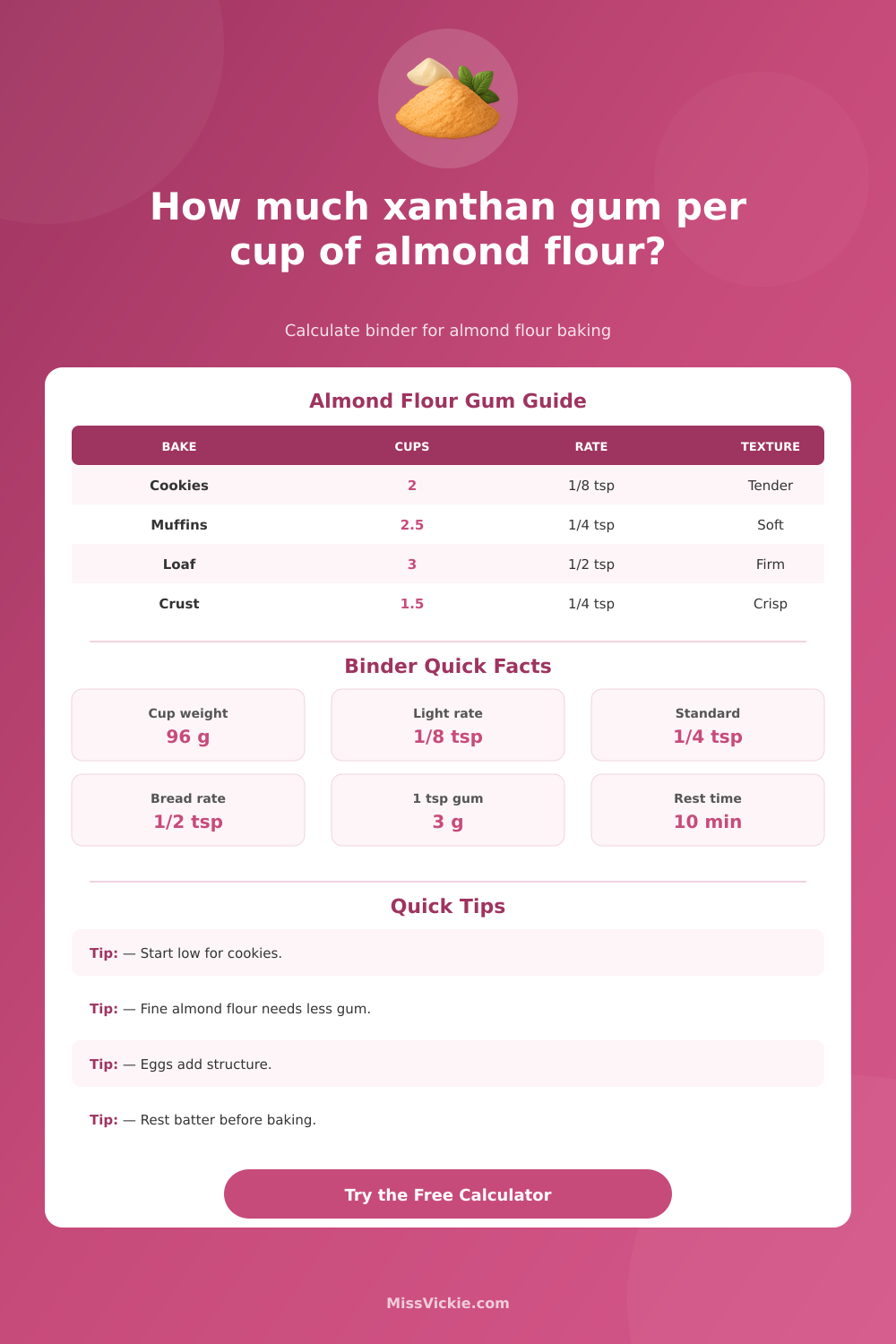
| Cookies and shortbread | 0 to 1/8 tsp | 1 to 3 cups | Tender, low chew, less spread |
| Cakes and cupcakes | 1/8 to 1/4 tsp | 1.5 to 4 cups | Soft crumb that does not crumble apart |
| Muffins and pancakes | 1/4 tsp | 1.5 to 4 cups | Flexible crumb with clean lift |
| Pie crust and tart shells | 1/8 to 1/4 tsp | 1 to 3 cups | Crisp edges with less cracking |
| Pizza crust and flatbread | 1/4 to 1/2 tsp | 1.5 to 4 cups | Better bend and slice strength |
| Loaves, buns, and rolls | 1/3 to 1/2 tsp | 2 to 6 cups | Stronger sliceable structure |
| Almond Flour | Approx. Grams | Light Gum | Standard Gum |
|---|---|---|---|
| 1 cup | 96 g | 1/8 tsp | 1/4 tsp |
| 1 1/2 cups | 144 g | 3/16 tsp | 3/8 tsp |
| 2 cups | 192 g | 1/4 tsp | 1/2 tsp |
| 3 cups | 288 g | 3/8 tsp | 3/4 tsp |
| 4 cups | 384 g | 1/2 tsp | 1 tsp |
| 6 cups | 576 g | 3/4 tsp | 1 1/2 tsp |
| Recipe Factor | When It Applies | Gum Move | Reason |
|---|---|---|---|
| More eggs | Three or more eggs in a small batch | Lower slightly | Egg proteins already bind the crumb. |
| Wet batter | Fruit, puree, yogurt, or thin batter | Raise slightly | Extra water needs more suspension. |
| Coarse meal | Visible specks or uneven homemade grind | Raise slightly | Coarser particles break more easily. |
| Added starch | Tapioca, arrowroot, potato, or cornstarch | Lower slightly | Starch helps gel and soften texture. |
| Freeform shape | Buns, rolls, or pizza shaped without walls | Raise slightly | Less pan support means gum carries more load. |
| Very tender goal | Cakes, cookies, or delicate bars | Lower slightly | Too much gum can turn the bite bouncy. |
| Preset | Almond Flour | Eggs | Starting Rate |
|---|---|---|---|
| Keto sandwich loaf | 3 cups / 288 g | 4 eggs | 1/2 tsp per cup |
| Almond burger buns | 2.5 cups / 240 g | 3 eggs | 0.45 tsp per cup |
| Blueberry muffins | 2 cups / 192 g | 2 eggs | 1/4 tsp per cup |
| Snack sheet cake | 2.5 cups / 240 g | 3 eggs | 0.22 tsp per cup |
| Almond shortbread | 1.5 cups / 144 g | 0 eggs | 1/8 tsp per cup |
| Almond pancakes | 1.25 cups / 120 g | 2 eggs | 1/4 tsp per cup |
| Low-carb pizza crust | 2 cups / 192 g | 1 egg | 1/2 tsp per cup |
| Almond pie crust | 1.75 cups / 168 g | 1 egg | 0.18 tsp per cup |
| Fudgy almond brownies | 1.5 cups / 144 g | 2 eggs | 0.16 tsp per cup |
Almond flour also bakes up nicely, but it have no gluten to give a recipe structure. Because of this, most almond-flour baked goods need xanthan gum to help them stay together, not just for loaves but for cookies too. The amount changes based off things like pan shape and egg count; you’ll use less gum if you’re using a loaf pan instead of freeform shapes, or if there is more eggs to help hold it together. Guess wrong? Dry slices or gummy centers are the result.
Get rid of the trial and error involved in your initial gluten-free baking experience: Use a calculator that figures out those variables. Before measuring your ingredients, think about this: The grind size of almond flour make a difference; a finer grind packs together well and requires less binder, whereas a coarser meal has gaps that need filling out. On the other hand, moisture content acts in reverse; the drier the better, as a wetter batter (whether from yogurt or fruit) flow around, so the gum must exert more effort to hold everything together. Heating the mixture also helps by lightening the gum’s load: Starch gels up and holds things together. Finally, eggs contribute protein networks that can takes over some of the gum’s job. This explains why recipes rich in eggs (three or four per two-cups-of-flour) may not call for more gum than usual.
How to Use Xanthan Gum in Baking
The change is unexpected: Pan support alters how much gum’s needed. Because the dough have walls (like from a loaf pan) to lean on, it requires less than something freeform like pizza crust or buns that rely on the gum holding their shapes until protein set. The texture goal matters as well. Too much gum make a tender cake rubbery, but more gum will help sandwich loaf slice stay together when you spread butter on it.
After you make your selections, it will run the math for you (above), removing any guesswork about what to change as various factors changes. The bottom line will appear in both grams and teaspoons (handy if your recipe calls for weight rather than volume). There are reference charts that list typical amounts for each type of recipe and changes based on common substitutions (so you’ll know whether you’re still close or need to rethink your strategy):
Once mixed, xanthan gum do not stop working. When it hydrates (which takes about 10 minutes, as recommended by most recipes), the dough firm up noticeabley. Often, when you taste right at the end of mixing, you find yourself adding too much. Wait, so you can see the actual texture, and then put pan in the oven.
After a few batches, using the tool becomes simpler. A pattern emerges: for example, replacing your loaf pan with a sheet pan requires more gum (or fewer eggs) than before or adding another egg decreases amount of required gum. Small adjustments add up, after a month’s worth of baking, transforming inconsistent results into consistent ones.
You should of seen the diffrence earlier.