Xanthan Gum for Cake Calculator
Estimate xanthan gum for gluten-free cakes from flour weight, pan shape, layer count, cake style, fat, eggs, moisture, tenderness, rise, and your own gum percentage.
Choose a real cake situation to load flour weight, structure, moisture, and crumb targets, then adjust the gum percentage for your batter.
Full Breakdown
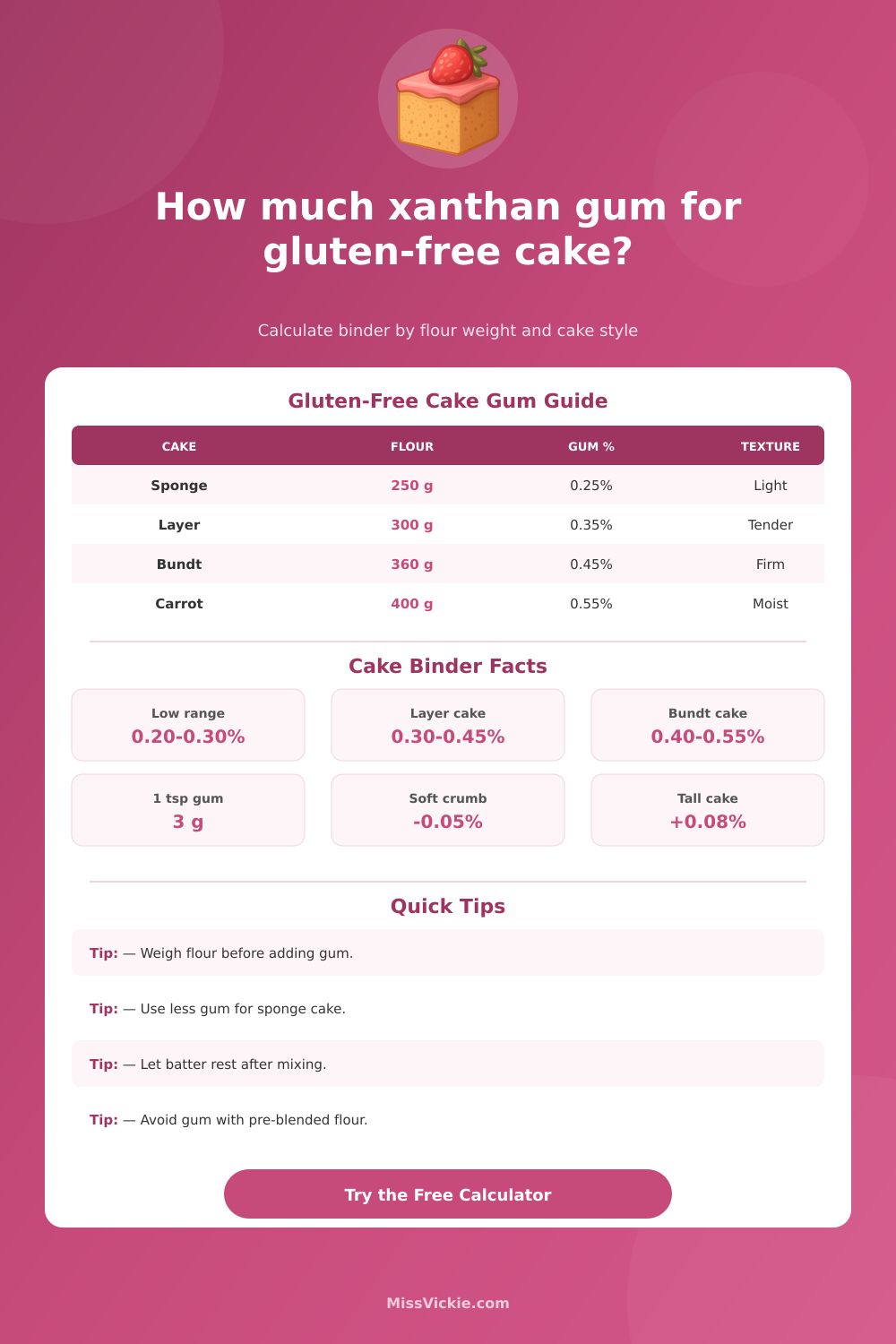
| Cake style | Starting gum percent | Best crumb target | When to lower it |
|---|---|---|---|
| Sponge or roll cake | 0.18% to 0.28% | Flexible, light crumb | When egg foam is strong and the cake must roll. |
| Butter layer cake | 0.30% to 0.42% | Tender slices with clean layers | When using a 1-to-1 blend that already includes gum. |
| Chocolate cake | 0.32% to 0.48% | Moist crumb with cocoa support | When batter includes yogurt, sour cream, or extra eggs. |
| Pound or bundt cake | 0.42% to 0.58% | Sturdy slices and tunnel control | When the recipe is high in eggs and butter. |
| Carrot or fruit cake | 0.45% to 0.65% | Moist crumb that holds mix-ins | When grated fruit is well drained. |
| Chiffon or oil cake | 0.22% to 0.36% | Open, springy crumb | When whipped whites carry most of the rise. |
| Egg-free vegan cake | 0.38% to 0.58% | Extra binding without chew | When psyllium, flax, or chia is also used. |
| Flour weight | At 0.25% | At 0.35% | At 0.50% |
|---|---|---|---|
| 200 g gluten-free flour | 0.5 g | 0.7 g | 1.0 g |
| 250 g gluten-free flour | 0.6 g | 0.9 g | 1.3 g |
| 300 g gluten-free flour | 0.8 g | 1.1 g | 1.5 g |
| 360 g gluten-free flour | 0.9 g | 1.3 g | 1.8 g |
| 450 g gluten-free flour | 1.1 g | 1.6 g | 2.3 g |
| 600 g gluten-free flour | 1.5 g | 2.1 g | 3.0 g |
| Recipe signal | Adjustment | Why it matters | Texture clue |
|---|---|---|---|
| High egg count | Lower 0.02% to 0.06% | Egg proteins add structure and reduce the need for gum. | Cake sets cleanly but stays tender. |
| Very rich batter | Add about 0.04% | Butter, oil, and nut flour soften the starch network. | Slices hold without feeling gummy. |
| Wet cocoa batter | Add 0.03% to 0.06% | Extra liquid needs more suspension while baking. | Crumb stays moist but not pasty. |
| Fragile sponge goal | Lower about 0.08% | Too much gum fights foam expansion and rolling. | Crumb bends before cracking. |
| Tall layer goal | Add 0.05% to 0.08% | Higher rise needs more wall strength during cooling. | Layers stack without crumbling. |
| Pan shape | Binder tendency | Layer note | Best use |
|---|---|---|---|
| Round layer pan | Moderate | Two or three layers need clean slice strength. | Birthday and filled cakes. |
| Sheet pan | Low to moderate | Single layer spreads weight across a wide pan. | Snack cakes and potlucks. |
| Bundt or tube pan | Moderate to high | Deep batter needs structure through the center. | Pound cakes and rich batters. |
| Loaf pan | High | Thick center line benefits from stronger binding. | Tea cakes and quick cakes. |
| Cupcake tin | Moderate | Small wells set quickly, so avoid heavy gum. | Party cupcakes and testing batches. |
| Jelly roll pan | Low | Thin cakes need flexibility more than firmness. | Roll cakes and sponge sheets. |
Edges break, slices shed crumbs, and layers can split when lifted.
Crumb cuts cleanly, bends slightly, and does not feel sticky.
Center feels elastic, damp, or chewy even when the cake is fully baked.
Pre-blended gluten-free flours often include xanthan gum already.
The problem is how you make cake bind. Without wheat flour providing natural structure, a cake made with any of these flours (rice, tapioca, almond blends) isn’t going to be cohesive. When you cut into it and pick up a slice, something needs to hold the crumb in place. That’s where xanthan gum comes in.
Too little makes the cake dry and crumbly; too much means it will feel strangeley elastic in the center. It starts even earlier: When the batter go into the bowl, it’s already being calculated. The weight of flour matters because xanthan gum bonds with starches, not liquids or sugars. Knowing that number help guide other choices.
How to Use Xanthan Gum in Cake
The shape of the pan matter, specifically how thick walls are. It needs support in the center different than a thin sheet cake. In the same way, a deep lidded bundt would be less stable then a flatter layer cake. How many layers will there be. Another factor? Those has to hold up under their own weight and to cutting and handling.
In fact, moisture and fat are pulling in opposite directions. If there’s a lot of fat (oil or butter) in the batter, you may need slightly less gum; it’ll help hold back a tightening crumb. And if the batter is moist, grated carrot or chocolate chips will do that. You’ll want more gum to balance moisture as the cake sets up.
Eggs, too: more eggs contribute a larger protein network. This means you may be able to use less gum and still have slice holding together. After you enter those parameters, the calculator does the math for you. It calculates an adjusted percentage depending on your desired rise. It also considers how many layers you want, what type of pan you use, and whether dough is moist or dry. It provides an estimated weight in teaspoons and grams.
So now when you want to make something using another flour mix, you don’t have to guess at proportions. Many people think there’s just one magic number for xanthan gum that works every time; it’s not that simple. In real life you want a very precise range. Too much gum: the insides are rubbery, even if you cool it down. Not enough: edges fall apart when you cut into it. That tiny fraction of a percent might mean the difference.
It’s worth spending extra minute to check your batter consistency before putting it in oven. That’s not all there is to it, however; behavior of the flour itself cannot be quantified in numbers. Commercial mixes may already include some binder such as xanthan gum. If you add a full measured amount to an unknown amount, you’ll get gummy results. This surprise could of been avoided by reading the label first.
It is better to measure, weigh the gum, and gently fold it in with other dry goods. Wait a few minutes; let the batter sit while the gum has time to absorb all the moisture and become somewhat thicker. By then you’ll have some idea of how it feels: does this feel correct, or not? You can make small tweaks before you put it in the oven instead of when it’s cooked through and cut open.”
The gluten-free cake cuts nicely, meaning, you’ve got the balance down. It also stays moist for two or three days. When you present it, no apologies are necessary. That’s the real reward for not playing the xanthan gum guessing game and using it as a measured ingredient.