Drink volume, fruit load, ice load, protein powder, thickness target, blender power, base type, gum percent, hydration time, and texture risk
Xanthan Gum for Smoothie Calculator
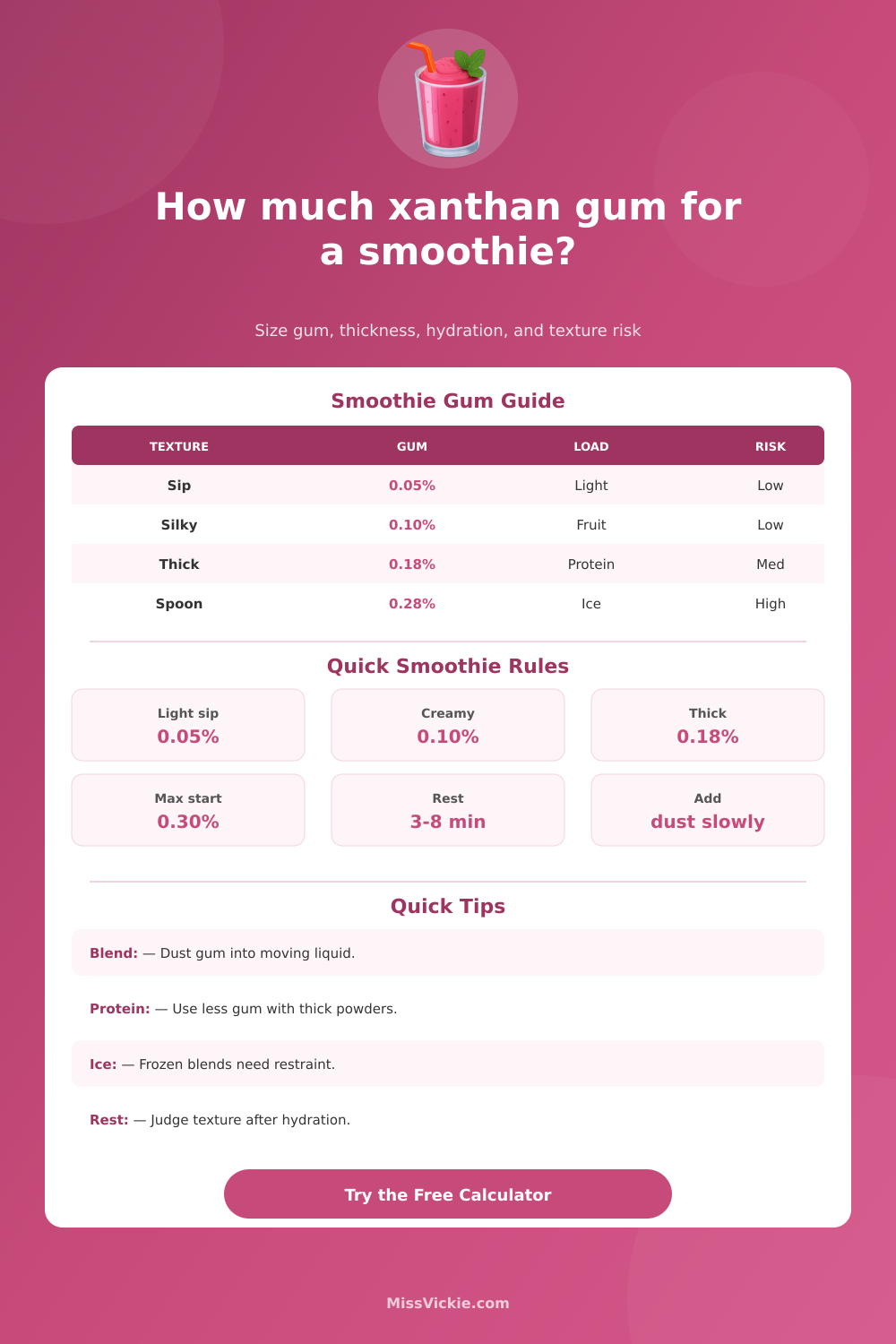
Estimate xanthan gum for a smoothie from finished drink volume, dairy or non-dairy base, fruit, ice, protein powder, desired thickness, blender power, hydration time, and texture risk.
Choose a smoothie scenario, then adjust the fruit, ice, protein, base, blender, hydration time, and gum percentage before blending.
Smoothie Breakdown
| Smoothie Texture | Typical Gum Percent | Best With | Texture Watchout |
|---|---|---|---|
| Light sipping smoothie | 0.04% to 0.07% | Fresh fruit, dairy milk, thin non-dairy milk | Too little may settle after 10 minutes. |
| Silky straw smoothie | 0.08% to 0.13% | Berries, banana, oat milk, kefir | Good first target for most home blenders. |
| Thick shake smoothie | 0.14% to 0.22% | Protein powder, frozen fruit, yogurt | High protein can make it tacky. |
| Spoonable smoothie bowl | 0.22% to 0.32% | Frozen banana, mango, low liquid ratio | Blend hard and judge after hydration. |
| Watery smoothie rescue | 0.08% to 0.18% | Juice base, melon, greens, thin milk | Add in tiny increments to avoid clumps. |
The calculator uses percent of estimated smoothie mass. For home measuring, 1 level teaspoon xanthan gum is estimated near 2.8 grams, though brands and scooping style vary.
| Ingredient Pattern | Effect On Gum | Hydration Cue | Blend Note |
|---|---|---|---|
| Juice, water, or almond milk | Needs more gum for body | Hydrates quickly but can clump | Start liquid spinning before adding gum. |
| Dairy milk, soy milk, or kefir | Moderate gum need | Usually smooth after 3 to 6 minutes | Good everyday smoothie base. |
| Oat milk or coconut beverage | Needs less gum | Body builds steadily as it rests | Use a conservative percentage first. |
| Greek yogurt or casein protein | Reduce gum amount | Can become spoon-thick after resting | Watch for tacky or stretchy texture. |
| Frozen fruit and ice | Reduces immediate gum need | May thin as ice melts | For bottles, rest and recheck texture. |
Most silky fruit smoothies need only a pinch to a small 1/4 tsp.
Protein powders thicken too, so avoid jumping straight to a full teaspoon.
Blend into the liquid base before adding the heaviest frozen ingredients.
Use high blender power and a short rest before adding more gum.
Smoothies often separates into a watery layer when the smoothie sits in the refrigerator for ten minutes. This is due to the lack of control that home blenders offer to smoothie maker over the texture of smoothies. Xanthan gum can fix this problems, but the smoothie maker must use the correct amount of xanthan gum for the smoothie to maintain the correct texture.
Using too little xanthan gum will make the texture of the smoothie collapse while using too much will make the smoothie develop the texture of glue. The thickness of a smoothie are dependent on the amount of ingredients added to the smoothie before adding the xanthan gum. The ingredient that add thickness to a smoothie include fruit fiber, ingredients that are frozen, and protein powder.
How to Keep Smoothies Thick with Xanthan Gum
The presence of ingredients like bananas or protein powder will require a much lower percentage of xanthan gum to be used in place of smoothies with only juice and berries. The liquid ingredient for the smoothie will also impact the amount of xanthan gum needed. For example, since oat milk contain starch, it will create more thickness than juice, meaning that less xanthan gum is required for oat milk than for juice.
The temperature of the liquids used in the smoothie will impact the rate at which the xanthan gum hydrates. Cold liquids will slow the xanthan gum hydration process. This means that the smoothie will appear thinly when made but will become thick once allowed to sit for five or six minutes.
Xanthan gum should not be added while the smoothie is still being blended as the xanthan gum is still hydrating. High speed blenders will shear the xanthan gum into the smoothie much better than slower blenders. This will ensure that the xanthan gum does not clump in the smoothie.
The texture of a smoothie is the result of the amount of xanthan gum and the other ingredients that is used to make the smoothie. Smoothies with high amounts of protein, using very cold bases for the smoothie, and using a poor method to disperse the xanthan gum will all create the risk of a slimy smoothie. In smoothies that have a high risk of becoming slimy, the smoothie maker should reduce the amount of xanthan gum by one quarter instead of increasing the amount of xanthan gum that is added to the smoothie.
Before adding the xanthan gum to the smoothie, the ingredients should be observed. Smoothies that contain heavy amounts of fruit and creamy bases will require less xanthan gum than smoothies that contain only juice and no protein. Smoothies that contain only juice and no protein will require more xanthan gum to provide the body for the smoothie.
Xanthan gum is just one variable in the smoothie making world among many others. By treating xanthan gum as only one of many variable in making a smoothie, smoothie makers will find consistency in there results. Through experience, smoothie makers will learn which smoothie ingredient will require very little xanthan gum to create the perfect texture versus those ingredients that will require more xanthan gum to assist in creating a thick texture.