Frosting acid stabilizer calculator
Cream of Tartar in Frosting Calculator
Estimate cream of tartar for frosting from frosting type, egg whites, sugar load, stabilizing target, tartness limit, batch weight, humidity, whipping time, and substitute choice.
🍰Frosting presets
Choose a real frosting setup, then fine tune the egg white, sugar, humidity, tartness, batch weight, and substitution fields.
⚖Units and frosting batch
Full Frosting Breakdown
🧁Cream of tartar target grid
🔬Frosting type reference
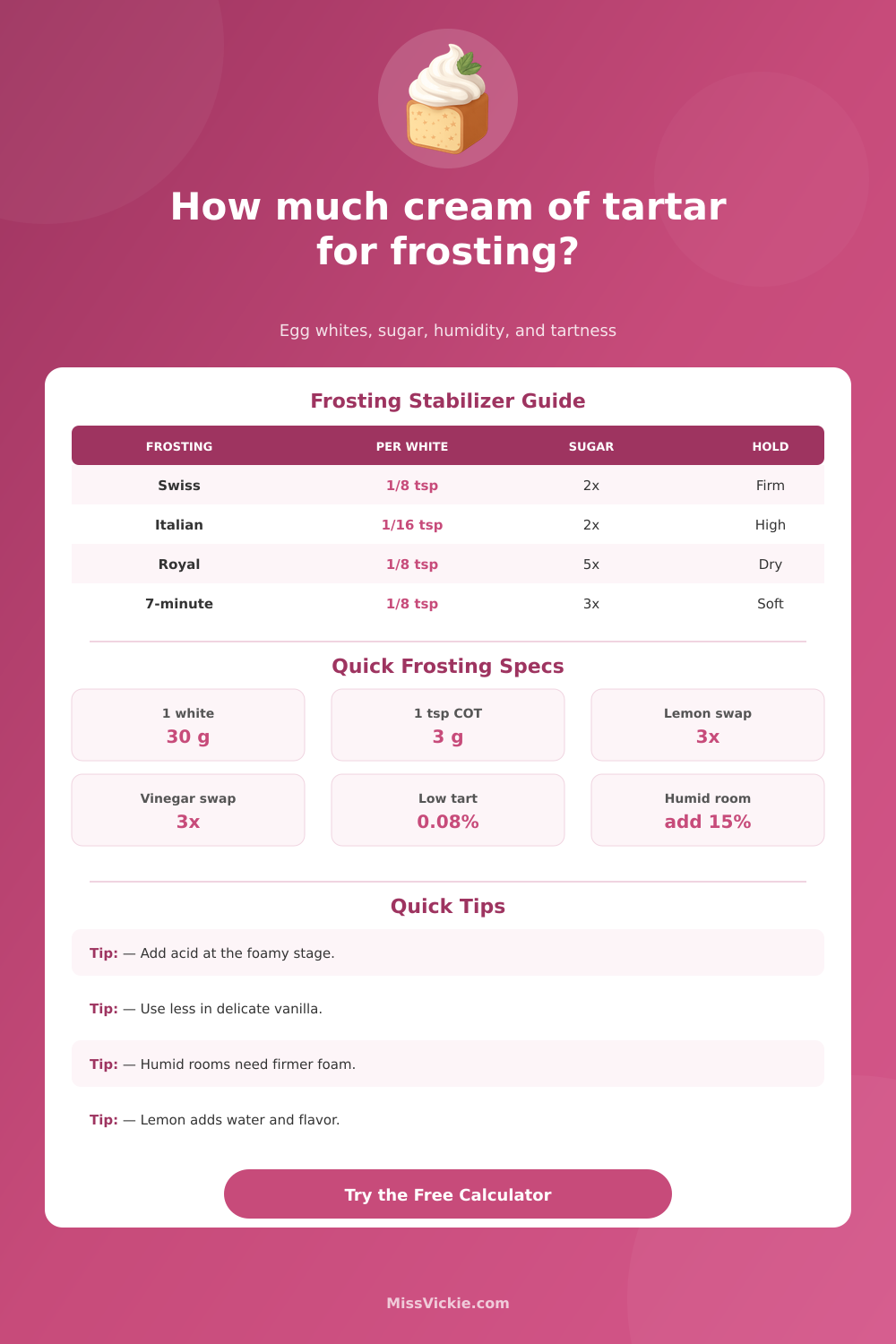
| Frosting type | Starting cream of tartar | Sugar behavior | Best timing |
|---|---|---|---|
| Swiss meringue buttercream | About 1/8 tsp per 3 to 4 whites | Sugar dissolves with heat, so acid mainly stabilizes foam | Add after warming, when whites begin to foam. |
| Italian meringue buttercream | About 1/16 to 1/8 tsp per 4 whites | Hot syrup sets the foam, so use a gentler acid dose | Add before syrup streams in, at soft foam. |
| French meringue buttercream | About 1/8 tsp per 2 to 3 whites | Raw sugar dissolves during whipping and needs clean foam | Add at foamy stage before most sugar. |
| Royal icing with egg whites | About 1/8 tsp per 2 whites | Heavy powdered sugar dries firm but can taste sharp | Add with the first powdered sugar addition. |
| Seven-minute frosting | About 1/8 tsp per 2 whites | Acid helps prevent syrup graininess and supports foam | Add before beating over heat. |
| Marshmallow frosting | About 1/8 tsp per 3 whites | Syrup and gelatin-like texture usually need a moderate dose | Add before hot syrup or during early whipping. |
📊Substitution reference
| Substitute | Amount for 1 tsp cream of tartar | Frosting effect | Moisture note |
|---|---|---|---|
| Fresh lemon juice | 3 teaspoons | Bright flavor, useful in citrus or fruit frostings | Adds about 15 ml liquid per teaspoon replaced. |
| White vinegar | 3 teaspoons | Clean acid with less citrus aroma | Adds water and should be used sparingly in buttercream. |
| Citric acid powder | 1/2 teaspoon | Sharp, strong acid with no extra water | Use a tiny amount and taste carefully. |
| Meringue powder | 1 to 2 teaspoons | Adds dried egg white plus stabilizers | Not a true acid swap; it supports structure. |
| No substitute | Use calculated cream of tartar | Most neutral option for egg-white frostings | No added liquid, easiest to control. |
☁Humidity and whipping guide
| Kitchen condition | Adjustment | Whipping cue | Frosting note |
|---|---|---|---|
| Dry kitchen under 45% | Use baseline or slightly less | Stop when glossy peaks hold | Too much acid can make delicate vanilla taste tangy. |
| Normal kitchen 45% to 60% | Use recipe baseline | Whip until bowl is cool for buttercream | Good default for most frosted cakes and cupcakes. |
| Humid kitchen 61% to 75% | Add about 10% to 15% | Whip a little longer for tighter bubbles | Watch powdered sugar and crusting behavior. |
| Tropical or rainy kitchen | Add about 18% to 25% | Use firm peaks before adding butter | Keep finished frosting cool and shorten display time. |
⚖Flavor cap comparison
Plain vanilla, almond, or wedding buttercream where acid shows quickly.
Delicate buttercream with enough sweetness to hide a small acid note.
Everyday frosting, chocolate, spice, and most filled cakes.
Lemon, raspberry, passion fruit, or cream cheese-style flavors.
💡Frosting acid handling notes
Cream of tartar is an acid that has a specific use in the creation of frostings. Cream of tartar is often added to recipes as a means of prevent egg white foams from collapsing. Additionally, cream of tartar ensure that the sugar remain dissolved in the frosting mixture so that the frosting dont become grainy.
Finally, cream of tartar is often use as a means of providing structural support to the frosting in environments that are humid. Many peoples may find that their frosting begins to “weep” or become soft when the kitchen humidity increase; cream of tartar can help to prevent this problem from developing. Due to the role that cream of tartar play in each of these frosting recipes, you must use a different amount of cream of tartar depending on the type of frosting that is being created.
How to Use Cream of Tartar in Frosting
For instance, Swiss meringue buttercream require the use of cream of tartar to warm the egg whites and sugar together, but only requires a moderate amount of cream of tartar to perform this function. Italian meringue buttercream uses syrup that a cook heats to assist with the formation of the foam, which allow for the use of less cream of tartar than Swiss meringue buttercream. French meringue and seven-minute frostings do not utilize syrup that is heated to the consistency required to create the foam, so these recipes contains more cream of tartar.
Finally, royal icing contain a high amount of powdered sugar, which can become too acidic if you add too much cream of tartar to the recipe. The calculator provide a specific amount of cream of tartar that you should use according to the type of frosting that you are creating, the amount of egg whites that you will use in your frosting, the amount of sugar that you will use, and even the humidity level of your kitchen. Humidity can play a role in the structure of the sugar in your frosting.
In kitchens that are dry, the sugar structure will maintain its texture. In kitchens that are humid, the moisture in the air can play a role in the softening of the frosting. Thus, the inclusion of the humidity in the equation for cream of tartar ensure that you do not have to manually account for this ingredient.
Additionally, the amount of tartness of the frosting is another factor that you can adjust. Since cream of tartar is an acid, it can contribute to the tartness of your frosting. You may choose a setting for flavors like vanilla or almond that use a low tartness setting to avoid an overly sharp aftertaste to the flavor, but you may choose a higher setting if your frosting also includes citrus or fruit flavor.
Although cream of tartar is the ingredient that is standard for frosting recipes, there are some substitution for cream of tartar, such as lemon juice and vinegar. Both of these ingredients add moisture to frosting recipes. This moisture can soften buttercreams or royal icing to where they take longer to crust.
The cream of tartar calculator will alert you of the additional liquid in the frosting by name so that you can decide whether the flavor is more important than the liquid effect of adding lemon juice or vinegar. Additionally, the source of your egg whites will also impact the outcome of your frosting. For instance, pasteurized carton eggs and reconstituted powdered egg whites will behave different than fresh egg whites.
Finally, the amount of time that you allow for the cream of tartar to be mixed into your frosting will also impact the outcome of your frosting. For instance, you should add cream of tartar after the egg whites begin to become foamy, but before the majority of the sugar is added to the mixture. If you add the cream of tartar too late into the recipe, it will not be able to strengthen the foamy bubbles.
Additionally, if you add it to the egg whites too early, prior to adding the majority of the sugar, the cream of tartar may interfere with the formation of the foamy bubbles. Many baker will add the cream of tartar once the egg whites have become opaque. Based off the amount of frosting that you plan to make, the type of frosting that you are making, and the humidity of your kitchen, the calculator can determine the amount of cream of tartar that you should use.
While the amount of cream of tartar that the calculator determines will come close to guaranteeing that your frosting will have the appropriate amount of tartness, you may have to make manual adjustments to the flavor of the frosting. The purpose of the cream of tartar calculator is to provide a starting point for the amount of cream of tartar to be used in your frosting recipe so that you dont have to guess the amount require.