Snickerdoodle tang, soda balance, spread, and coating math
🍪 Cream of Tartar for Snickerdoodles Calculator
Estimate cream of tartar for snickerdoodles from flour weight, cookie count, tang target, baking soda ratio, cinnamon sugar coating, spread or puff goal, dough chill, and batch scale.
Start with a real cookie batch: each preset loads flour weight, cookie count, tang level, soda balance, coating strength, chill time, and spread or puff target.
Snickerdoodle Batch Breakdown
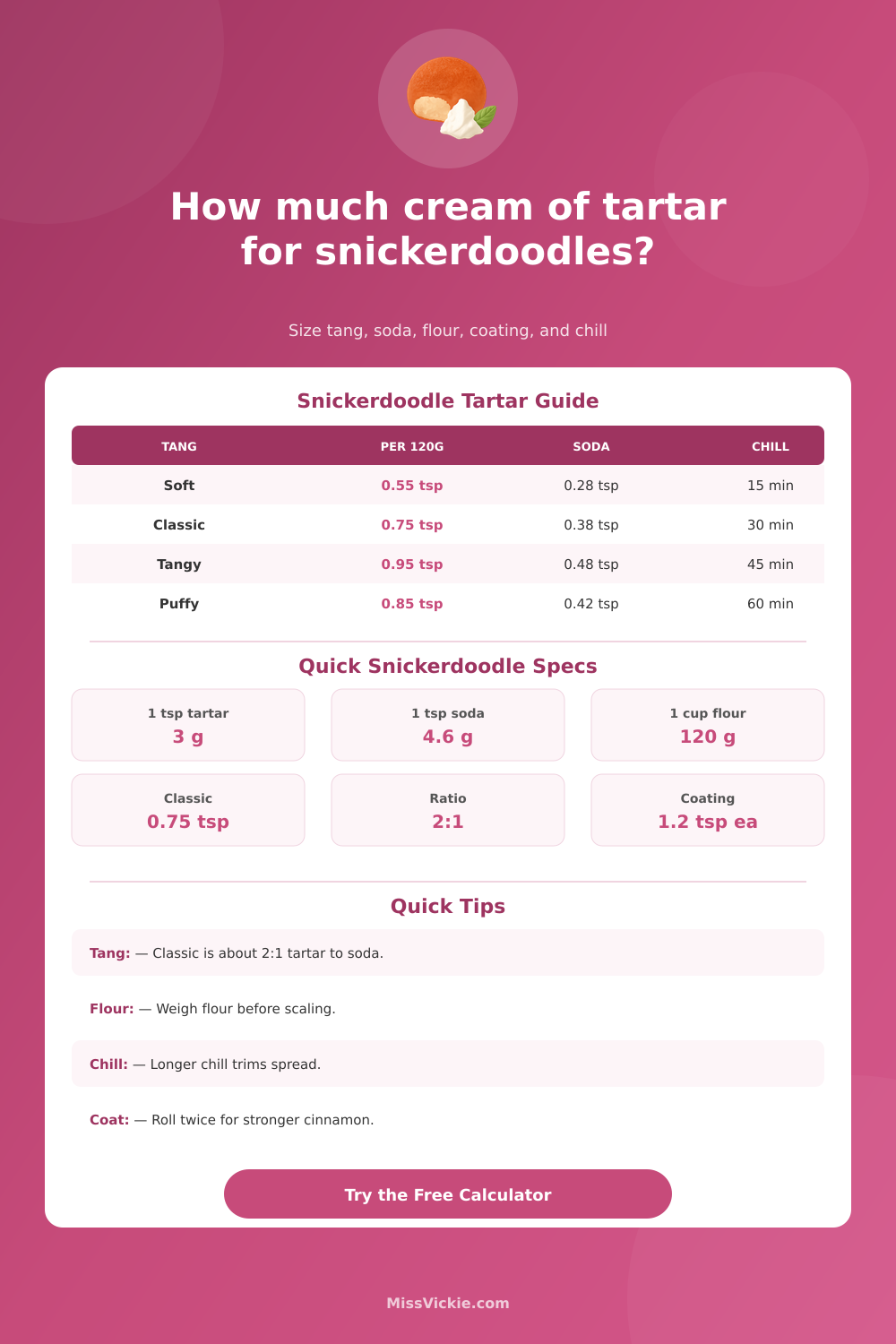
| Tang target | Cream of tartar per 120 g flour | Soda ratio | Best snickerdoodle result |
|---|---|---|---|
| Mild | 0.55 tsp, about 1.7 g | 2.1:1 tartar to soda | Soft cookie with a light vanilla-forward tang. |
| Classic | 0.75 tsp, about 2.3 g | 2:1 tartar to soda | Traditional tart edge, crackly surface, and balanced browning. |
| Bright | 0.95 tsp, about 2.9 g | 2:1 tartar to soda | More noticeable tang with enough soda to avoid dense centers. |
| Extra tart | 1.1 tsp, about 3.3 g | 2.2:1 tartar to soda | Bakery-style bite; best with a chill and medium scoop. |
| Low-soda tang | 0.9 tsp, about 2.7 g | 2.5:1 tartar to soda | Cleaner tartness and less spread, but less browning. |
| Coating style | Sugar per cookie | Cinnamon ratio | Use when |
|---|---|---|---|
| Light dusting | 0.8 tsp sugar blend | 5:1 sugar to cinnamon | You want the cream of tartar tang to lead. |
| Classic roll | 1.2 tsp sugar blend | 4:1 sugar to cinnamon | Most standard snickerdoodle batches. |
| Heavy coating | 1.55 tsp sugar blend | 3.5:1 sugar to cinnamon | Large cookies or extra-crackly tops. |
| Double roll | 1.9 tsp sugar blend | 4:1 sugar to cinnamon | Chilled dough balls that need a bold crust. |
| Warm spice | 1.3 tsp sugar blend | 3.5:1 plus nutmeg | Holiday trays or brown-butter dough. |
| Dough condition | Spread effect | Calculator adjustment | Practical cue |
|---|---|---|---|
| No chill, soft butter | High spread | Restrains tartar and soda slightly | Edges brown early and centers flatten. |
| 30 minute chill | Balanced spread | Uses the selected tang target as-is | Good crackle with soft centers. |
| 60 minute chill | Less spread | Allows a small puff-support increase | Dough balls hold shape longer. |
| Brown butter | Can spread more | Adds a spread warning and favors chill | Nutty flavor with wider edges. |
| Part shortening | Less spread | Flags a thicker cookie profile | Rounder, puffier cookies. |
Cream of tartar is another ingredient that provide acid to the snickerdoodle cookie recipe. Cream of tartar will react with the baking soda in the snickerdoodle cookie recipe to create the necesary lift for the cookies to rise to the surfaces and create a crackly texture when the cookies is finished baking. Additionally, cream of tartar will provide a distinct tang flavor to the snickerdoodle cookie.
However, if there is too much cream of tartar in the recipe, the snickerdoodle cookies may contain an excesive amount of tang flavor and have a dense texture. If there is too little cream of tartar in the recipe, the snickerdoodle cookie will contain a flavor that is too sweetly and will lack the distinct flavor that is desired from these cookies. To achieve the desired flavor and texture, it is critical to balance the amount of cream of tartar in the recipe.
How to Balance Snickerdoodle Ingredients
The weight of the flour to use in the recipe is another importantly measurement of the ingredients for the snickerdoodle cookies. The weight of the flour will determine the structure of the dough that will be cooked. Additionally, the cookie count will determine the amount of cinnamon sugar that are necessary for these snickerdoodle cookies and how these cookies will spread on the baking sheets.
If the weight of the dough per cookie is larger or smaller than the size of the scoops of dough that will be poured into the cookie pan, the amount of cinnamon sugar that will be used and the spread of the cookies can change. Due to these relationships between the weight of the flour and the cookie count, it is critical to use the weight of the flour and the cookie count measurements for the snickerdoodle cookie recipe to ensure accuracy in the measurements of the ingredients. Chill time is another variable in the snickerdoodle cookie recipe that will control how much the cookies spreads.
If the dough is chilled for a longer period, the fat in the dough will firm and the flour in the dough will hydrate, which will lead to a reduction of the spread of the cookies. A shorter chill time will result in more spread from the cookies, while a longer chill time will result in taller cookie center. Additionally, the temperature of the fat in the dough and the type of sugar used will also affect the cookies.
Using brown butter and brown sugar will add moisture to the dough along with acidity. These elements will affect the leavening agent in the snickerdoodle cookie recipe. The amount of cinnamon sugar to use in the snickerdoodle cookie for the coating is another important ingredient to consider in the recipe.
If too little cinnamon sugar is prepared, it is possible to run out of cinnamon sugar before the snickerdoodle cookies are finished coating. Additionally, if the snickerdoodle cookies are large in size, the amount of cinnamon sugar necessary for the recipe will increase. Additionally, if you roll the dough balls in the cinnamon sugar multiple times, more cinnamon sugar will be necessary.
A double coating of cinnamon sugar will require more of the cinnamon sugar than a light dusting of cinnamon sugar on the cookies. To avoid running out of the cinnamon sugar, you should prepare a surplus of the ingredient. The altitude at which the cookies will be baked and the temperature of the dough can also play a significant role in how the snickerdoodle cookies will behave on the baking sheets.
If the snickerdoodle cookies are baked at higher altitude, they will spread faster. Additionally, the softness or melting of the fat in the snickerdoodle cookie will cause the cookies to spread more. To account for these variable, it is possible to use a cookie recipe calculator to determine the proper amount of acid and baking soda needed in the snickerdoodle cookie to account for the altitude, the temperature of the dough, and to ensure that the desired level of tang flavor is used for the snickerdoodle cookies.
If any of the measurements for the snickerdoodle cookie recipe are changed, other will have to change as well. For instance, if the target flavor of tang flavor is increased, the amount of baking soda will adjust to keep the ratio of acid to baking soda in the cookies sensibly. Additionally, if the amount of chill time changes, the spread score of the cookies will change, which will possibly require a change in scoop size or cookie coating style.
All of these measurements is connected to one another in the recipe. Finally, the measurements of cream of tartar and baking soda will have to be rounded to the nearest spoon measurement. Additionally, it is recommended to bake two test cookies after the cream of tartar and baking soda have been measured to ensure the proper texture and flavor of the cookies.
By baking only two test cookies, it is possible to adjust the amount of cream of tartar or baking soda before cooking the remainder of the batch of snickerdoodle cookies. This will ensure the cookies taste the way they are intended to when they are finished baking.