Quick bread leavening, acid, and soda balance
Baking Powder for Bread Calculator
Estimate baking powder for yeast-free quick breads from flour weight, loaf pan size, batter thickness, acidic ingredients, baking soda already present, rise target, and bake time.
Choose a non-yeast bread style, then tune the flour weight, pan, acid, soda, and rise target. These presets are for chemical leavening, not yeast dough.
Leavening Breakdown
| Quick bread style | Typical baking powder | Common acid | Soda note |
|---|---|---|---|
| Banana, apple, or fruit loaf | 0.85 to 1.15 tsp per cup flour | Fruit puree, brown sugar, yogurt | Small soda amount helps browning and fruit acidity. |
| Zucchini or carrot quick bread | 0.9 to 1.2 tsp per cup flour | Vegetable moisture and brown sugar | Use modest soda; too much tastes soapy. |
| Cornbread or skillet bread | 0.75 to 1.0 tsp per cup flour and meal | Buttermilk if used | Buttermilk cornbread often needs both powder and soda. |
| Soda bread style loaf | 0.45 to 0.75 tsp per cup flour | Buttermilk or yogurt | Soda does the acid lift; powder adds insurance. |
| Biscuits, scones, and drop dough | 1.1 to 1.5 tsp per cup flour | Buttermilk, cream, or no acid | Higher powder creates lift in short bake times. |
| Gluten-free quick loaf | 1.15 to 1.45 tsp per cup flour blend | Varies by blend and dairy | Extra lift helps without gluten structure. |
These ranges assume fresh baking powder and quick mixing. Salt, sugar, fat, eggs, and starch blends can shift the best amount.
| Acidic ingredient | Starting soda amount | What it changes | Flavor warning |
|---|---|---|---|
| Buttermilk or soured milk | About 1/4 tsp soda per cup | Neutralizes tang and adds carbon dioxide | Too much can taste alkaline and brown fast. |
| Yogurt or sour cream | About 1/4 to 3/8 tsp per cup | Helps thick dairy batters rise lighter | Dense batter may still need powder support. |
| Mashed banana, applesauce, pumpkin | About 1/8 tsp per cup | Balances mild fruit acidity and color | Fruit breads can turn bitter if soda is high. |
| Molasses, honey, brown sugar | About 1/8 to 1/4 tsp per cup | Improves browning and lift in dark loaves | Watch for dark crust in long bakes. |
| Lemon juice, vinegar, cider | About 1/2 tsp per cup | Strong acid reacts quickly with soda | Mix fast and bake immediately. |
| Beer or fermented liquid | About 1/8 tsp per cup | Gives a small boost without muting flavor | Beer bread still relies mostly on powder. |
| Powder type | Best use | Calculator adjustment | Handling |
|---|---|---|---|
| Double-acting baking powder | Loaves, muffins, cornbread, biscuits | Baseline amount | Works during mixing and again in the oven. |
| Single-acting baking powder | Fast bakes and immediate oven loading | Slightly higher amount | Avoid resting the batter before baking. |
| Aluminum-free double-acting | Most home quick breads | Small flavor-safe cap | Good when avoiding metallic taste in light loaves. |
| Homemade cream of tartar blend | Emergency replacement | Fresh but quick-reacting | Mix dry ingredients well and bake promptly. |
| Older opened baking powder | Only if it still foams in hot water | Adds a small compensation | Replace if the hot-water test is weak. |
Baking powder are a leavening agent that allows quick bread to rise during the baking process. Baking powder allows for the creation of gas bubble in the batter, which allow for the quick bread to expand. Using the correct amount of baking powder for the quick bread recipe will allow the quick bread to rise even and have a good texture.
If the amount of baking powder is too low, the quick bread will be dense. However, if the amount is too high, the quick bread may crack or collapse during the baking process. Unlike baking soda, baking powder contains both an acid and a base; baking soda alone require another acid to react with.
How Much Baking Powder to Use in Quick Bread
Baking powder reacts chemically in two different stage. The first stage of the reaction occur when the liquid ingredients are mixed with the baking powder. The second stage of the reaction occurs when the oven heats the baking powder.
Because the second stage of the reaction occurs during baking, baking powder can provide a steady release of carbon dioxide gas that create the bubbles during the baking process. If the quick bread also contains acids like buttermilk, yogurt, or brown sugar, those acid will also interact with any baking soda include in the quick bread recipe. Too much baking powder and baking soda will create an unpleasant taste on the quick bread, as too much baking soda will cause the crust to brown quick.
The shape and thickness of the pan in which the quick bread is baked can impact the baking powder reaction. If the pan that you will use is a tall loaf pan, it will require a longer baking time than a shallow pan or skillet. A large amount of baking powder in a shallow pan will result in large hole in the quick bread, as it will cook quick.
The thickness of the quick bread batter also affect the baking powder reaction. Thick dough will trap the carbon dioxide gas bubbles differently than thin batters. Heavy ingredient can also affect the reaction to baking powder.
Ingredients with more weight than others, like fruit purees, will add more weight to the batter, preventing the baking powder from being able to lift the batter. The calculator include on this page will help you to determine the proper amount of baking powder to include in your quick bread recipe. Input the weight of the flour that you will use in the recipe, the size of the baking pan, the thickness of the batter, the type of acid ingredient that you will use in the recipe, and the amount of baking soda that will be included in the quick bread.
Based on these inputs, the calculator will provide an amount of baking powder for the recipe. Furthermore, the calculator will also offer a note regarding the balance of the baking soda in the recipe. For instance, if the quick bread contains alot of buttermilk but no baking soda, the baking powder calculator will suggest adding a small amount of baking soda to neutralize the acid in the buttermilk.
However, if the quick bread recipe contains a lot of baking soda, the baking powder calculator will provide a warning regarding the potential bitterness of the quick bread if more baking powder are added. Using the same amount of baking powder for each type of quick bread is one of the mistake that can be made in the baking process. Using too much baking powder in a thin, even batter will create tunnels in the quick bread, as well as a peaked center that may collapse as it cook.
Adding baking powder to help a recipe that need more acid to neutralize the baking soda will cause the quick bread to develop a metallic taste. Furthermore, baking soda will cause the quick bread’s crust to brown quick, often before the rest of the quick bread is cooked. Using old baking tin or single-acting baking powder will also prevent the quick bread recipe from rising properly.
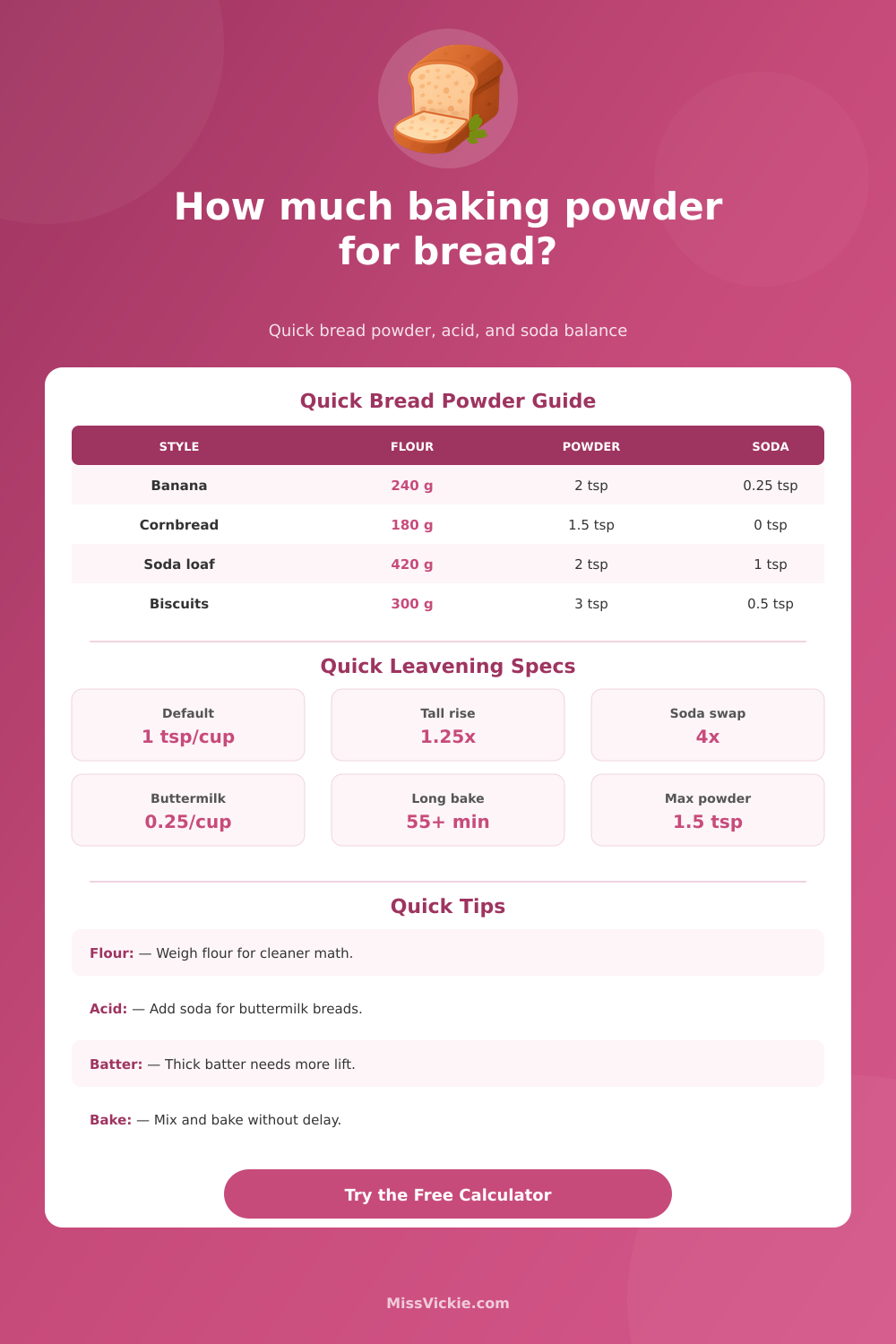
The reference table include on this page provides the range of baking powder needed for different type of quick bread. Although you may not measure baking powder in precise amount for each type of quick bread, the amounts provided in the table are a helpful starting point for baking. For instance, the baking powder calculator include on this page can provide insight into the amount of baking powder needed based on different variable of the quick bread recipe.
For instance, if the zucchini loaf rises properly on top and sides but sink in the middle, more baking powder or less baking soda may be needed. Thus, by observing the baking process, you can make adjustments to the amount of baking powder or baking soda to provide the perfect amount of baking powder for the quick bread recipe to develop the desired structure and flavor.