Baking Powder for Cake Calculator
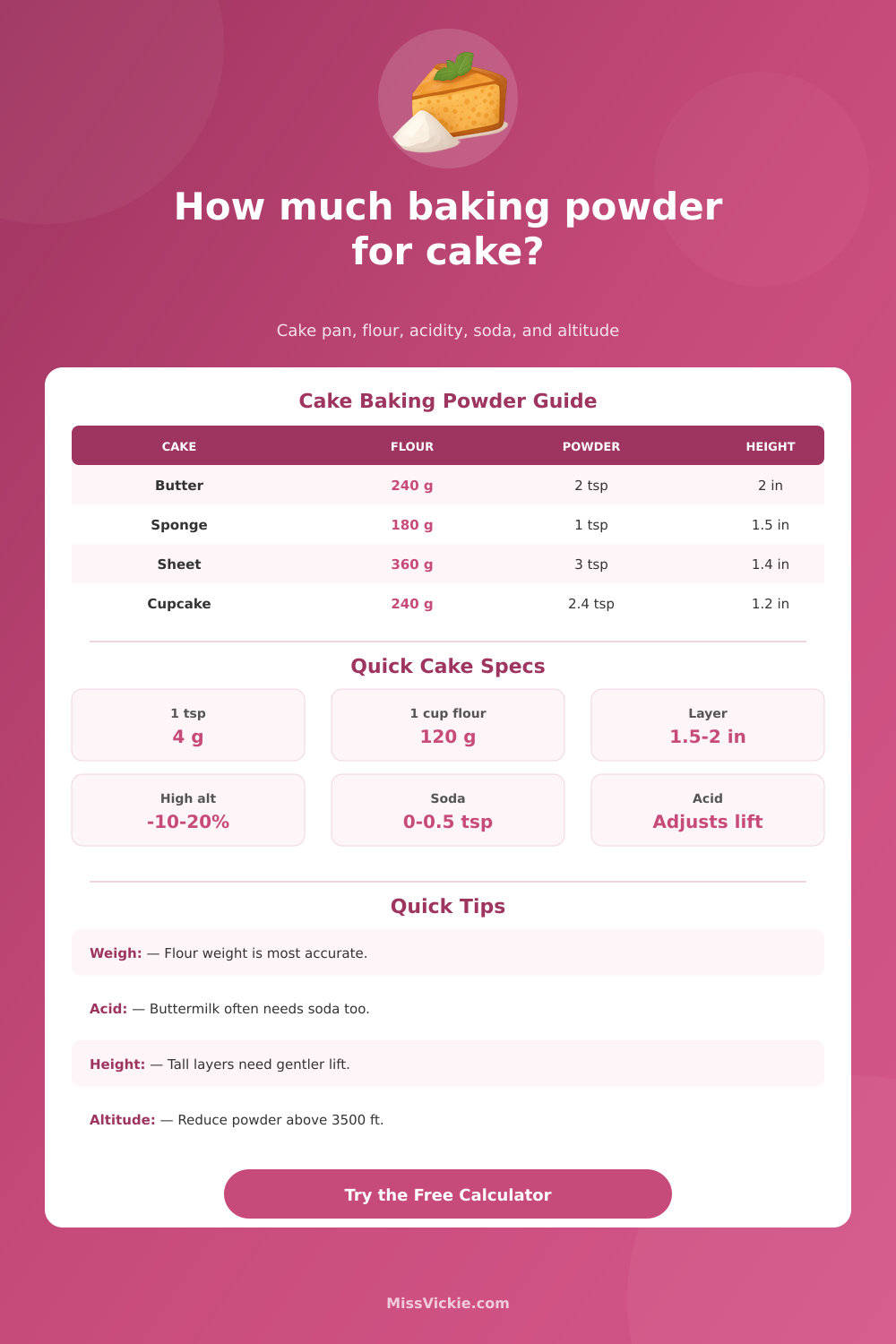
Estimate baking powder for cakes from flour weight, cake pan size, cake style, batter acidity, baking soda balance, layer height, crumb tenderness, and altitude.
Choose a starting point: each preset loads a cake style, pan format, flour amount, acidity profile, soda balance, tenderness target, layer height, and altitude setting.
Cake Formula Breakdown
| Cake style | Base range | Best pan fit | Crumb note |
|---|---|---|---|
| Butter layer cake | 3.4-4.2% of flour weight | Two 8- or 9-inch rounds | Balanced lift, fine crumb, moderate dome. |
| High-ratio bakery cake | 4.2-5.2% of flour weight | Layer pans and cupcakes | Handles sugar and liquid but can tunnel if pushed too high. |
| Sheet cake | 3.1-3.8% of flour weight | 9 x 13, half sheet, snack cake | Lower height makes excess powder taste sharper. |
| Pound or loaf cake | 1.7-2.6% of flour weight | Loaf, bundt, dense crumb | Relies more on creaming and eggs than chemical lift. |
| Sponge-assisted cake | 1.8-3.0% of flour weight | Genoise, chiffon-style support | Too much powder can collapse the foam structure. |
| Batter acidity | Common sources | Soda guide | Baking powder adjustment |
|---|---|---|---|
| Neutral | Milk, water, vanilla batter | Usually none | Use the cake-style base rate. |
| Buttermilk or yogurt | Cultured dairy, sour milk | Small soda amount helps browning and lift | Slightly reduce powder if soda is already included. |
| Natural cocoa | Chocolate cake, red velvet | Soda often balances cocoa acidity | Keep powder moderate to avoid soapy flavor. |
| Fruit or citrus | Lemon juice, puree, berry batter | Only enough soda to soften acidity | Too much soda can gray fruit color. |
| Alkaline | Dutch cocoa, excess soda | Usually reduce soda first | Powder may need to carry more of the lift. |
| Condition | Why it matters | Typical adjustment | Watch for |
|---|---|---|---|
| Sea level to 2500 ft | Normal gas expansion and setting speed | No powder reduction | Use recipe temperature and pan size. |
| 3500-5000 ft | Faster rise before starch and egg set | Reduce powder about 8-12% | Center sink, coarse crumb, fragile dome. |
| Above 6500 ft | Gas expands quickly and moisture evaporates faster | Reduce powder about 15-22% | Dry edges and fallen centers. |
| Tall layers | Center sets later than edges | Use gentler powder and avoid overfill | Volcano dome or wet center line. |
| Thin sheets | Batter sets quickly with less vertical climb | Use slightly less leavener | Sharp taste, crumbly surface, dry corners. |
Achieving the correct amounts of rise is a necessary step in baking cakes. Achieving the correct amount of rise will ensure that the cake has the correctly texture. Using too little leavening agents will result in a dense center to the cake.
Using too much leavening agent can result in tunnels forming in the cake, a soapy aftertaste, or a cracked dome to the cake. The correct amount of leavening agent depend on several variable. These variables include the depth of the pan in which the cake will be baked, the acidity of the cake batter, the amount of baking soda already present in the cake recipe, and the altitude at which the cake is being baked.
How Much Baking Powder to Use for a Cake
Many recipes include a fixed amount of baking powder. However, the fixed amount of baking powder may not be correct for youre specific conditions. For example, if you use a deeper cake pan, the rise of the cake will be slower so that the center of the cake have time to set before the edges of the cake burn.
Additionally, if you use a thin cake pan, the cake will set more fast. Thus, you will need to use a different amount of baking powder for thin cake pans to avoid giving the cake a sharp taste. The more acidity in the cake, the less baking powder will be needed.
This is because the acidity in the cake will provide part of the chemical reaction that creates the rise of the baked goods. Furthermore, if you are baking the cake at a high altitude, baking powder will need to be reduced in the recipe. This is due to the fact that at high altitudes, the gases in the cake will expand faster then in lower altitude.
The calculator on this page allow you to input several variables related to your cake recipe. Specifically, the weight of the flour that will be used, the dimensions of the pan in which the cake will be baked, the height of the cake layer that will be baked, the acidity of the ingredients in the cake, and how much baking soda is already in the cake recipe. Additionally, the cake recipe and the type of baking powder that will be used.
This calculator does not provide a specific number. Instead, it provides a measurement in teaspoons and a note regarding the status of the cake batter. The status note will let the baker know if the batter is balanced or if there is the need to adjust the recipe.
Additionally, there are two tables on this page that shows the ranges of baking powder for different types of cakes. A common error in cake baking is treating baking powder and baking soda as if they is the same substance. However, baking powder and baking soda are not the same.
Baking powder contains an acidic substance within the baking powder. Therefore, baking powder will work well in recipes with a neutral reaction. Baking soda will require an acidic ingredient in the recipe to provide the chemical reaction that will allow the baked good to rise.
If there is no acid in the recipe along with baking soda, the baking soda will give the cake an alkaline aftertaste. The calculator will track the baking soda and baking powder relationship to ensure that the baker knows if the baking soda will provide the bulk of the rise of the cake. This will inform the baker not to add too much baking powder to a recipe that already contains baking soda that will set the recipe’s rise.
The shape of the pan in which the cake will be baked and the height to which the batter fill the pan are two more variables that should be considered when baking a cake. If the cake will be tall and baked in a deep pan, then the cake will require a smaller dose of leavening agents so that the center of the cake does not remain wet. Additionally, cupcakes will require a stronger rate of leavening to provide sufficient time for the cakes to set.
Cupcakes are small in size and bake quickly. The altitude at which the cake is baked is another variable. Once you reach altitudes above 3,500 feet above sea level, the gases in the recipe will expand at a faster rate than in lower altitudes.
Therefore, the percentage of baking powder by volume will need to be lower at high altitudes. The calculator will automatically adjust the baking powder amount once you input your baking altitude. The weight of the flour that is to be used in the cake is the most reliable measurement for baking cakes.
The amount of baking powder will be consistent regardless of whether cake flour or all-purpose flour is used. This is because if you measure the flour in grams, the percentage of baking powder that is required will stay the same. The calculator will calculate the baking powder amount by first converting the cup measurements of flour into grams.
Then the percentage of baking powder will be calculated by the type of cake that is to be baked. Altitude, acidity, and pan depth will change the ideal amount of leavening agent that is required to bake a cake. Thus, the amount of baking powder that is needed for the cake can be calculated before the mixing of the batter.
By calculating the amount of baking powder needed before mixing the batter, bakers can avoid introducing other variables into the recipe. By following the steps listed above, bakers can produce cakes with the desired amount of rise to provide even textures to the baked good, produce cakes with a clean taste, and produce well structured cakes after they are cooked.