MissVickie biscuit leavening math
Baking Powder for Biscuits Calculator
Estimate baking powder for biscuits from flour weight or cups, biscuit count, cutter thickness, buttermilk acidity, self-rising flour, oven temperature, desired lift, and powder freshness.
🍞Pick a biscuit scenario
Use a preset as a starting point, then adjust the flour amount, thickness, buttermilk tang, self-rising flour credit, and oven heat for your actual dough.
⚖Choose units
🌾Flour, count, and cut shape
🥛Liquid, flour type, and oven spring
📈Lift goal and baking powder freshness
Biscuit leavening breakdown
📌Biscuit leavening snapshot
📋Baking powder rate by biscuit style
| Biscuit style | Starting powder rate | Best thickness | Oven range | Notes |
|---|---|---|---|---|
| Classic cut buttermilk | 1.4-1.6 tsp per cup flour | 0.65-0.9 in | 425-450F | Balanced lift with cold butter and quick handling. |
| Tall layered biscuits | 1.6-1.9 tsp per cup flour | 0.9-1.25 in | 425-475F | Folded layers and touching sides help vertical rise. |
| Drop biscuits | 1.25-1.55 tsp per cup flour | Scooped, not rolled | 400-425F | Wet dough spreads more, so too much powder can taste sharp. |
| Self-rising flour biscuits | Usually 0-0.5 tsp extra per cup | 0.65-1 in | 425-450F | Credit the built-in powder before adding more. |
| Whole wheat blend | 1.55-1.85 tsp per cup flour | 0.75-1 in | 425-450F | Heavier flour can need a small lift cushion. |
🥛Buttermilk and flour adjustment guide
| Ingredient choice | Calculator effect | Why it matters | Practical biscuit note |
|---|---|---|---|
| Sweet milk or cream | Small powder increase | Less acid balance and less tang. | Use fresh powder and avoid long holding. |
| Cultured buttermilk | Standard or slight reduction | Acid supports tenderness and flavor. | A classic match for baking powder biscuits. |
| Very tangy buttermilk | Slight powder reduction | Extra acid can sharpen flavor if over-leavened. | Consider a tiny soda addition only if recipe calls for it. |
| Self-rising flour | Built-in powder credit | Already contains leavener and salt. | Extra powder is only for extra-tall or older flour. |
| Older baking powder | Freshness cushion added | Weak powder releases less gas. | Do a hot-water fizz test before relying on a large increase. |
📏Flour and biscuit count reference
| Batch plan | Flour basis | Common yield | Classic powder | High-lift powder |
|---|---|---|---|---|
| Small breakfast pan | 1.5 cups / 180 g | 6 biscuits | 2.25 tsp | 2.6-2.9 tsp |
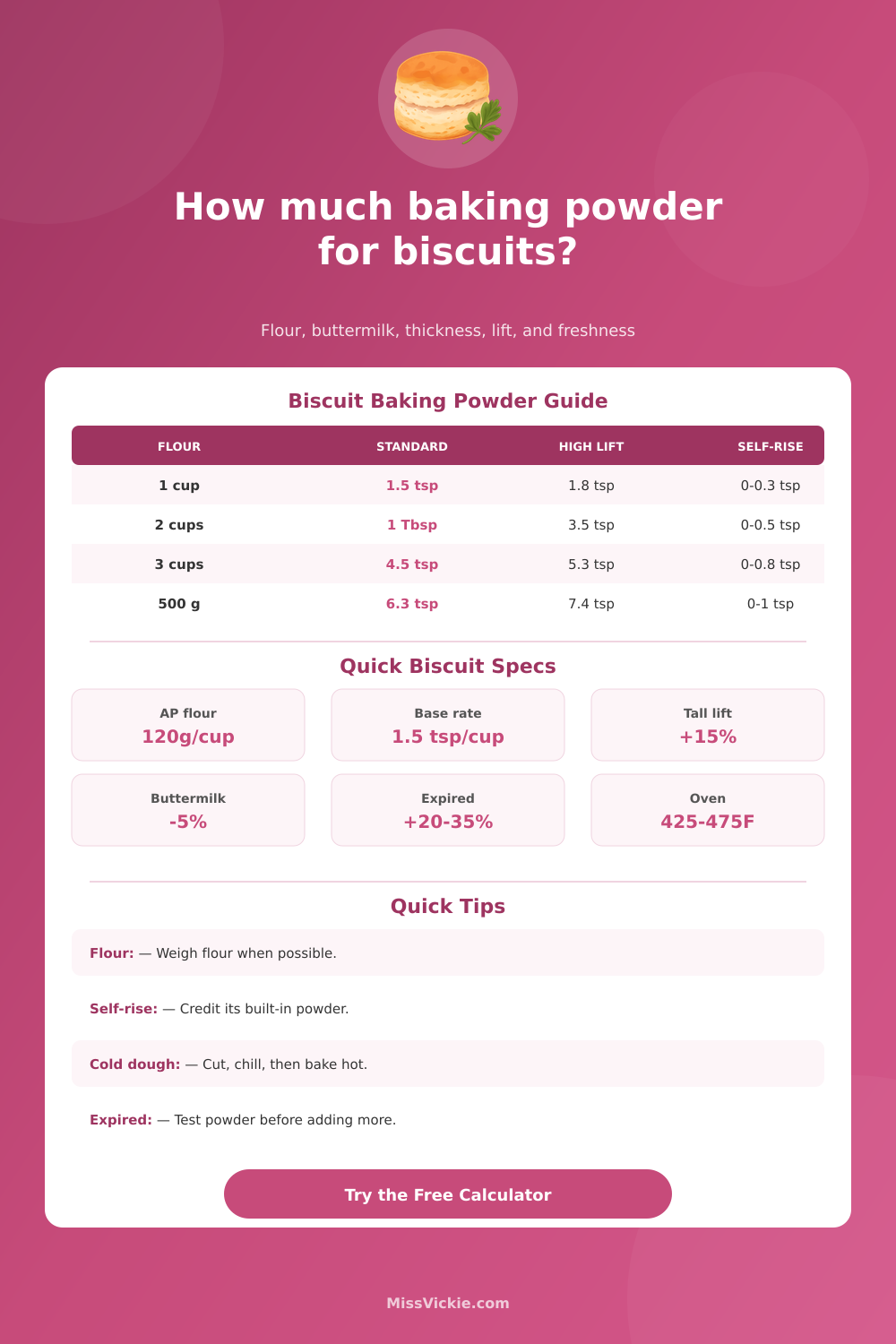
| Family batch | 2 cups / 240 g | 8 biscuits | 1 Tbsp | 3.4-3.8 tsp |
| Tall dozen | 3 cups / 360 g | 12 biscuits | 4.5 tsp | 5.1-5.7 tsp |
| Party mini tray | 4 cups / 480 g | 22-28 minis | 2 Tbsp | 6.8-7.6 tsp |
| Metric half kilo | 500 g / 4.17 cups | 14-18 biscuits | 6.25 tsp | 7.1-7.9 tsp |
💡Biscuit powder notes
To achieve the correct rise in your biscuits, you must understand how each ingredient and method can affect the amount of gas that the dough will produce. The amount of baking powder that you use will depend on several different variable, including the type of flour that you use, the thickness of the cuts of the biscuits, the acidity of the liquid ingredients, and how long the dough sit before being baked into biscuits. Each of these variables will have an effect upon the amount of baking powder that is required to produce a specific amount of flour.
If you change either the thickness of the biscuits or the acidity of the liquid ingredients that are used in the biscuits, you will also have to change the amount of baking powder that is used in the recipe in order to allow the biscuits to rise correct. The biscuit calculator will allow you to determine the correct amount of baking powder that will be required for the biscuits that you wish to bake. To use the calculator, you will need to input the amount of flour that you will use, the number of biscuits that you wish to bake, the size of the biscuits that will be cut from the dough, and the thickness of the biscuits.
How Much Baking Powder for Biscuits
If the size of the biscuits is thick, the calculator will adjust the amount baking powder that is required for those biscuits; thick biscuits require more gas to allow them to rise before the heat of the oven reaches the center of the biscuits. If the biscuits contain an acidic liquid, the calculator will reduce the amount of baking powder that is required. This is due to the fact that acidic liquids will react with the baking powder.
If you are utilizing self-rising flour, the amount baking powder will be reduced again; self-rising flour contains baking powder. By allowing the calculator to automatically subtract the amount of baking powder that is contained in the self-rising baking flour, you ensure that you do not use too much baking powder for your biscuits. Too much baking powder can lead to the biscuits having a soapy taste.
Most recipes will call for one and a half teaspoons of baking powder for every cup of all-purpose flour. However, this recipe is based off assumptions about the recipe; namely, that the butter for the biscuits is cold, that you handles the biscuits as little as possible when mixing the dough, and that the oven has enough heat to create steam in the baking of the biscuits. If you change any of these variables, you must change the amount of baking powder that is used in the biscuits.
For instance, if you have folded the dough many times when making the biscuits, you need more baking powder; folding the biscuits can remove the gas from the biscuits. Baking biscuits that contain a high amount of butter may require more baking powder; the fat from the butter can weigh down the biscuits. However, drop biscuits may require less baking powder than biscuits that are folded and have more fat.
Another factor that will influence the baking of the biscuits is the freshness of the baking powder. Baking powder packets that have been opened may still react with the hot water in which the biscuits are soaked, but the reaction will be slower if the baking powder is old. To compensate for this, the calculator will add extra baking powder to ensure that the biscuits will rise.
However, the calculator will also warn you if the amount of baking powder that is calculated may lead to the biscuits having a bitter taste due to the baking powder; too much baking powder can produce a bitter taste in the biscuits. In this case, rather than adding more baking powder to the biscuits, you should of purchased new baking powder for your biscuits. The thickness of the biscuits can also help to determine the amount of baking powder that is needed to produce a good rise in the biscuits.
A one-inch thick biscuit will require more baking powder than a half-inch thick biscuit. This is because the heat from the oven will reach the center of the thin biscuit quick. As such, the calculator will automatically increase the amount baking powder if the thickness of the biscuits is increased; this will prevent the biscuits from collapsing after they exit the oven.
The calculator will also help ensure that the amount of baking powder that is calculated will not become too high; high amounts of baking powder can lead to a harsh taste in the biscuits. The temperature of the oven and how the biscuits are spaced on the baking pan will also have an effect upon the amount of baking powder that is required. If the oven is set to 425 degrees, the biscuits will have more time to rise before the outside of the biscuits brown in the hot oven.
However, if the oven is set to 475 degrees, the outside of the biscuits will set quicker. Because of this, a lower amount of baking powder will be required if the oven is set to 475 degrees. Additionally, if the biscuits touch each other on the baking pan, they will use each other to help them rise.
Biscuits that are spread out on the baking pan will require more baking powder to help each biscuit rise on its own. The reference tables include information about the amount of baking powder that is required for several types of biscuits. For instance, the tables will show the amount of baking powder that is required for biscuits that use self-rising flour, whole wheat flour blends, and drop biscuits.
You can calculate the amount of baking powder that is required by hand using these reference tables. However, the goal is for you to understand why the amount of baking powder changes for different biscuits. Through using the biscuit calculator several times, you will begin to understand how the oven temperature, the thickness of the biscuits, and the acidity level of the buttermilk will affect the biscuits that are baked.
Through gaining an understanding of these variables, you will also gain an understanding how to use the correct amount of baking powder for your baking needs.