Sauce volume, tomato acidity, meatiness, bitterness, cocoa type, simmer time, sweetness balance, and mole-style depth
Cocoa Powder in Spaghetti Sauce Calculator
Estimate how much cocoa powder belongs in spaghetti sauce, then check whether the tomato acidity, meatiness, cocoa type, simmer time, sweetness, and mole-style depth are in balance.
Pick a sauce scenario, then adjust the exact pot volume, tomato sharpness, meatiness, cocoa type, simmer time, sweetness, chile warmth, and depth target.
Balance Breakdown
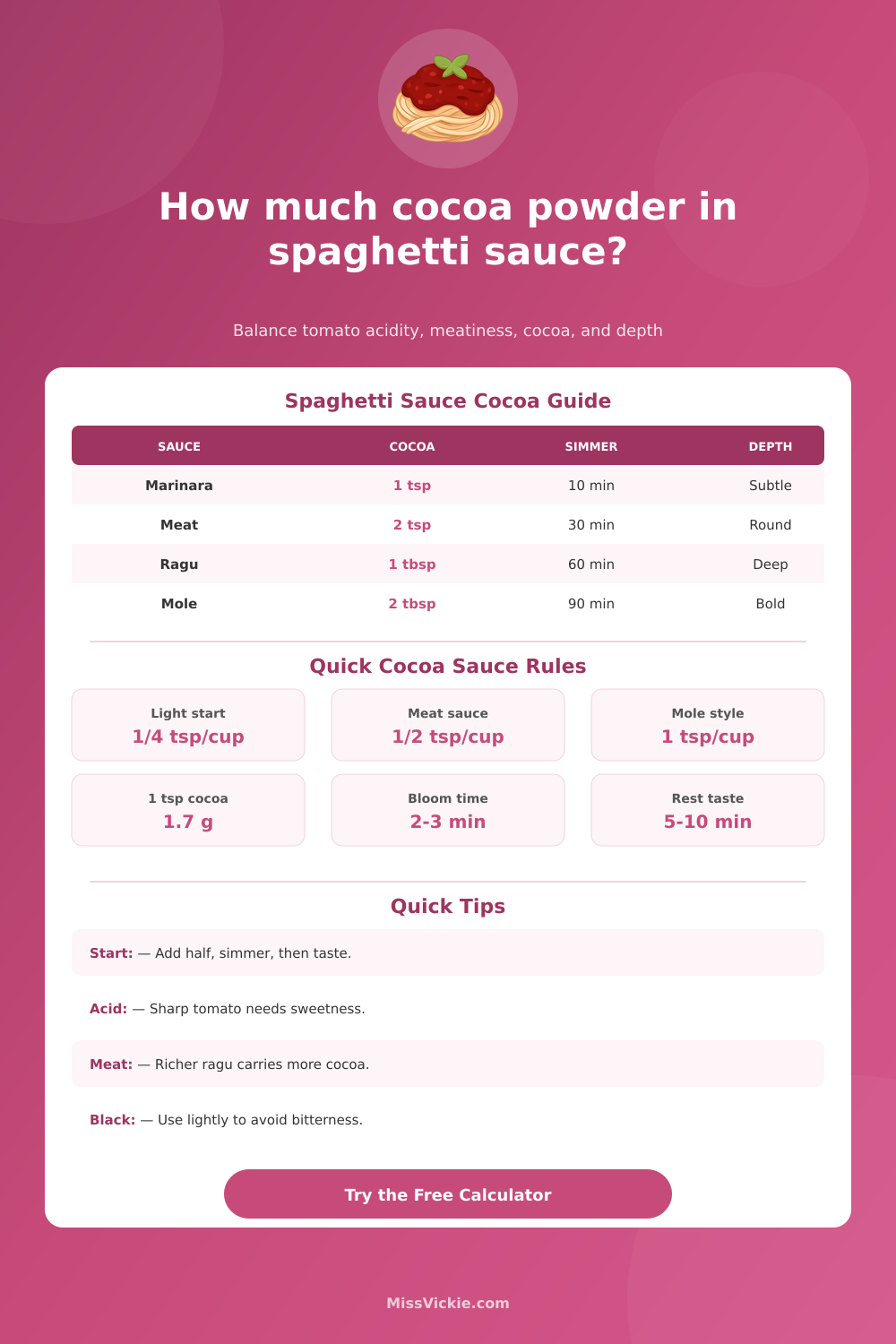
Cocoa Dose by Sauce Style
| Sauce base | Good start | Usual range | Best support |
|---|---|---|---|
| Bright marinara | 1/4 tsp per cup | 1/4 to 1/3 tsp per cup | Olive oil, onion sweetness, short simmer |
| Classic meat sauce | 1/2 tsp per cup | 1/3 to 2/3 tsp per cup | Browned beef, 20 to 40 minute simmer |
| Long ragu | 2/3 tsp per cup | 1/2 to 3/4 tsp per cup | Braised meat, rendered fat, long reduction |
| Mushroom tomato | 1/2 tsp per cup | 1/3 to 2/3 tsp per cup | Mushroom umami, butter or oil bloom |
| Mole-style red sauce | 1 tsp per cup | 3/4 to 1 1/4 tsp per cup | Chile, warm spice, sweetness, long simmer |
Cocoa Type Behavior
| Cocoa type | Flavor in tomato | Use level | Watch point |
|---|---|---|---|
| Natural cocoa | Sharp, familiar chocolate bitterness | Baseline | Can feel tangy with acidic tomatoes |
| Dutch-process cocoa | Round, mellow, darker color | Slightly higher | Can flatten very delicate sauce |
| Black cocoa | Very dark, roasted, almost cookie-like | Very low | Turns bitter if used as the whole amount |
| High-fat cocoa | Silky and round | Moderate | Needs thorough whisking to avoid specks |
| Raw cacao | Earthy and assertive | Lower | Bitterness reads stronger in tomato sauce |
Common Pot Sizes
| Finished sauce | Subtle depth | Meaty depth | Mole-style |
|---|---|---|---|
| 2 cups | 1/2 tsp | 1 tsp | 2 tsp |
| 4 cups | 1 tsp | 2 tsp | 1 tbsp plus 1 tsp |
| 6 cups | 1 1/2 tsp | 1 tbsp | 2 tbsp |
| 8 cups | 2 tsp | 1 tbsp plus 1 tsp | 2 tbsp plus 2 tsp |
| 12 cups | 1 tbsp | 2 tbsp | 1/4 cup |
Sweetness and Acidity Cues
| Sauce tastes like | Likely cause | Before more cocoa | After simmering |
|---|---|---|---|
| Sharp and thin | High acid, low fat | Add oil and a small sweet note | Taste again after 10 minutes |
| Dusty or dry | Too much cocoa too fast | Add hot sauce liquid and fat | Hold extra cocoa back |
| Flat but dark | Not enough acid or salt | Add tomato, salt, or splash of wine | Keep sweetness modest |
| Deep but bitter | Black cocoa or cacao heavy | Add onion sweetness or carrot | Finish with butter or olive oil |
| Mole-like and round | Cocoa, chile, sweet, fat balanced | Stop adding cocoa | Rest before serving |
Cocoa powder strength varies by brand, fat level, roast, age, and measuring style. This calculator gives a practical sauce-balancing estimate, not a fixed recipe rule.
Cocoa can be added to tomato sauce to balance the flavor in that tomato sauce. Cocoa wont make the tomato sauce taste like a dessert, but it will add a deep background flavor to the sauce. It will help to even out the sharpness of the sauce, which are a result of the sauce having simmered and reduced.
Additionally, because cocoa add such a deep flavor to the tomato sauce, it can make the sauce taste like it has been simsimmering for a longer period of time than it has actualy being simmering. The amount of cocoa that should be added to the tomato sauce is dependent upon a few different variable. Variables to consider when adding cocoa to a tomato sauce include the acidity of the tomato sauce, the amount of fat in the sauce, and the simmering time of the sauce.
How to Add Cocoa to Tomato Sauce
For instance, if the tomato sauce contains passata rather than tomato paste, then you will add less cocoa than if the sauce contain tomato paste. This is due to the fact that tomato paste is much more acidic than passata. Additionally, if the sauce contains browned meat it will more better tolerate the addition of cocoa than if the sauce contains only vegetable for instance, as the fat in the meat will allow the cocoa to better incorporate into the sauce.
A calculator can be used to determine the amount of cocoa that should be added to the tomato sauce. The calculator takes into account variable like the volume of the sauce, the type of cocoa that will be added, and the level of sweetness that is already present in the sauce. The calculator will provide an amount of cocoa to start with, as well as a reserve amount of cocoa that can be added later once the sauce has simmered.
The starting amount of cocoa should be used first, and the reserve amount can be added later, once the sauce has simmered for five to ten minute. The reason for this step is that the flavor of different type of cocoa can change when simmering in the sauce. For instance, black cocoa will behave different than Dutch-process cocoa when simmering in the tomato sauce.
Many cooks add cocoa to their tomato sauce base to compensate for the fact that the jarred sauce base often taste thin. However, cocoa should just be one of many ingredient that are used to flavor the tomato sauce. For instance, before adding cocoa to the tomato sauce bases, the cook should first taste the sauce to determine whether additional sweetness or fat are needed before adding the cocoa powder.
Additionally, the bitterness of the cocoa will soften after blooming the cocoa in warm fat and after simsimmering the sauce for five to ten minutes. Therefore, adding all of the cocoa at once and tasting the sauce may result in adding too much cocoa to the sauce. Different type of sauces will require different amounts of cocoa because the base ingredient for each of these sauces can be different.
For instance, a mushroom and lentil sauce may require a moderate amount of cocoa to be added, but a sausage or pancetta sauce may allow for the addition of more cocoa than a sauce that contain only vegetables. The reason for this is due to the fact that the added ingredient to the sauce will impact how the cocoa interact with the sauce. Common mistake when adding cocoa to a tomato sauce may include adding cocoa to a sauce that is too sharp.
Additionally, another mistake would be to use black cocoa in the same amount as natural cocoa. Yet another mistake would be to add cocoa powder to a watery sauce without first blooming the cocoa in fat. While the sauce should always be tasted to determine how much cocoa to add, the calculator can help to avoid mistakes in adding cocoa to a tomato sauce.
The calculator will help to determine the starting amount of cocoa to add to the sauce based off the volume and acidity of the sauce. After the starting amount of cocoa is added to the sauce, the cook will cook and taste the sauce after the cocoa has had time to bloom and simmer into the sauce. Based upon the sauce after simmering, the cook can then decide whether the reserve amount of cocoa need to be added.
The goal of using cocoa in a tomato sauce is not to make the sauce taste like cocoa, but rather to enhance the taste of the tomato and meat in the sauce.