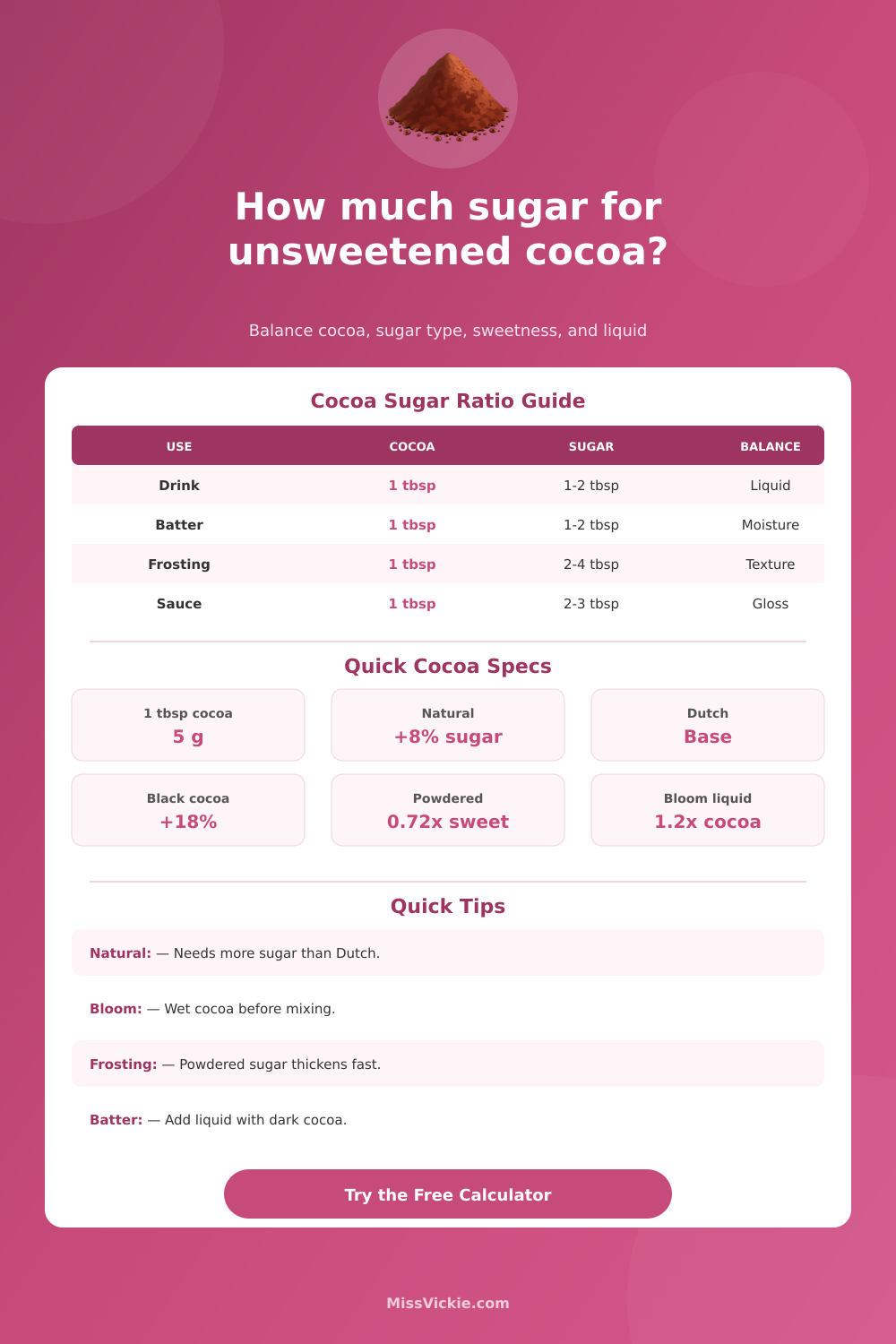
Cocoa amount, sugar type, use case, bitterness, Dutch or natural cocoa, liquid, and fat balance
Sugar for Unsweetened Cocoa Powder Calculator
Estimate how much sugar to add to unsweetened cocoa powder for drinks, batter, frosting, sauces, or dry mixes while balancing cocoa bitterness, sugar type, liquid, fat, and natural versus Dutch cocoa.
Pick a common use for unsweetened cocoa powder, then adjust the cocoa amount, cocoa type, sugar style, sweetness target, bitterness tolerance, and moisture correction.
Cocoa Sweetening Breakdown
Milk and heat soften bitterness, but cocoa still needs enough sugar to dissolve smoothly.
Existing recipe sugar often covers part of the cocoa, while extra liquid keeps crumbs tender.
Powdered sugar sweetens and thickens, so the calculator also flags liquid or fat needs.
Sauce needs enough sugar for gloss and roundness, especially with natural or black cocoa.
Cocoa Type Adjustment
| Cocoa type | Flavor cue | Sugar adjustment | Liquid or fat note |
|---|---|---|---|
| Natural unsweetened cocoa | Bright, acidic, sharp | Add about 8 percent | Blooms well in hot milk or water. |
| Dutch process cocoa | Smoother and darker | Baseline ratio | Often needs less bite correction. |
| Black cocoa powder | Dark, dry, cookie-like | Add about 18 percent | Usually needs more liquid and fat. |
| Dutch-natural blend | Round but still cocoa-forward | Add about 4 percent | Good all-purpose balance. |
| Raw cacao powder | Fruity, bitter, dry | Add about 12 percent | Bloom gently to reduce grit. |
Sugar Type Conversion
| Sugar type | Sweetness factor | Weight per tbsp | Kitchen behavior |
|---|---|---|---|
| Granulated sugar | 1.00 | 12.5 g | Dissolves best in warm drinks or syrup. |
| Powdered sugar | 0.72 | 7.5 g | Thickens frosting and can taste sweeter by volume. |
| Brown sugar | 0.95 | 13.8 g | Adds molasses moisture and a rounded flavor. |
| Honey | 1.25 | 21 g | Sweet and liquid, reduce added liquid slightly. |
| Maple syrup | 0.67 | 20 g | Adds water and a softer sweetness. |
| Agave syrup | 1.35 | 21 g | Very sweet, useful for cold cocoa mixtures. |
Common Cocoa Sweetening Ranges
| Use | Starting cocoa | Typical sugar | Practical correction |
|---|---|---|---|
| One hot cocoa mug | 1 tbsp | 1 to 2 tbsp sugar | Bloom cocoa with 1 tbsp hot liquid first. |
| Chocolate milk glass | 2 tsp | 2 to 4 tsp sugar | Make syrup before adding cold milk. |
| Cake batter | 3 tbsp | 3 to 5 tbsp sugar | Add 2 to 4 tsp extra liquid if batter tightens. |
| Brownie batter | 1/2 cup | 3/4 to 1 cup sugar | Keep enough fat for a glossy top. |
| Buttercream | 2 tbsp | 1/3 to 1/2 cup powdered sugar | Add cream slowly after cocoa hydrates. |
| Chocolate sauce | 1/4 cup | 1/2 to 3/4 cup sugar | Simmer until sugar is fully dissolved. |
Liquid and Fat Balance
| Mixture | Cocoa effect | Suggested balance | Watch for |
|---|---|---|---|
| Water-based drink | Sharp and thin | Use enough sugar and a pinch of salt | Undissolved cocoa specks. |
| Milk drink | Rounder and softer | Less sugar may taste balanced | Scalded milk if overheated. |
| Butter frosting | Cocoa thickens quickly | Add cream or milk in small splashes | Stiff piping texture. |
| Oil batter | Dry cocoa absorbs moisture | Add liquid before adding more oil | Dense crumb or dry finish. |
| Dry mix | No hydration yet | Use fine sugar and whisk thoroughly | Layering in the jar. |
This calculator estimates practical kitchen ratios. Cocoa brand, grind, recipe sugar, dairy fat, heat, and personal sweetness preference can change the final taste and texture.
Cocoa is a bitter ingredient, but the amount of sugar you needs to add to cocoa depends on several different factors. The type of cocoa that you use, the type of sweetener that you use, the type of liquid you use to mix with the cocoa, and the type of foods that you intend to use the cocoa in are all variables that will influence the amount of sugar that you need to add to your cocoa. Using the cocoa and sugar calculator will allow you to determine the correct amount of sugar to add to your cocoa depending on these different variable.
The type of cocoa that you use will influence the bitterness of the cocoa and, therefore, the amount of sugar that you need to add to balance that cocoa flavor. Natural cocoa will have acidity to it, and that acidity will be more pronounced than processed cocoa variety. Dutch process cocoa will have had its acidity reduced during processing, while black cocoa will have an intense bitterness due to its dark color.
How Much Sugar to Use with Cocoa
Raw cacao will have a strong bitterness that is balanced by fruitiness, and raw cacao will need additional sugar and moisture to balance the cocoa. The type of sweetener that you use will change the bitterness of the cocoa and the amount of liquid that you use in your recipe. Granulated sugar is a traditional sweetener for recipes with cocoa.
Powdered sugar is often used in recipes for frosting. Brown sugar will add moisture to recipes, and will reduce the amount of liquid that you need to add to your recipe. Using a liquid sweetener will similarly reduce the amount of liquid that you need to add to your recipe.
Finally, erythritol will behave different in recipes with batters than it will with granulated sugar. The type of food that you use cocoa in will impact the amount of sugar that you use. If you are making a hot cocoa drink, you will need to add sugar to provide a rounded taste to the cocoa, but the milk in the drink will add some of the sweetness to the cocoa.
Cake and brownie batter already contains sugar. Frosting recipes will require a specific amount of sugar to provide the proper texture to the frosting; too little sugar will make frosting too loose, while too much sugar will create frosting that is too stiff. Finally, chocolate sauce will require an amount of sugar that will allow the chocolate to dissolve thorough to create a glossy chocolate sauce.
The bitterness of the cocoa that you can tolerate and the type of liquid base to which you will add the cocoa will impact the amount of sugar that you need to use. If you would like a softer flavor from the chocolate, the calculator will tell you to use more sugar. If you would like a darker flavor, the calculator will calculate less sugar in that recipe.
The type of base to which you will add the cocoa will impact the bitterness of the cocoa; milk will reduce the bitterness of cocoa, but water will not. Butter and cream will add richness to the cocoa that masks it’s sharpness. By calculating each of these variable, you can determine the amount of sugar that will best balance the bitterness of the cocoa.
For example, if you use a type of sweetener that contains a liquid base, the calculator will automatically adjust the amount of liquid that you need to add to the cocoa recipe. Using Dutch process cocoa instead of natural cocoa will increase the amount of sugar that you need to use. Using an amount of sugar in your batter will reduce the amount of sugar that you need to add to your cocoa recipe.
Each of these variables may seem small when considered individually, but they have the potential to change the flavor of your recipe altogether. Many cooks make mistakes when adding cocoa and sugar to their recipes. For one, they may use volume measures to measure the cocoa instead of weight.
Additionally, they may not account for the bitterness of cocoa when it is bloomed in warm liquid. Finally, they may use the same amount of sugar for each batch of cooks products, but the type of cocoa or liquid base may differ for each batch. The cocoa and sugar calculator will help cooks to avoid these types of mistake by prompting them to account for each variable in the recipe.
The output of the calculator will provide the amount of sugar to add to the cocoa, the weight ratio of the sugar, the amount of liquid to add to the cocoa to hydrate, and a note regarding the texture of the cocoa and sugar mixture. Each of these ingredient can be adjusted to taste when making the recipe. If the recipe is too sweet, reduce the target sweetness level to the cocoa for the next batch of products to be made.
If the recipe is too sharp, increase the bitterness level that you are willing to tolerate when making the products. Though cocoa and sugar are two of the simplest ingredients to use in the kitchen, the relationship between cocoa and sugar changes with each recipe for which you use cocoa. By calculating each of the variables prior to cooking, you can remove the uncertainty of the recipe to be made.
Thus, while the sugar and cocoa calculator will not provide you with the precise amount of sugar to measure to the gram, it will provide you with the starting point for the amount of sugar to add to your cocoa recipe.