Vanilla frosting cocoa calculator
Cocoa Powder in Vanilla Frosting Calculator
Estimate how much cocoa powder to add to vanilla frosting, then balance powdered sugar, liquid, buttercream or cream cheese texture, color darkening, and piping hold.
🍫Quick chocolate frosting scenarios
Start with a real frosting batch, then adjust cocoa type, chocolate intensity, correction style, color rest, and piping target.
🍰Base frosting and cocoa plan
Cocoa frosting breakdown
📊Cocoa and correction snapshots
🧁Frosting base behavior
Powdered sugar and milk corrections respond quickly, so cocoa can be adjusted by feel.
Sifted cocoa blends best with a small warm liquid bloom before mixing into buttercream.
Extra liquid loosens it fast; use cocoa and sugar first, then add drops of liquid.
Cocoa adds weight, so stop at lighter chocolate unless stabilizers are already in the batch.
📖Cocoa amount reference
| Chocolate target | Cocoa per cup frosting | Approx grams | Texture effect | Best use |
|---|---|---|---|---|
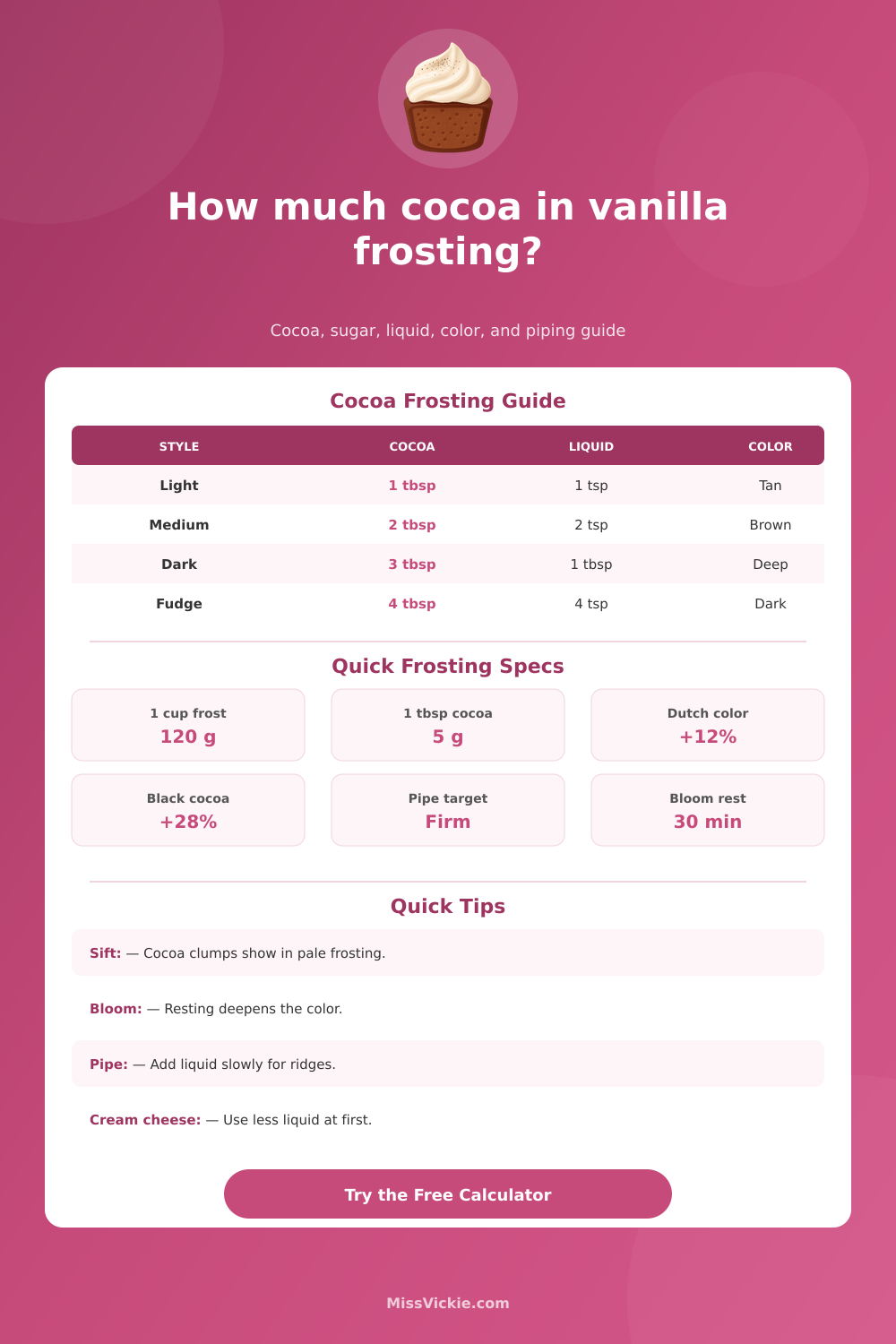
| Light chocolate tint | 1 tbsp per cup | 5 g | Slightly thicker | Kids cupcakes, marble colors, vanilla-forward frosting |
| Medium chocolate | 2 tbsp per cup | 10 g | Noticeably firmer | Cupcake swirls, sheet cake, everyday chocolate frosting |
| Dark bakery chocolate | 3 tbsp per cup | 15 g | Firm ridges | Layer cake filling, borders, strong chocolate flavor |
| Fudge-style cocoa boost | 4 tbsp per cup | 20 g | Very stiff | Cookie sandwiches, tall piping, intense cocoa frosting |
| Black cocoa coloring | 1.5 to 2 tbsp per cup | 8 to 10 g | Dry but smooth | Deep color, cookies and cream tone, reduced food coloring |
| Raw cacao powder | 1.5 to 3 tbsp per cup | 8 to 16 g | Dry and earthy | Less processed flavor, not the darkest color |
🥄Powdered sugar and liquid correction table
| Frosting base | When cocoa is added | Powdered sugar move | Liquid move | Piping note |
|---|---|---|---|---|
| American buttercream | Medium cocoa or darker | 0 to 1 tbsp per cup | 1 to 2 tsp per cup | Good ridges after a short rest |
| Swiss meringue buttercream | Any dry cocoa addition | Little or none | Bloom cocoa with warm cream | Rewhip if the emulsion looks flat |
| Italian meringue buttercream | Dark cocoa target | Little or none | Use warm coffee or cream | Add cocoa slowly to avoid graininess |
| Ermine frosting | Medium cocoa target | Small amount only | Milk by teaspoon | Can loosen if overmixed warm |
| Cream cheese frosting | Any cocoa addition | Often helpful | Start with half the liquid | Chill before piping tall swirls |
| Whipped vanilla frosting | Light cocoa target | Stabilizer preferred | Avoid extra liquid | Pipe softly and keep chilled |
🎨Color darkening and cocoa type guide
| Cocoa type | Flavor profile | Color strength | Typical liquid need | Best pairing |
|---|---|---|---|---|
| Natural cocoa | Bright, classic cocoa | Moderate | Medium | Milk, vanilla, berry cakes |
| Dutch process cocoa | Round and smooth | Stronger | Medium | Chocolate layer cakes and cupcakes |
| Black cocoa powder | Mild, cookie-like | Very strong | Low to medium | Cookies and cream color, dark borders |
| Dutch plus black blend | Balanced dark cocoa | Very strong | Medium | Deep chocolate without harsh flavor |
| Raw cacao powder | Earthy and assertive | Moderate | Higher | Less sweet frostings |
| Milk chocolate cocoa blend | Milder and sweeter | Lighter | Lower | Family cupcakes and pale chocolate tones |
🧈Practical frosting notes
Adding cocoa powder to vanilla frosting requires a systematic approach because cocoa powder changes teh texture and the sweetness of the vanilla frosting. When you adds cocoa powder to vanilla frosting, the cocoa powder absorbs the moisture from the frosting. This absorption of moisture can make the frosting dryly and chalky.
To prevent the frosting from being too dry or too sweet, you must adjust the amount of sugars and the amount of liquid in the frosting when you add cocoa powder. The type of cocoa powder and the type of frosting base also change the recipe for frosting with cocoa powder. The type of frosting base you use will change the way you have to adjust your frosting recipe with cocoa powder.
How to Add Cocoa Powder to Vanilla Frosting
For instance, you can easily adjust an American buttercream with added sugar and milk. However, cream cheese frosting are a soft product that will change when you add cocoa powder to it. Additionally, Swiss meringue and Italian meringue buttercream are two types of frosting that contain an emulsion that cocoa powder can disrupt unless you bloom the cocoa powder first.
The moisture content in different types of buttercream will require you to adjust the amount of liquid and sugar in your frosting based off the type of buttercream you use. The type of cocoa powder you use will also change the requirement for making frosting with cocoa powder. If you use natural cocoa powder, you will need to add more liquid to the frosting to achieve a smooth texture.
Dutch process cocoa powder change the color of the frosting to a deeper tone and has a different flavor that requires less liquid when you use it in your frosting. Finally, black cocoa powder will create a darker color in your frosting that has a different flavor to it; thus, you must account for the specific qualities of black cocoa powder when you makes your frosting recipe. To add cocoa powder to vanilla frosting, you must first choose the cocoa powder that will provide the color and flavor that you want to the final frosting.
After choosing your cocoa powder, you must adjust the amount of liquid and sugar that you use to accommodate the specific cocoa powder that you have chose. Another important factor to consider in the process of adding cocoa powder to vanilla frosting is allowing the frosting to rest following the addition of the cocoa powder. By allowing the frosting to rest, the cocoa powder will continue to hydrate, which will lead to the frosting developing a deeper color and changing the texture of the frosting.
Because the color of the frosting will deepen during this resting period, you can use less cocoa powder than you may otherwise require. Additionally, because using less cocoa powder will result in frosting that dont become too stiff, you can also consider the temperature of your room prior to adding the cocoa powder; frosting that is stable at room temperature may become too soft if the room is warm. One of the most common mistake in adding cocoa powder to vanilla frosting is adding too much cocoa powder or too much liquid at one time.
If you add too much cocoa powder to the frosting, the frosting will be too dry; adding too much liquid to the frosting to compensate for the dryness will result in frosting that is too runny. Small amounts of cocoa powder and liquid can be added to the frosting to make small correction to the frosting recipe; you can observe the texture of the frosting with a spatula to ensure the desired texture, and this observation should be performed frequent. If the frosting base that you are using is cream cheese frosting, you will need to add less liquid to the frosting than you would if you were using an American buttercream base; cream cheese frosting contains moisture.
By following these steps, your resulting chocolate frosting will have the correct flavor and texture to satisfy your need.