MissVickie pie filling math
Apple Pie Filling for a Pie Calculator
Estimate sliced apple weight, sugar, lemon, thickener, and baked filling yield from pie diameter, pan depth, mound height, apple juiciness, crust style, and overflow allowance.
🥧Pick an apple pie starting point
Use a preset, then adjust the pie pan, apple style, slice thickness, mound, sugar draw, top crust, thickener, and serving goal for your exact pie.
⚖Choose measuring units
🥞Pie pan and serving shape
🍏Apple behavior and slicing
🥄Flavor, crust, and thickener
Full filling breakdown
Enter your pie details, then calculate.
📊Filling snapshot
🍎Apple variety reference
| Apple style | Juice behavior | Typical shrink | Best calculator adjustment |
|---|---|---|---|
| Granny Smith | Firm, tart, moderate juice | 18 to 22 percent | Works with classic sugar and cornstarch |
| Honeycrisp | Very crisp and juicy | 22 to 28 percent | Add overflow and starch for syrup control |
| Golden Delicious | Tender, sweet, medium juice | 23 to 30 percent | Use balanced lemon and normal shrink |
| Fuji | Sweet and high juice | 25 to 32 percent | Extra lemon plus juicy safety margin |
| McIntosh | Soft and saucy | 28 to 36 percent | Use high shrink or partly cook first |
🥣Pie pan filling guide
| Pie plate | Normal depth | Raw sliced apples | Baked filling target |
|---|---|---|---|
| 7 inch mini pie | 1.0 inch | 1.3 to 1.7 lb | 4 to 5 cups |
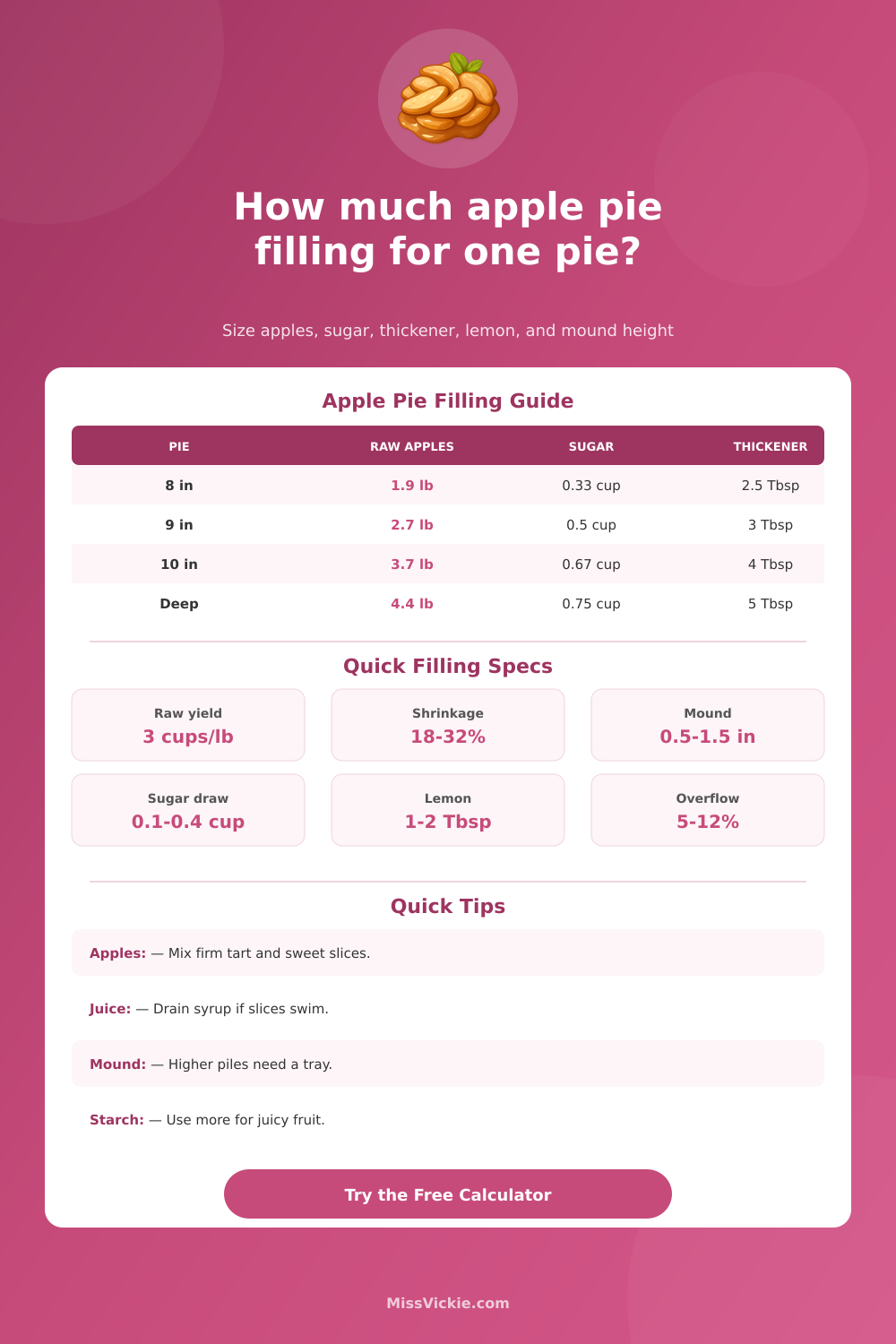
| 8 inch standard pie | 1.1 inch | 1.8 to 2.3 lb | 5.5 to 6.5 cups |
| 9 inch standard pie | 1.25 inch | 2.5 to 3.2 lb | 7.5 to 9 cups |
| 10 inch family pie | 1.35 inch | 3.4 to 4.2 lb | 10 to 12 cups |
| 9 inch deep dish | 1.75 inch | 3.8 to 4.8 lb | 11 to 13 cups |
🥄Thickener conversion table
| Thickener | Texture in pie | Use per cup juice | Notes for apple filling |
|---|---|---|---|
| All-purpose flour | Soft, slightly cloudy | 1.6 Tbsp | Gentle set, good for firm apples |
| Cornstarch | Glossy, firmer set | 1.0 Tbsp | Best for classic clear syrup texture |
| Instant tapioca | Juicy with tiny pearls | 1.2 Tbsp | Rest filling before baking so pearls hydrate |
| ClearJel or pie starch | Stable and sliceable | 0.9 Tbsp | Useful for deep dish or make-ahead pies |
| Arrowroot starch | Clear, tender gel | 0.9 Tbsp | Avoid very long high heat bubbling |
🔪Slice thickness and crust comparison
| Choice | Pack factor | Juice release | Calculator effect |
|---|---|---|---|
| Thin 1/8 inch slices | Tight | Fast | More cups per pound, slightly more thickener |
| Medium 1/4 inch slices | Balanced | Moderate | Default apple pie filling behavior |
| Thick 3/8 inch slices | Looser | Slower | More raw apple volume for the same pan |
| Full top crust | Pressed | Contained | Small displacement reduces mound capacity |
| Lattice or crumb top | Open | More evaporation | Allows a higher mound with less pressure |
🧮Comparison grid
💡Filling calculation notes
Making apple pie filling require consideration of the proportion of each ingredient required for the filling. If there is too much liquid in the apple pie filling, the liquid will leak out of the crust and onto an oven rack, creating a mess in the oven. Factors to consider before adding the ingredients to the pan include the amount of fruit to use, the amount of sugar to use, and the amount of thickener to use.
The size and shape of the pie pan are another important factor in determining the amount of apple pie filling to make. The size of the pan will determine the amount of apple pie filling that can be pour into the crust. When the cook cooks the apples, they will shrink in size and release some of there liquid.
How to Make the Right Apple Pie Filling
Thus, the amount of fruit that is cooked must be larger then the amount of fruit that will be contain within the pie when it is complete. Calculators is available that can calculate the amount of fruit that should of be use in the pie to account for the shrinkage that will occur during the baking process. The variety of apple that will be used in the pie is important to consider.
Apples that contains more juice than others will require more thickener to the apple pie filling. For instance, apples that are sweet will contain more juice then apples that are firm, like Granny Smith apples. The thickness of the apple slices will also impact the amount of liquid that the apples will release.
Thinly slice apples will release more of there liquid than thickly slice apples. Because these factor will change the liquid content of the pie, it is important to adjust the recipe based off the type of apples and the size of the apple slices that will be used in the pie. Sugar is another ingredient that must be considered in the preparation of the apple pie filling.
Sugar will provide the flavor of sweetness to the pie. Additionally, sugar will release moisture from the apples, creating a thick syrup that must be thickened to prevent the pie filling from leak out of the crust. If you drain the liquid from the apples prior to adding the ingredients to the pie crust, less thickener will be needed.
Furthermore, lemon juice can be used to balance the flavor of the sweetness of the sugar; however, you must scale the amount of lemon juice to the weight of the apples to balance the flavor. The style of the crust will also impact the amount of filling that the crust will be able to hold. If the pie include a full top crust, the amount of pie filling that is poured into the crust will be less than those pies that utilize lattice or crumb toppings.
Full crusts will trap the steam from the pie and require an under-pie mound of pie filling to avoid overflow. Pies with lattice or crumb toppings will allow the steam to escape from the pie, allowing for a taller mound of apple pie filling. Finally, an overflow allowance setting can be used to ensure that the filling does not boil over the crust.
Calculating the measurement that will be used to make the pie prior to beginning the cooking process is a helpful step. For instance, increasing the amount of raw fruits will increase the shrinkage of the fruit. However, increasing the amount of raw fruit will also increase the amount of pie that is fill and complete.
Using more sugar will increase the amount of syrup that is create. However, using more sugar will also make the apple slices appear more glossier. Additionally, using a specific type of starch will increase the amount of setting that the pie filling will create, as well as the ability of the pie to slice clean.
Additionally, the amount of apple slices will need to be tossed in an even amount with the sugar and the starch. Finally, allowing the pie to cool prior to slicing will ensure that the pie filling does not leak out of the crust.