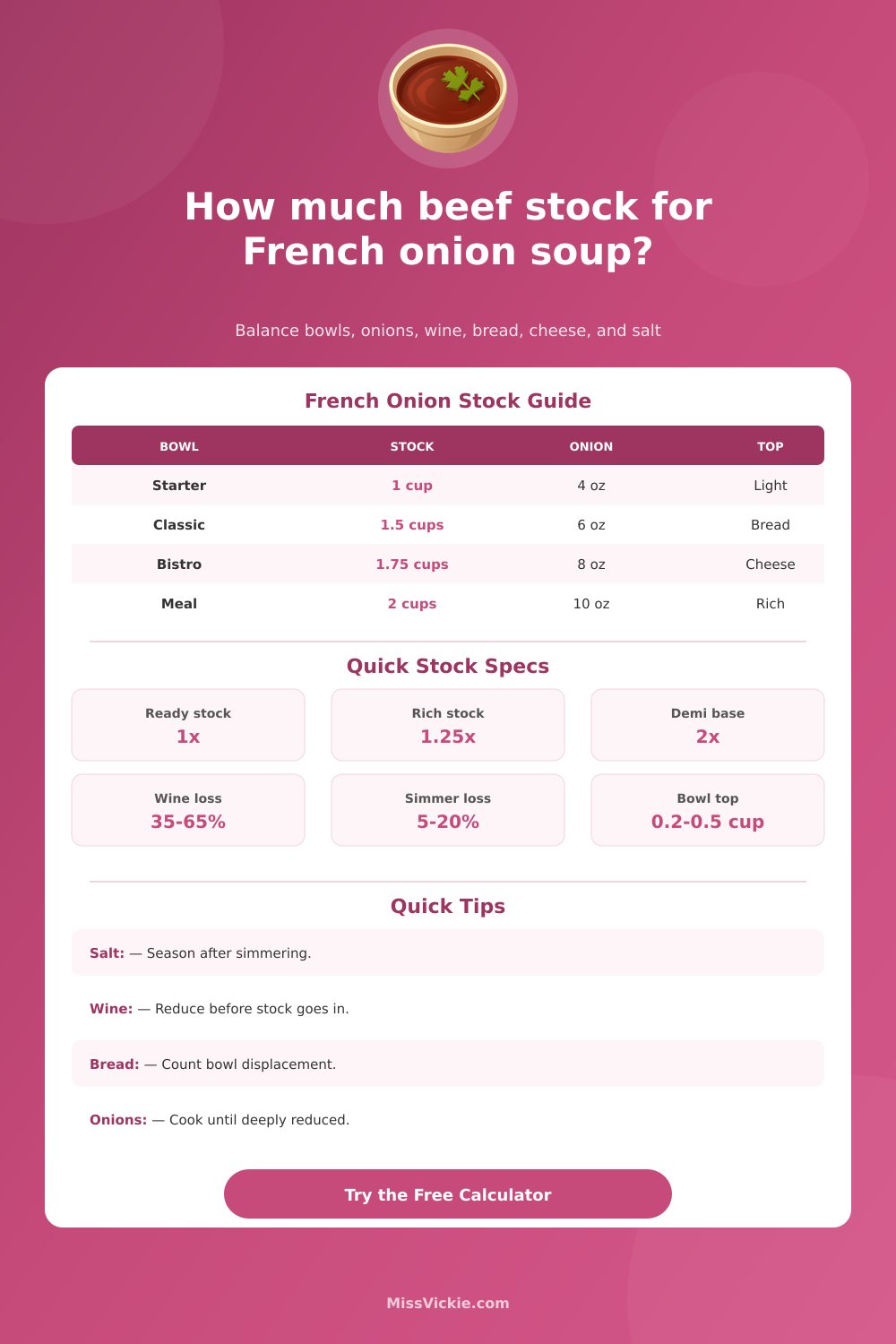
Serving bowls, onion weight, beef stock concentration, wine reduction, bread, cheese, simmer loss, salt, and richness
Beef Stock for French Onion Soup Calculator
Estimate the beef stock, concentrate, water, wine, and onion load needed for French onion soup after caramelized onion shrinkage, simmer evaporation, salty stock, and bread-cheese bowl displacement.
Choose a serving plan, then adjust bowl size, onion weight, beef stock strength, wine reduction, bread thickness, cheese load, simmer loss, salt, and richness.
French Onion Soup Breakdown
| Serving style | Bowl capacity | Raw onion per bowl | Finished onion | Stock goal |
|---|---|---|---|---|
| Small starter crock | 1.0 to 1.25 cups | 3 to 5 oz | 0.9 to 1.5 oz | Clear, salty-light broth with modest bread. |
| Classic bistro bowl | 1.5 to 1.75 cups | 6 to 8 oz | 1.8 to 2.4 oz | Enough stock for onions to float under bread. |
| Cheese-heavy gratinee | 1.5 to 2.0 cups | 7 to 9 oz | 2.0 to 2.8 oz | Extra liquid because bread and cheese crowd the bowl. |
| Meal-size onion soup | 2.0 to 2.5 cups | 9 to 12 oz | 2.7 to 3.8 oz | Richer stock, larger cushion, and lower salt base. |
| Party service cup | 0.75 to 1.0 cup | 2.5 to 4 oz | 0.7 to 1.2 oz | Reduced wine and stock held warm separately. |
| Stock type | Typical strength | Sodium range | Richness behavior | Best use |
|---|---|---|---|---|
| Boxed beef stock | 1x ready stock | 420 to 780 mg/cup | Lean body, easy to oversalt after simmering. | Weeknight soup with modest cheese. |
| Homemade roasted beef stock | 1x to 1.25x | 0 to 450 mg/cup | Good roast depth and flexible salt control. | Classic French onion soup. |
| Rich veal or beef stock | 1.25x to 1.5x | 250 to 650 mg/cup | Gelatin gives body without heavy reduction. | Bistro bowls and broiled crocks. |
| Demi-glace base | 2x to 4x | 500 to 1100 mg/cup prepared | Very rich; needs careful dilution and short simmer. | Small batches, luxury finish, or restaurant style. |
| Bouillon or paste base | 1x to 3x | 700 to 1300 mg/cup prepared | Strong salt and roast flavor, lower gelatin. | Use with low-sodium water and late seasoning. |
| Beef and mushroom stock | 1x to 1.25x | 350 to 750 mg/cup | Umami can taste richer than its gelatin score. | Vegetarian-leaning or extra savory onion soup. |
One narrow toast displaces little soup but softens quickly.
A wide toasted slice needs a real liquid allowance.
Thick bread and cheese can make bowls look full early.
Reduce wine hard before stock so the soup is savory, not sharp.
| Component | Light bowl | Classic bowl | Heavy bowl | Calculator effect |
|---|---|---|---|---|
| Wine or sherry per bowl | 0.08 cup | 0.15 to 0.22 cup | 0.25 cup | Reduced wine replaces a small part of final broth. |
| Wine reduction | 35 percent | 50 to 60 percent | 65 percent | Higher reduction leaves less liquid but deeper flavor. |
| Toasted bread | 0.10 cup | 0.20 to 0.28 cup | 0.35 cup | Subtracts from the soup space in each bowl. |
| Melted cheese | 0.75 oz | 1.25 to 1.75 oz | 2.5 oz | Adds displacement, salt, fat, and richness. |
| Simmer after stock | 5 percent | 10 to 15 percent | 18 to 22 percent | Raises starting stock and concentrates sodium. |
This calculator estimates kitchen planning amounts. Onion variety, pot width, toast size, cheese salt, broiler time, stock brand, and how deeply the onions caramelize will change final yield and flavor.
When you make French onion soup, you must calculate an amount of stock you need. The amount of stock you require change according to the ingredients you use because various ingredient will change the total amount of volume that your soup will contain. For instance, the onions will lose volume when they cooks.
The wine will also lose volume as it simmers and reduce. Additionally, the bread and the cheese will displace some liquid in your soup bowl. When you dont account for the volume that will be lost to the onions and the volume that will be displace by the bread and the cheese, the soup may end up being too thin or it may overflow the bowl.
How to Calculate Stock and Volume for French Onion Soup
The calculator on this page will allow you to enter the numbers for various ingredients to calculate the amount of stock you should of start with to make your soup. The weight of the onions is one of the main factor that must be considered when calculating the amount of stock required for the soup. The raw onions will lose roughly two-thirds of there weight when they are caramelized.
This means that when you calculate the amount of liquid that the onions will take up in the bowl, you must use the weight of the raw onions as a starting point. If you use the weight of the cooked onions, you will find that you have too many liquid for your soup. Therefore, the calculator will ask for the raw weight of the onions and the cook loss of the onions so that it can calculate the weight of the cooked onions that will take up space in the soup bowl.
Stock can also change the volume of your soup. For instance, if you use a boxed stock, you can skip this step. However, if you use a demi-glace base for your stock, you will have to add water to the demi-glace to make it strong enough to use in your soup.
The calculator will ask for the starting concentration of your stock so that it can calculate for you the amount of stock concentrate and water that you need to add to make your soup. This is essential because the water that you add to your stock will evaporate during the simmering of your stock. Wine will also change the total amount of liquid that your soup will contain.
Before you add the stock to the wine, you will need to reduce the wine to remove the sharpness of the wine. This will also cause the wine to lose some of its volume. In your soup calculation, the calculator will count the reduced wine as part of the total volume of the soup.
Thus, you will not have to account for the volume that the wine will take up in your soup as an additional amount of liquid to add. The amount of bread and cheese that you use in the soup will take up some of the space within the soup bowl. A slice of baguette and a layer of Gruyere cheese will take up space that the broth cannot use.
If you dont account for the space that the bread and cheese will take up, they will push the broth out of the bowl. The calculator will ask for the displacement of the bread and cheese so that it can calculate the amount of broth that will occupy the remaining space within the soup bowl. Finally, the amount of salt and richness in the broth change during the cooking of the soup.
The sodium within the broth increase as it simmers due to the evaporation of the broth. Additionally, the cheese adds more sodium to the broth. The amount of sodium in each bowl of soup can be estimated so that you can decide if you need to add unsalted liquid to your broth.
The richness of the broth can also change; stocks that contain gelatin will be richer than stocks that contain no gelatin. The calculator can track richness so that you know how much to reduce the liquid in the stock. These calculations will help you to plan your soup.
Based off these calculations, you will know the weight of the raw onions that you will need to purchase and the amount of stock that you will need to start with. Additionally, you will know if the bread and cheese will leave enough space in the soup bowl for the broth. By planning your soup from the finished bowl of soup as a starting point, you will know how each ingredient will affect the total volume of your soup.