MissVickie wok oil math
Oil in Wok for Stir Fry Calculator
Estimate stir fry oil from wok diameter, food weight, oil smoke point, protein and vegetable ratio, batch count, sauce oil, seasoning layer, moisture, and splatter margin.
🥘Pick a stir fry scenario
Each preset loads a realistic wok plan. Adjust the wok diameter, food weight, protein share, batch count, sauce oil, seasoning layer, and safety margin after it loads.
⚖Choose units
🔥Wok, food, and oil inputs
📏Wok oil reference grid
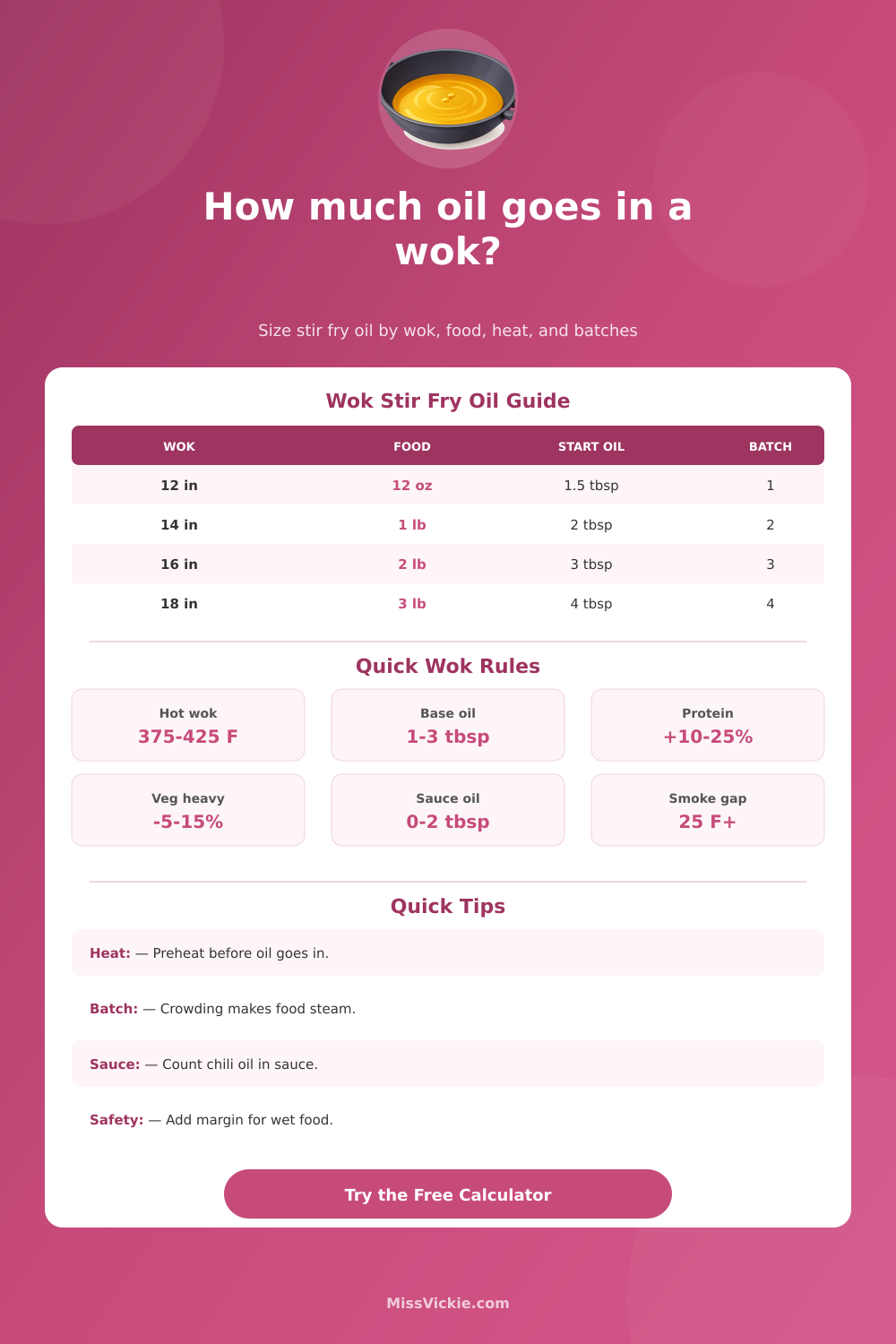
These are starting points for a hot wok. Exact needs shift with moisture, protein share, seasoning, and how much oil is already in the sauce.
🥄Oil type smoke point table
| Oil | Typical smoke point | Best wok use | Calculator note |
|---|---|---|---|
| Refined avocado | 500 to 520 F | Very high heat searing | Largest smoke headroom but easy to overuse because it feels light. |
| Peanut oil | 440 to 450 F | Classic stir fry and shallow fry | Good default for beef, chicken, and vegetable batches. |
| Rice bran oil | 445 to 450 F | Clean neutral wok cooking | Stable choice when the wok gets very hot before food is added. |
| Canola oil | 400 to 435 F | Everyday home stir fry | Keep a modest smoke gap and avoid long empty-wok heating. |
| Toasted sesame oil | 330 to 350 F | Finishing sauce only | The calculator treats it as sauce oil, not main searing oil. |
📊Batch load and oil adjustment table
| Food mix | Oil behavior | Good batch load | Adjustment used |
|---|---|---|---|
| Leafy greens | Release water quickly | 10 to 14 oz in a 14 in wok | Lower base oil, higher splatter caution. |
| Beef or chicken strips | Need surface film for sear | 8 to 12 oz per hot batch | Adds protein oil and refreshes between batches. |
| Tofu or eggplant | Absorbs oil into surface pores | 10 to 16 oz per batch | Adds absorbent-food multiplier. |
| Fried rice | Needs grain separation | 2 to 3 cups cooked rice per batch | Adds glide oil but subtracts oil already in egg or sauce. |
| Noodles | Stick if under-oiled | 12 to 18 oz cooked noodles | Raises sauce and glide allowance. |
💡Wok oil notes
The amount of oil that you uses in your wok is a variable that is influenced by several different factor. The amount of oil that you use will impact whether the food that you are cooking with the wok stick to the surface of the wok or whether the food becomes too grease when cooked. If you use too little oil, the food will either stick to the wok or steam instead of proper cooking the food.
If you use too much oil, however, the food will become greasy. Each of these factor influences the interaction between the wok, the food, and the oil, the interaction between these three element is what dictates the success of using oil in the wok. One of the factors that influence the amount of oil that should be used in the wok is the size of the wok itself.
How Much Oil to Use in a Wok
The amount of surface area that the oil is able to spread across the wok is related to the size of the wok. Smaller woks will heat the oil different than large woks. The weight of the food is another of the factors that can influence the amount of oil that should be used.
The weight of the food influence how the oil film will be shared among the ingredients within the wok. The more food that is added to the wok, the more oil is required to appropriate cook each of the ingredients. Both the diameter of the wok and the weight of the food can be entered into the calculator to provide an appropriate amount of oil.
Another of the factors that can influence the amount of oil that should be used in the wok is the type of oil that is used. Some oils have smoke points that are higher than others, which can impact the way in which the oil behave when it is heated within the wok. Some oils will cling to the wok better than others, and some oils will be more lighter than others.
Each of these factor indicates that the calculator will require the temperature that is to be targeted for cooking and the type of oil that is to be used to determine whether the oil will break down at high temperature or remain stable during cooking. Another of the factors that can influence the amount of oil that should be used is the type of food that is to be cooked. The protein and vegetable that are prepared for cooking have different amount of moisture.
Protein requires a thin oil film to properly sear the protein without damage it. Vegetables, however, will release some of there moisture into the wok when they are cooked. The oil will be in contact with this moisture, which will alter the amount of oil that is necessary for the batch of vegetables compared to the amount of oil that would be necessary for a protein.
In order to account for this difference, the calculator will also include a setting for adjusting for the moisture content of the food to be cooked. Another of the factors that can influence the amount of oil that should be used in the wok is the batching of the food. If the total weight of the food to be cooked is too high for the diameter of the wok, it is necessary to cook the food in smaller batch.
Cooking in smaller batches will allow the temperature within the wok to remain stable. If too much food is cooked at once, the liquid that is released from the food will dilute the oil within the wok, preventing the food from being properly cook. The oil amount calculator calculates the amount of oil that is necessary for each batch of food to be cooked.
Another of the factors to account for is the additional fat that will be added to the wok and the food after the oil has been added. Fat from ingredients like chili crisp, sesame oil, and garlic oil will contribute to the total fat that is contained within the food. This amount of fat need to be subtracted from the oil amount that is calculated to avoid the food from being too oily.
Finally, there are two different reference table that contain information about the behavior of the oil and the food. One table demonstrates the behavior of different types of oils when heated to high temperatures. The other table demonstrates how different batches of food will respond to different batch size.
These tables allow individuals to review the different cooking variable prior to using the oil amount calculator. The numbers provided by the oil amount calculator are only starting point for the oil amount to be used in the wok. The heat of the burner stove and the dryness of the ingredient will alter the amount of oil that is necessary.
Thus, using the oil amount calculator allow the user to consider the oil amount as a variable within the cooking process that is dependent upon the wok, the heat, and the food.