MissVickie tomato pasta sauce math
Tomato Puree for Pasta Sauce Calculator
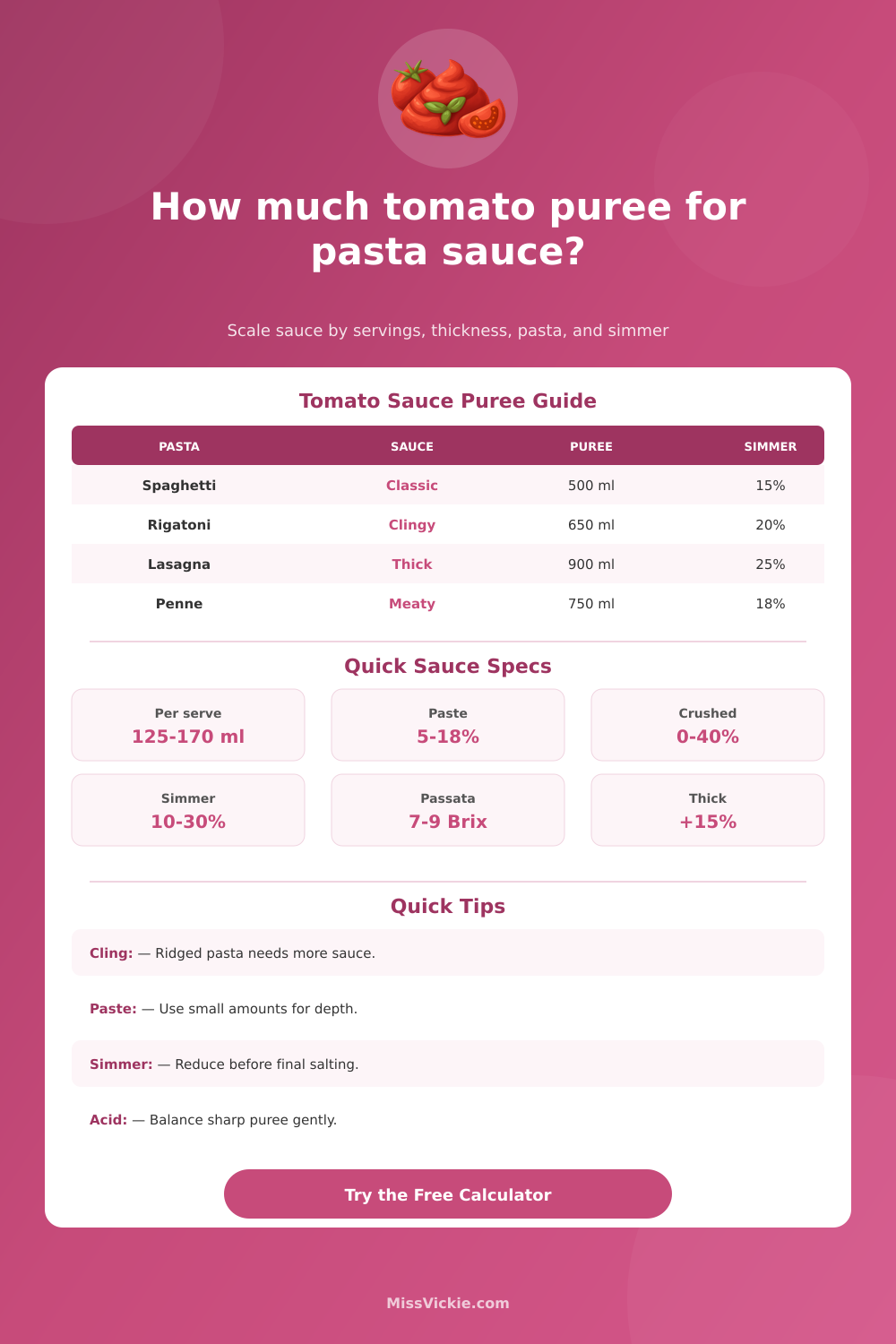
Scale tomato puree for pasta sauce by servings, sauce thickness, puree concentration, tomato paste and crushed tomato mix, simmer reduction, pasta shape cling, meat or vegetable additions, and acidity balance.
🍝Pick a pasta sauce scenario
Each preset loads a real tomato puree sauce plan. Adjust the pasta shape, simmer loss, paste, crushed tomato, additions, and acidity after it fills.
⚖Choose units
🍅Servings, pasta shape, and sauce target
🥄Tomato paste, crushed tomato, additions, and acidity
🧾Tomato base summary
📋Puree and pasta sauce references
| Pasta shape | Finished sauce per serving | Cling behavior | Best tomato texture |
|---|---|---|---|
| Spaghetti or linguine | 120 to 135 ml | Moderate surface cling | Smooth puree with a little paste |
| Angel hair | 105 to 120 ml | Needs a lighter coating | Loose passata-style sauce |
| Penne or ziti | 135 to 155 ml | Tubes hold sauce inside | Puree plus crushed tomato |
| Rigatoni, shells, fusilli | 145 to 170 ml | Ridges grab thicker sauce | Clingy simmered puree |
| Gnocchi | 150 to 175 ml | Dense pieces need more sauce | Soft puree with fat added |
| Lasagna or baked pasta | 165 to 210 ml | Pasta absorbs while baking | Thicker tomato base, not watery |
| Tomato product | Typical concentration | Calculator behavior | Kitchen note |
|---|---|---|---|
| Fresh blended tomatoes | 4 to 6 Brix | Requires more volume or simmer | Bright and watery until reduced |
| Passata or smooth puree | 7 to 9 Brix | Baseline puree estimate | Best all-purpose pasta sauce base |
| Canned tomato puree | 9 to 11 Brix | Slightly less volume needed | Usually thicker than passata |
| Thick puree | 11 to 13 Brix | Lower puree volume, more water control | Good for clingy sauces |
| Tomato paste | 24 to 28 Brix | Small spoonful replaces larger puree share | Brown in oil for deeper flavor |
| Crushed tomatoes | 6 to 8 Brix | Adds chunk and loosens smooth puree | Simmer longer if very watery |
| Batch size | Classic smooth sauce | Clingy rigatoni sauce | Baked pasta sauce |
|---|---|---|---|
| 2 servings | 250 to 300 ml finished | 300 to 340 ml finished | 360 to 420 ml finished |
| 4 servings | 500 to 560 ml finished | 600 to 680 ml finished | 720 to 840 ml finished |
| 6 servings | 750 to 850 ml finished | 900 to 1020 ml finished | 1.1 to 1.25 L finished |
| 10 servings | 1.25 to 1.4 L finished | 1.5 to 1.7 L finished | 1.8 to 2.1 L finished |
| 24 servings | 3 to 3.4 L finished | 3.6 to 4.1 L finished | 4.3 to 5 L finished |
💡Tomato sauce calculation notes
This calculator estimates cooking quantities for kitchen planning. Taste, salt, and adjust texture at the stove because tomato brands and pasta shapes vary.
To determine the correct amount of tomato puree for pasta sauce, you must first determine how much liquid will remain in the pot after you are finished cooking the sauce. Many people attempts to determine the amount of tomato puree needed for there pasta sauce by guessing at the amount of liquid that will remain in the pot. If you guess at the amount of tomato puree needed, you may find that the sauce is either too thin or too thick.
Sauces that are too thin will slide off of the noodles when the pasta is removed from the pot, while sauces that are too thick will feel heavy on the plate. The thickness of the sauce will depend upon the amount of liquid that evaporates while simmering the sauce, the amount of liquid that the other ingredients add to the pot, and the shape of the pasta. Each of these factor can change, which is why a one-size fits all ratio of tomato puree to pasta will not work effectiveley in each recipe.
How Much Tomato Puree to Use for Pasta Sauce
The concentration of the tomato puree will also play a role in the amount of tomato puree needed for the sauce. For instance, passata-style tomato puree contains a specific concentration of solids in the sauce, while fresh blended tomatoes contain a lower concentration of solids in the sauce. Because of the different concentrations of solids in different types of tomato puree, if you use a tomato puree with a low concentration of solids will require that you simmer the sauce for a longer period of time or use a greater volume of the tomato puree to thicken the sauce.
Similarly, tomato paste contain a high concentration of solids in a small volume of tomato paste, meaning that a small amount can be used to replace a large amount of regular tomato puree. Crushed tomatoes contain a higher concentration of solids then liquid tomato puree; however, crushed tomatoes also contain an amount of added water that must evaporate during the simmering of the sauce. The shape of the pasta will also affect the amount of tomato puree needed for the sauce.
Long, smooth pasta shapes contain less surface area than pasta that has ridged tubes or dense pasta shapes. Because there is less surface area on long, smooth pasta shapes, less sauce is needed for those pasta shapes compared to pasta that has ridged tubes or dense pasta shapes. Consequently, you will need to adjust the starting amount of tomato puree based off the specific shape of the pasta that is to be prepared.
Other ingredients will affect the amount of tomato puree needed for the sauce. Ingredients like ground meat and mushrooms will contribute to the amount of liquid in the sauce as the meat and mushrooms cooks. Vegetables like zucchini or peppers will contribute to the amount of liquid in the sauce as the vegetables cook.
Each of these ingredients will require an adjustment to the amount of tomato puree needed to prevent the sauce from being too thin. Additionally, you may also need to adjust the amount of fat or sugar that is added to the sauce due to the effect that the liquid has upon the flavor of the sauce. Simmering the sauce will cause the volume of the tomato puree to decrease.
Simmering the tomato puree gently for thirty minutes will cause approximately a fifteen percent loss in the volume of the tomato puree. Boiling the tomato puree in a wide pot will cause a twenty-five percent loss in the volume of the tomato puree. The volume of the tomato puree needs to be accounted for before simmering the sauce.
Additionally, you need to adjust the ratio of salt to tomato puree prior to simmering the sauce because simmering the sauce will increase the concentration of the salt in the sauce. These factors are accounted for in the calculation of the amount of tomato puree needed. The acidity of the tomato sauce can also affect the amount of tomato puree needed for pasta sauce.
High acidity in the tomato puree will make the sauce feel thin when tasted, while low acidity will make the sauce feel rich and thick. You can balance the acidity of the sauce with the addition of olive oil and butter to the sauce to neutralize the acidity of the tomato puree, or by adding sugar or baking soda to adjust the acidity of the tomato sauce. The acidity of the sauce will impact the amount of tomato puree that adheres to the pasta.
To assist in the preparation of the sauce, you can use the tables that are provided on this page to determine the amount of tomato puree that will yield the desired amount of sauce after simmering. These tables can be used to verify the calculations that are provided with each recipe. The reference tables account for the various brands of tomato puree and the temperatures at which the sauce is simmered.
The calculations that are provided are merely the starting point for the chef to prepare the sauce; their experience will allow them to adjust the amount of tomato puree that is added to the pot. To prepare the sauce correctly, you should of measured the amount of tomato puree prior to cooking the sauce, account for the volume that will be lost during simmering, and adjust the other ingredients to ensure that the finished tomato puree sauce has the same shape and size as the pasta.