🍫 Brownie Batter in a Pan Calculator
Estimate how many cups of brownie batter your pan needs from shape, inside dimensions, batter depth, mix yield, leavening lift, edge loss, and fudgy or cakey thickness.
Use a preset to load a common brownie pan, then adjust the inside dimensions and fill depth. The calculator sizes raw batter before baking and shows baked height after expansion.
Brownie Pan Breakdown
Dense brownies usually bake well at a lower raw batter depth.
Balanced box mix depth for chewy centers and set edges.
Taller batter needs more room because expansion is higher.
Lower depth gives lunchbox-style bars with faster baking.
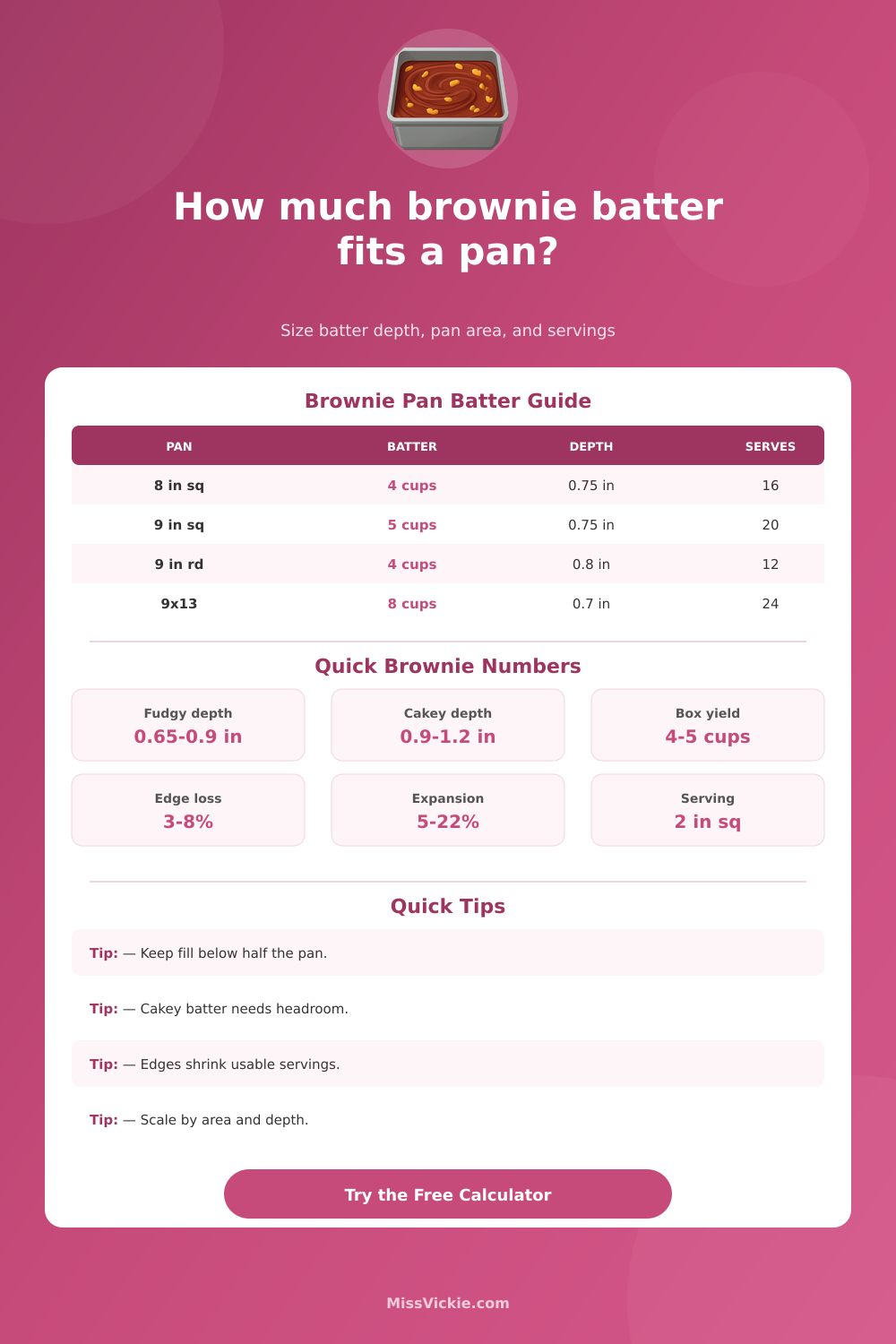
Common pan batter ranges
| Pan | Area | Fudgy | Cakey |
|---|---|---|---|
| 8 inch square | 64 sq in | 3.5 to 4.5 cups | 5 to 6 cups |
| 9 inch square | 81 sq in | 4.5 to 5.5 cups | 6 to 7.5 cups |
| 9 inch round | 64 sq in | 3.5 to 4.5 cups | 5 to 6 cups |
| 9 x 13 inch | 117 sq in | 6.5 to 8 cups | 9 to 11 cups |
| 11 x 15 inch | 165 sq in | 9 to 11.5 cups | 12.5 to 15 cups |
Texture depth guide
| Style | Raw depth | Expansion | Result |
|---|---|---|---|
| Thin | 0.50 to 0.65 in | 5 to 10% | Fast-baking bars |
| Fudgy | 0.65 to 0.90 in | 5 to 12% | Dense center |
| Classic | 0.75 to 1.00 in | 10 to 16% | Chewy set edges |
| Cakey | 0.90 to 1.20 in | 15 to 25% | Taller crumb |
| Deep | 1.10 to 1.45 in | 8 to 18% | Slow-bake squares |
Box mix yield estimates
| Source | Dry weight | Mixed yield | Best pan |
|---|---|---|---|
| Small mix | 10 to 12 oz | 2.5 to 3.3 cups | 8 x 8 thin |
| Standard box | 18 to 19 oz | 4 to 5 cups | 8 or 9 square |
| Family box | 20 to 22 oz | 5 to 6 cups | 9 square |
| Double box | 36 to 44 oz | 8.5 to 11 cups | 9 x 13 deep |
| Scratch batch | Varies | Measure cups | Match depth |
Serving cut reference
| Cut | Area | 8 square | 9 x 13 |
|---|---|---|---|
| Party bite | 2.25 sq in | 25 to 28 | 44 to 48 |
| Standard | 4 sq in | 14 to 16 | 26 to 29 |
| Dessert bar | 6.25 sq in | 9 to 10 | 17 to 18 |
| Round wedge | 5 to 6 sq in | 10 to 12 | Not typical |
| Edge trim | 3 to 8% | Reduce count | Reduce count |
Kitchen note: Brownie formulas vary by brand, egg count, sugar level, and pan material. Use this calculator for pan sizing and batter planning, then follow your recipe for bake temperature and doneness cues.
In order to determine how much brownie batter are needed for a baking pan, there are a variety of factor that must be considered. The factor to consider include the shape of the baking pan that will be used, the depth of the brownie batter that will be poured into the pan, and how much of the brownie will need to be trimmed before serving. If the baker dont calculate the amount of brownie batter correctly prior to baking, the brownies may either become too thinly to eat or may overflow the side of the baking pan.
The shape of the baking pan that will be used to bake the brownies is one of the factors to consider. Many baking pan are square pans, with dimension of 8 inches or 9 inches in each direction. Many people select these dimensions for the amount of brownie batter that is provided with a box of brownie batter.
How Much Brownie Batter Do You Need
Additionally, the depth of the brownie batter that is poured into the pan may impact the baking of the brownies. For instance, if there is a shallow layer of brownie batter poured into the pan, the edges of the brownie batter will have time to set prior to the center of the brownie batter dry out. In contrast, if the pan is deep with brownie batter, the leavening agent will have time to work into the brownies; deep pans are useful if extra baking powder or extra egg added to the brownie recipe.
In addition to the factor of the depth of the brownie batter, baker must also consider the amount of brownie batter that will need to be trimmed. The edge of brownies tend to dry out faster than the center portion of the brownies. Additionally, metal pans will cause the edges of the brownies to dry out more faster than if another type of pan was used.
If the baker is to trim the edges of the brownies prior to serving, the number of servings of brownies that will be produced will be less than if the edge are allowed to remain intact. Therefore, it is important to account for the amount of edge loss prior to baking the brownies. The calculation for round pans are slightly different than those for square pans.
The sides of round pans cause for the pan to have a smaller area of contact with the brownie batter than a square pan of the same diameter. Therefore, less brownie batter will be required to reach the same depth of brownie batter into a round pan as a square pan. Additionally, the wedge of brownies that are cut from a round pan will vary in size; the center portion will be larger than those near the edge of the pan.
However, calculators are available to convert between pan shape and depths to make the calculations for each pan the same. Another factor to consider is the texture that is to be desire from the baked brownies. Fudgy brownies contain a higher ratio of fat to flour than cakey brownies; therefore, fudgy brownies will tend to have headroom for steam to escape if they are poured into a thin layer.
In contrast, cakey brownies will require more headroom for steam to escape from the pan prior to setting. Thus, because there is differences in the requirements of the two types of brownies, the amount of brownie batter that is poured into the pans may differ according to the type of texture that is to be produced. The total amount of brownie batter that can be poured into the pans is dependent upon the recipe from which the brownies will be prepared.
A standard box of brownie mix contains 18 ounce of batter, which yields 4.5 cup of batter when the wet ingredient are added. However, other size of brownie boxes exist, as do other recipes for brownies. Thus, the amount of brownie batter that can be prepared may not always be 4.5 cup.
The use of a calculator to determine the amount of brownie batter that is to be prepared can aid in the baking process. Calculators can indicate whether the depth of brownie batter that will be used will allow for the brownies to rise appropriate. Additionally, calculators show if the amount of brownie batter to be prepared will match the amount of the baking pan that will be used.
Finally, calculators can show the number of serving of brownies that can be produced after accounting for the portion that may need to be trimmed. This information can be used to create an adjustment to the baking plan prior to preheating the oven. Making adjustment to the baking plan prior to preheating the oven will prevent anyone from realizing that there is a mistake in the baking plan while the brownies are baking.