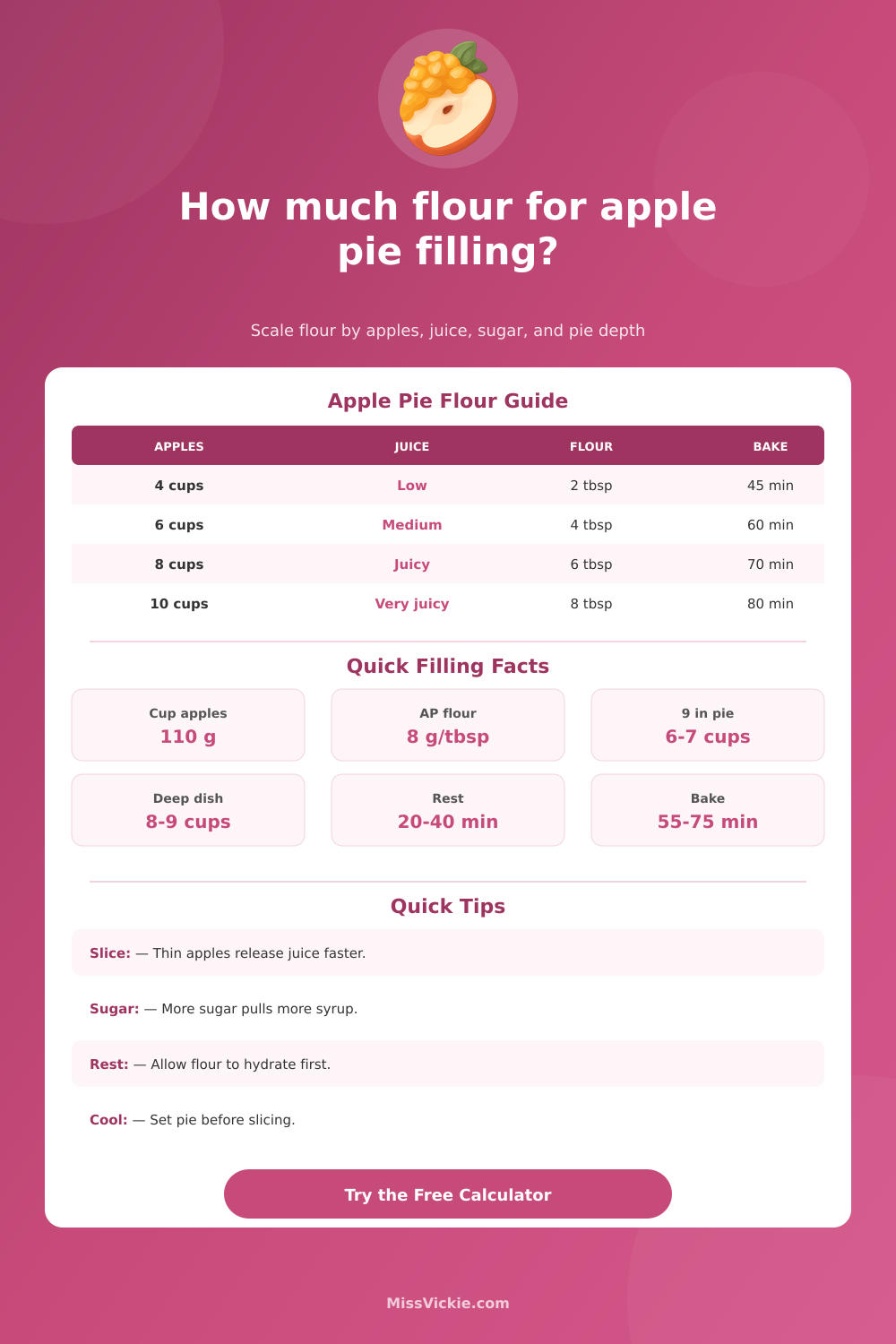
Apple weight, sliced volume, juice, sugar, lemon, flour, rest, and bake math
Flour for Apple Pie Filling Calculator
Estimate flour for apple pie filling from apple weight, sliced volume, apple variety juiciness, sugar, lemon juice, pie depth, flour type, rest time, bake duration, and overflow allowance.
Pick a familiar pie filling style, then tune the apple variety, sugar, lemon, pan depth, rest, bake time, and overflow allowance.
Flour Breakdown
Granny Smith needs a little less flour because it stays firm and releases juice slowly.
Golden Delicious, Braeburn, and mixed pie apples fit the standard flour range.
Honeycrisp, Fuji, and Gala give a sweeter syrup that asks for modest extra flour.
McIntosh softens quickly and releases more liquid, so the filling needs a stronger bind.
| Apple Volume | Approx Weight | Balanced Flour | Juicy Apple Flour | Typical Pie Format |
|---|---|---|---|---|
| 4 cups sliced | 1.0 lb / 440 g | 2 1/2 tbsp | 3 tbsp | Small pie or hand pies |
| 6 cups sliced | 1.45 lb / 660 g | 4 tbsp | 4 1/2 to 5 tbsp | 9-inch standard pie |
| 8 cups sliced | 1.95 lb / 880 g | 5 to 5 1/2 tbsp | 6 to 6 1/2 tbsp | 9-inch deep dish pie |
| 10 cups sliced | 2.4 lb / 1.1 kg | 6 1/2 tbsp | 7 1/2 to 8 tbsp | 10-inch deep dish pie |
| 14 cups sliced | 3.4 lb / 1.54 kg | 9 tbsp | 10 1/2 tbsp | Quarter sheet slab pie |
| Pie Pan | Working Capacity | Safe Fill at 10% | Flour Note | Overflow Cue |
|---|---|---|---|---|
| 9-inch standard | 6.5 cups | 5.9 cups | Round up for juicy apples | Mounded above rim |
| 9-inch deep dish | 8.5 cups | 7.7 cups | Good for tall apple pies | Syrup near crimp |
| 10-inch deep dish | 10.5 cups | 9.5 cups | Needs longer bake set | Center stays soupy |
| Quarter sheet slab | 14 cups | 12.6 cups | Use less flour per cup | Edges bubble early |
| Mini pies | 1.4 cups each | 1.25 cups | Thin slices set best | Filling escapes vents |
| Flour Type | Adjustment | Weight per Tbsp | Best Use | Texture Cue |
|---|---|---|---|---|
| All-purpose flour | 1.00x | 8 g | Classic apple pie | Cloudy, soft set |
| Instant blending flour | 0.85x | 7 g | Smoother filling | Less clumping |
| Cake flour | 1.15x | 7 g | Tender, mild filling | Softer set |
| Whole wheat pastry | 1.05x | 7.5 g | Rustic pie | Lightly nutty |
| Bread flour | 0.95x | 8.5 g | Firm apple slices | Slightly stronger set |
| Gluten-free blend | 1.10x | 8 g | Gluten-free crusts | Varies by blend |
| Rest and Bake | What It Does | Flour Direction | Best With |
|---|---|---|---|
| 0 to 10 min rest | Less syrup drawn before baking | Add 4 to 6% | Firm apples |
| 20 to 40 min rest | Flour hydrates and syrup forms | Standard amount | Most pies |
| 45+ min rest | Juice is easier to judge | Reduce slightly | Juicy apples |
| Under 50 min bake | Less evaporation | Add 5% | Mini pies |
| 65+ min bake | More evaporation and bubbling | Reduce 3 to 8% | Deep dish pies |
Apples contains an high amount of water. When sugar are added to the apples, the water from the apples is released and creates a syrup that makes the bottom crust of the pie soggy. To avoid this, you must use flour to absorb the water from the apples.
The amount of flour that is required to absorb the water from the apples are not a fixed number since the amount of flour that is required to absorb the water from the apples can depend on several differentely factors. These factors include the type of apple that are used, the amount of sugar that is added, the length of time that the apples sit in the pie, and the depth of the pan that the pie are to be baked in. The variety of the apple that is used can impact the amount of water that is released from the apples into the pie.
How to Use Flour to Stop a Soggy Apple Pie
For example, if firm and tart apples is used, less flour will be required than if soft and sweet apples are used. Firm and tart apples tend to release less water than soft and sweet apples when prepared in a pie. Additionally, sugar will draw water from the apples, as well.
The same is true of lemon juice being added to the pie to help balance the amount of sugar. Thus, since the variety of the apple, the amount of sugar, and the amount of lemon juice can impact the amount of liquid in the pie, the amount of flour will need to be adjusted according to these factors. The calculator can help determine the amount of flour that should be used in the pie by inputting several different factors related to the pie.
The weight and volume of the apples, the variety of the apple, the amount of sugar and lemon juice, the depth of the pie pan, the length of time that the pie will sit in the crust prior to baking, and the length of time that the pie will be baked can all be entered into the calculator. These factors impact the amount of liquid in the pie, so altering these factors will impact the amount of flour that is needed to absorb that liquid. For instance, the longer the apples are allowed to rest in the pie prior to baking, the more time the flour will have to absorb the liquid from the apples.
Thus, less flour may be required if the amount of resting time is increased. The shorter the baking time for the pie, the more liquid that will remain in the apples; thus, more flour will be required. The calculator also accounts for the possibility of overflow of the filling from the edges of the crust.
The results of the calculator will indicate whether the amount of filling that will be prepared will fit in the pan, as well as whether that amount of flour will create a filling thick enough to hold a slice of the pie together. If the calculation shows that the amount of filling that will be prepared comes close to the capacity of the pie pan, then either deeper pan may be used for the pie, or fewer apples can be used. If the calculation states that there will be less filling than the capacity of the pie pan, then the amount of flour that is added is likely the correct amount for the pie to contain a balanced filling.
Balanced fillings tend to properly set when allowed to cool to room temperature. Flour should not be treated the same as cornstarch in relation to pies. Flour has to be tossed together with the sugar, and the filling must be allowed to rest after measuring the flour and other ingredient to allow the flour to thicken the filling.
Additionally, not all types of flour are the same. For instance, instant blending flour tends to disperse quick and easily within the pie, so smaller amounts of that flour are required. Cake flour and gluten-free blends absorb more liquid than other types of flour, so more flour of that type will be required.
These different types of flour are accounted for in the flour calculator. The moisture content of the apples may change based off the way in which the apples were stored. For instance, apples that were just picked from the tree contain different amount of water than apples that were stored in cold storage for long periods of time.
Additionally, the humidity level in the kitchen in which the pie is being prepared may alter the amount of moisture in the air around the apples, as well. Should the humidity be high in the kitchen, it is possible that more flour will be required to help balance the amount of moisture in the air. While the flour calculator can indicate the amount of flour that should be added to the pie, it is also possible to taste the filling after it has rested for twenty minutes to again ensure that the correct amount of flour is used.
When the correct amount of flour is used in the pie, the pie will hold its shape when sliced. In other words, if the filling contains the correct amount of flour, it will not weep liquid when a slice of the pie is removed from the rest of the pie. Additionally, if the correct amount of flour is used, the bottom crust is likely to remain crisp and the filling will not be a puddle of syrup.
Thus, using the correct amount of flour will ensure that the pie is successful when prepared by an individual.