Pizza hydration, dough balls, and fermentation water
Water in Pizza Dough Calculator
Estimate pizza dough water from flour weight or target dough balls, then tune hydration for pizza style, flour absorption, fermentation, dough temperature, salt, oil, humidity, altitude, bassinage, and mixing loss.
Pick a dough style to load practical hydration, ball size, salt, oil, ferment, and handling assumptions. You can change any field after the preset loads.
Water and Dough Breakdown
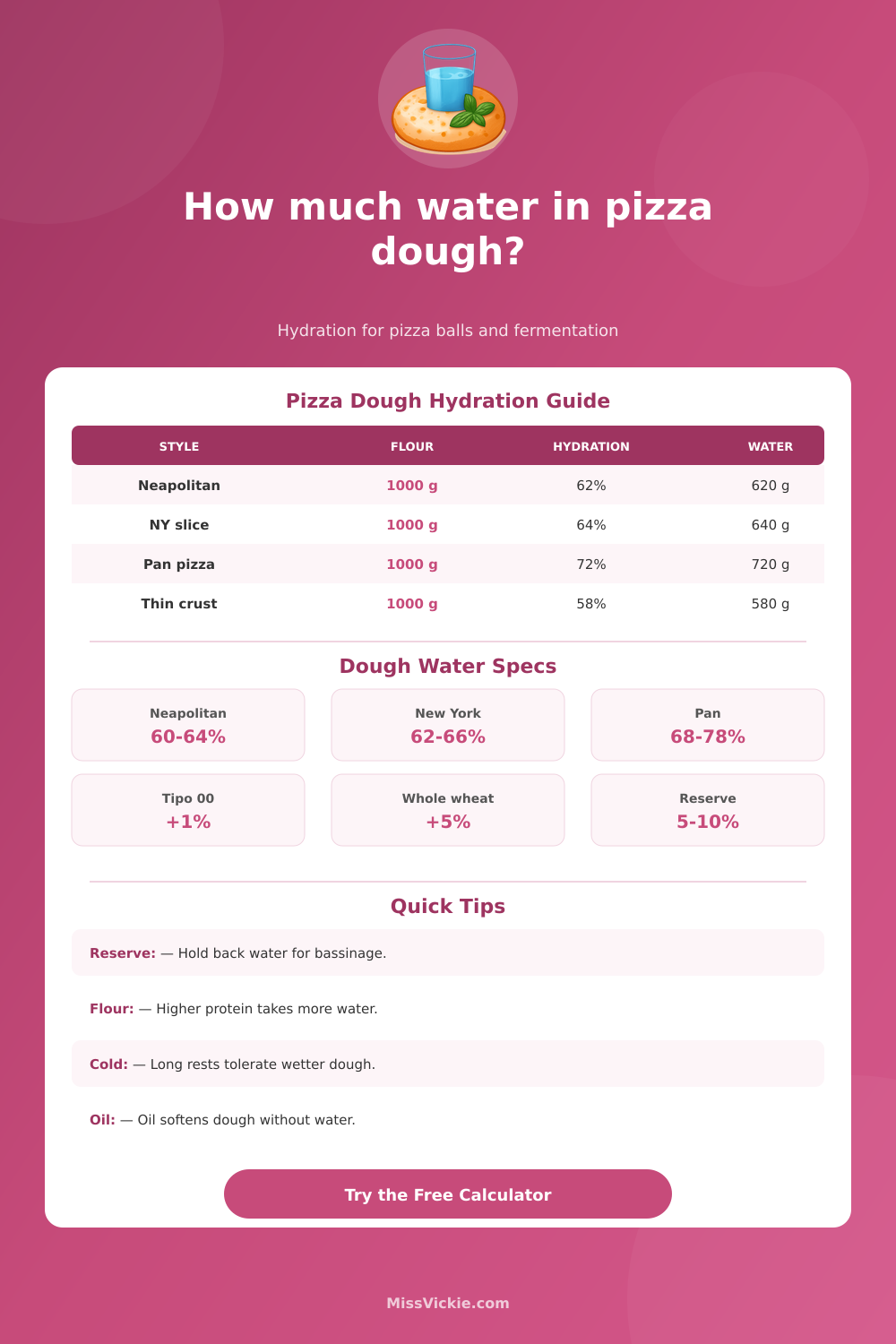
| Pizza style | Common hydration | Ball size guide | Best use |
|---|---|---|---|
| Neapolitan | 58-64% | 230-280 g | Leopard-spotted crust, fast bake, soft center |
| New York slice | 62-66% | 380-520 g | 16-inch to 18-inch pies with foldable slices |
| Detroit pan | 68-74% | 650-850 g | Oiled rectangular pan with airy crumb |
| Sicilian tray | 65-72% | 900-1300 g | Thicker tray pizza with a sturdy base |
| Roman sheet | 72-85% | 900-1400 g | Open crumb, long fermentation, gentle folds |
| Crisp thin crust | 52-58% | 180-260 g | Rollable dough, cracker edge, quick bake |
| Flour type | Absorption shift | Handling note | Good range |
|---|---|---|---|
| Soft flour, 9-10% protein | -3% | Can slacken quickly; start lower | 54-60% |
| All-purpose, 10.5-11.5% | -1% | Good for same-day pizza and thin crust | 58-64% |
| Bread flour, 12-13% | 0% | Balanced strength for most home pizza | 62-70% |
| High-gluten, 13.5-14.5% | +2% | Absorbs water and suits large NY pies | 64-72% |
| Tipo 00 pizza flour | +1% | Silky feel; add water slowly | 60-66% |
| Whole wheat blend | +5% | Bran drinks water during rest | 66-78% |
| Fermentation and dough temperature | Water shift | Why it matters | Watch for |
|---|---|---|---|
| Same-day, 2-6 hours | 0 to +0.5% | Less time for flour to hydrate fully | Stiff dough after mix |
| Cold ferment, 24-48 hours | +0.8 to +1.5% | Long rest improves water absorption | Loose dough after warming |
| Cold ferment, 72+ hours | +1 to +2% | Flavor and extensibility rise together | Over-soft gluten |
| Warm dough above 28°C | -1% | Warm dough feels wetter and ferments faster | Sticky shaping |
| Cool dough below 21°C | +0.5% | Cold dough feels tighter at the bench | Tearing edge |
| Sourdough pizza | +1% | Preferments add acidity and extensibility | Weak final proof |
| Extra factor | Typical adjustment | Use this when | Mixing cue |
|---|---|---|---|
| Salt above 2.8% | +0.4 to +0.8% | Dough feels tight despite enough rest | Add water slowly |
| Oil above 3% | -0.5 to -1% | Pan or NY dough gets too soft | Mix water first |
| Humidity below 35% | +1 to +2% | Dry room, uncovered scaling, floury bench | Cover dough fast |
| Humidity above 70% | -1% | Dough slackens during shaping | Reserve more water |
| Altitude above 600 m | +0.3% per 300 m | Faster drying and quicker evaporation | Check dough skin |
| Bassinage reserve | 5-12% | High hydration or strong flour dough | Add after shaggy mix |
These tables are practical baking ranges. Flour brand, milling age, and local climate can move a dough by several hydration points.
The amount of water in pizza dough is critical because the amount of water determine the behavior of the dough. If there is to little water, the dough will tear when stretching. However, if there is too much water, the dough will slump.
The amount of water that the flour can absorb depend on the type of flour and the environments in which it is prepared. You must account for these conditions when determining the amount of water to use in the dough. The protein level of the flour are another critical element to consider when preparing pizza dough.
How Much Water to Use in Pizza Dough
The protein level of the flour will determine the amount of water that the flour can absorb. Flour with a higher protein content will have more gluten content. Flour with more gluten content can absorb more water.
Flour with a lower protein content will reach its maximum water absorption limit more fast than flour with a higher protein count. The type of flour that you use will determine the amount of water you need to prepare your dough. This amount will change once the dough has rested as the flour will continue to absorb the water.
Another important element that will change the doughs behavior is the fermentation time. The longer the dough ferments, the more extensible the dough will be. Fermenting the dough for twenty-four or forty-eight hours in the refrigerator will create more extensibility than fermenting the dough for a shorter period, such as the same day that the dough is mix and bake.
This is due to the continued hydration and relaxation of gluten that occurs during long periods of fermentation. The calculator takes into account the length of time that the dough rests to provide you with an appropriate hydration percentage for your dough. The calculator also accounts for whether the dough will rest at room temperature or in the refrigerator.
Other factors that will change the behavior of your dough includes the environmental conditions in the kitchen. If the kitchen is dry, this will extract moisture from the dough. In contrast, if the kitchen humidity are high, the dough will feel slack.
The temperature of the kitchen also matters. Warm dough will feel wetter to the touch than cold dough. Warm dough will also ferment faster than cold dough.
These factors will affect how the dough feels and how fast it ferments. For these reasons, you must account for the target temperature of the dough in your calculations. The other ingredients that will impact the amount of water that you use to prepare your dough are oil and salt.
Oil will coat the flour particles. When oil coats the flour particles, the amount of water that they require to achieve the same texture than the dough will decrease. Salt will also impact the amount of water that the dough can absorb.
The gluten structure of the dough will feel tighter with salt, making it feel drier. The calculator accounts for these ingredient to ensure you dont have to guess at the amount of oil and salt that you will use in your recipe. Another method of controlling the amount of water that is in the dough is through the use of bassinage.
Bassinage is the process of holding back a portion of the water that will be used in the dough until after the initial mixing of the ingredients. While you can manage the initial mixing of the dough with the amount of water that is added to the flour and mixed with other ingredient, the bassinage method of adding water to the dough will allow you to achieve the total amount of hydration that you require for your recipe. The calculator will provide information on how much water to hold back through the bassinage process to allow for proper mixing of the dough.
The amount of hydration that can be achieved in the dough is not a single number. The hydration of the dough is the result of various conditions. These conditions include the type of flour that is used, the amount of time in which it ferments, the humidity of the kitchen in which the dough rests, and the temperature of the dough.
By understanding each of these factors and how they can change the target hydration percentage, you can adjust the amount of water that should be used in the preparation of your dough for the next batch of pizza dough. Using this calculator will allow you to have better control of the dough and the process of prepare the dough.