🍕 MissVickie pizza dough math
Fresh Yeast for Pizza Flour Calculator
Estimate fresh cake yeast for pizza dough from total flour weight, fermentation hours, dough temperature, room or cold ferment, yeast freshness, salt, oil, and pizza style.
📌Quick pizza presets
Each preset loads a full pizza dough profile. Adjust the flour, dough balls, fermentation hours, temperature, freshness, salt, oil, and yeast type after choosing a starting point.
⚖Choose flour units
🧮Pizza dough inputs
📊Pizza yeast reference cards
📘Fresh yeast percentage guide
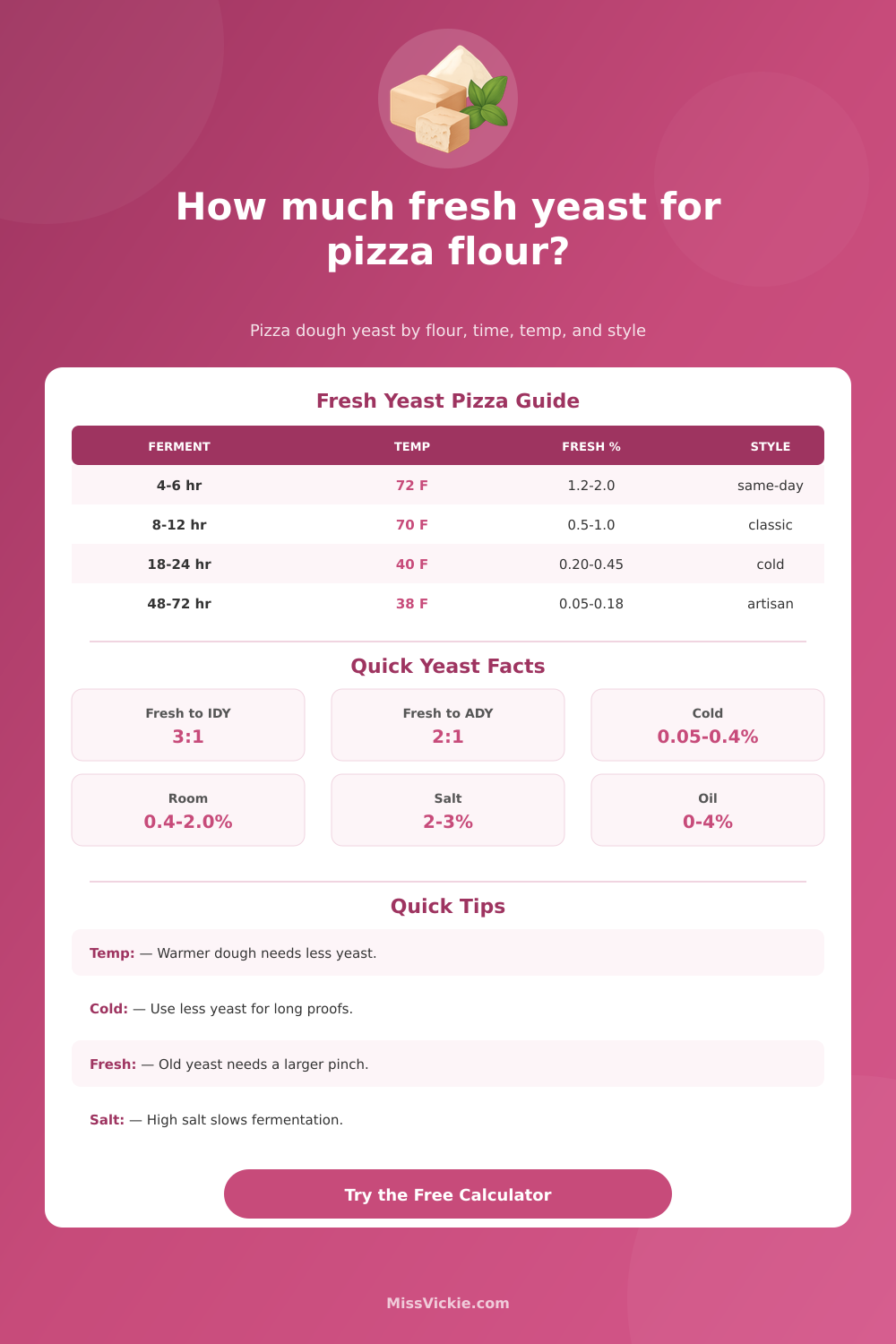
| Pizza schedule | Typical dough temp | Fresh yeast percentage | Instant dry equivalent | Best fit |
|---|---|---|---|---|
| Fast same-day, 3 to 5 hours | 74 to 80°F | 1.2% to 2.4% | 0.4% to 0.8% | Weeknight NY or pan pizza |
| Room ferment, 6 to 12 hours | 68 to 72°F | 0.45% to 1.1% | 0.15% to 0.37% | Neapolitan style or classic hand-stretched dough |
| Cold ferment, 18 to 30 hours | 38 to 42°F | 0.15% to 0.45% | 0.05% to 0.15% | Cold-proof pizza with flavor development |
| Long cold ferment, 48 to 72 hours | 36 to 40°F | 0.04% to 0.18% | 0.013% to 0.06% | Artisan, low-yeast, slow-fermented dough |
| Combo ferment, room start then fridge | 40 to 72°F | 0.12% to 0.65% | 0.04% to 0.22% | Flexible pizza prep with a head start |
🧂Salt, oil, and style adjustments
| Pizza style | Salt range | Oil range | Typical hydration | Yeast note |
|---|---|---|---|---|
| Neapolitan or artisan round | 2.5% to 3.0% | 0% | 58% to 65% | Low oil means temperature and time dominate yeast choice. |
| New York style | 2.0% to 2.8% | 1% to 3% | 60% to 65% | Oil and cold time usually call for moderate fresh yeast. |
| Thin crust | 1.8% to 2.5% | 0% to 2% | 50% to 58% | Lower hydration rises a little slower and needs good mixing. |
| Pan, Grandma, or sheet pizza | 2.0% to 2.7% | 2% to 6% | 65% to 78% | Oil and pan proofing often benefit from a slight yeast boost. |
💡Fresh yeast handling notes
Determining the correct amounts of fresh yeast for pizza dough is a difficult process due to the number of factor that affect the rate of rise of the dough and the flavor that develop in the dough. The calculator above will mathematically calculate for you the amount of fresh yeast that are required for your recipe once you have entered the weight of the flour that you plan to use for your pizza dough, and the calculator will remove the need to perform the process of trial and error to find the correct amount of fresh yeast. Fresh yeast and dry yeast perform different function in pizza dough.
Fresh yeast is already active with the dough, and contains a high percentage of water. Fresh yeast will react more quick to the dough at room temperature, but will lose it’s strength if it is exposed to air in the refrigerator. The questions regarding the condition of the fresh yeast is important because the strength of the fresh yeast will impact the amount of fresh yeast that should be added to the pizza dough.
Find the Right Amount of Fresh Yeast for Pizza Dough
If the fresh yeast is crumbly or the edge have darkened, the calculator will increase the amount of fresh yeast to compensate for the weaker cells in the fresh yeast. This adjustment is small, but it will ensure that the dough will rise at the rate that you require for your pizza. The length of fermentation of the dough and the temperature at which the dough is fermented are two of the most important factor for the outcome of the pizza.
The length of fermentation and the temperature of the environment have even more importance than the amount of fresh yeast that is added to the pizza dough. Dough that ferments in the refrigerator for two days will require less fresh yeast than dough that ferments for five hour. The cold fermentation slows the action of the fresh yeast dramaticly.
The calculator accounts for this by reducing the amount of fresh yeast that must be added to the pizza dough for long fermentation. However, if you add the amount of fresh yeast selected for the pizza dough to the fresh yeast for a warm fermentation schedule, the calculator will increase the amount of fresh yeast to account for the fact that warm dough ferments faster than cold dough. An additional factor that impacts the amount of fresh yeast that is added to pizza dough is the amount of salt that will be added to the dough.
The salt will slow the fermentation of the dough. Most pizza recipe include salt levels of 2.5 percent. Therefore, the calculator will add more fresh yeast to the pizza dough if the amount of salt that is to be included in the pizza is increased.
Another ingredient that can impact the amount of fresh yeast that is required for pizza dough is oil. Oil will also slow the fermentation of the dough, but has a milder effect on the dough than the salt. This is important in pan pizza and sheet pizzas, in which the amount of oil is increased.
Therefore, the calculator will increase the amount of fresh yeast in recipes that include oil, though only to the extent of the mild effect that oil have on the dough. The type of pizza that is to be made can also impact the amount of fresh yeast that is required for the pizza dough. Each type of pizza has different requirement for the dough.
For instance, Neapolitan pizza recipes require the dough to rise in such a manner that when the dough is baked into a pizza, the rim of the pizza will open but not tear the dough. New York style pizza dough can contain more fresh yeast than Neapolitan dough because the baking time for a New York style pizza is longer. Pan pizzas and sheet pizzas contain more oil than other type of pizza, and the more oil the dough contains, the more fresh yeast will be required to ensure that the dough does not rise too quick.
These adjustment to the amount of fresh yeast are small in amount, but they prevent the fresh yeast from under-proofing or over-proofing the pizza dough prior to placing the dough into the pan. The value of this calculator is that it forces the individual to consider each of the variables of making pizza dough with fresh yeast. Rather than copying the percentage of fresh yeast from the recipe that was created under different condition, the recipe can be adjusted for the type of flour that you will use, the temperature of the refrigerator, and the number of hours that the pizza dough will ferment.
By considering each of these variable, the pizza dough will become more predictable and the individual can better understand the amount of fresh yeast that should of been added to dough to create the desired outcome for the pizza.