Powdered sugar glaze thinning math
Water to Add to Glaze Calculator
Estimate how much water to add to powdered sugar glaze by sugar amount, glaze type, current thickness, target drizzle, dip, pour, or flood texture, liquid already added, temperature, and citrus or milk choices.
🥄Glaze Thinning Presets
Load a common powdered sugar glaze situation, then adjust the sugar, current ribbon thickness, temperature, and correction increment for your bowl.
⚖Glaze Batch and Texture Inputs
Glaze thinning breakdown
📏Powdered Sugar Glaze Reference
🍯Target Texture Guide
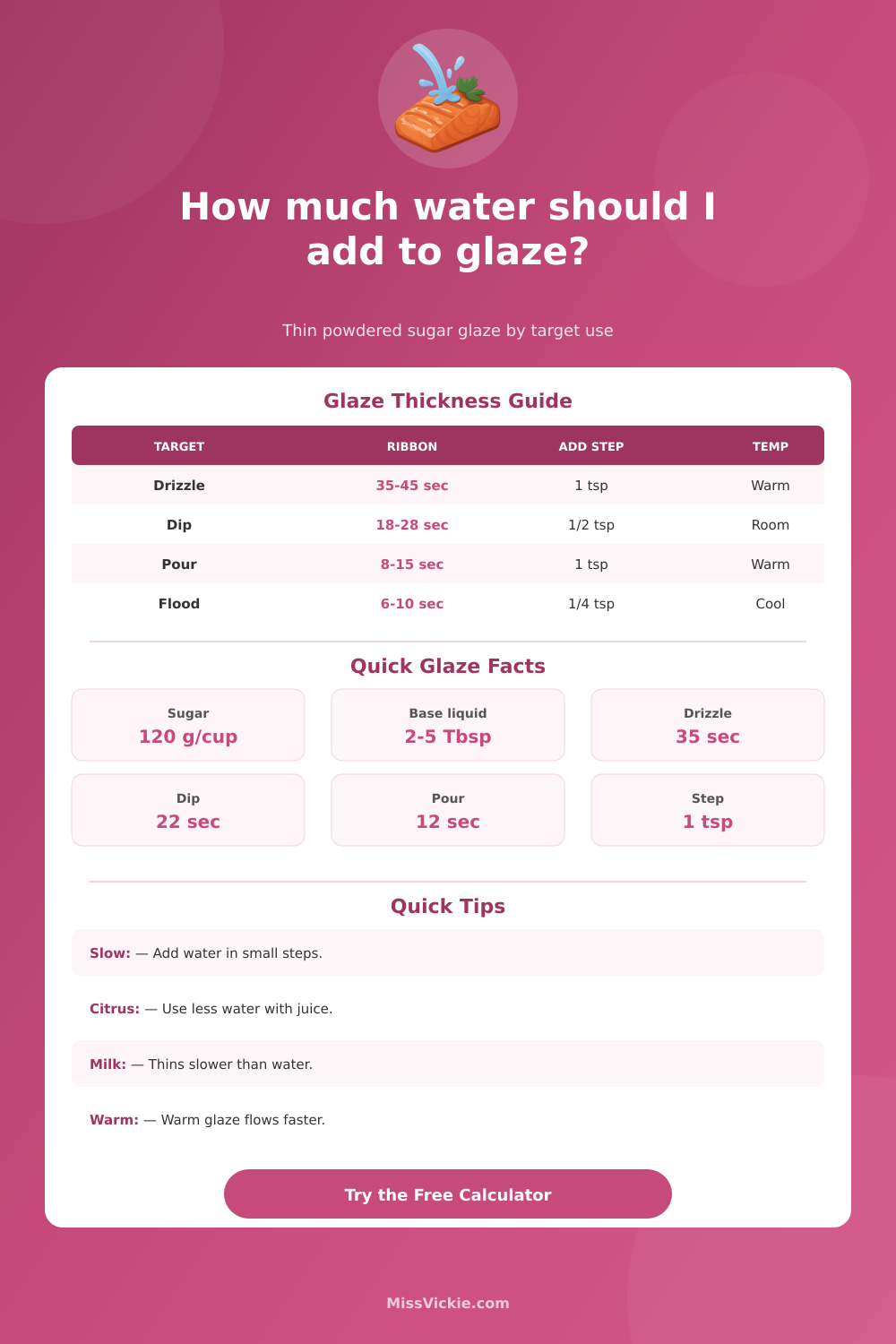
| Target finish | Typical use | Liquid per cup powdered sugar | Ribbon or drip check | Correction increment |
|---|---|---|---|---|
| Thick drizzle | Bundt cakes, pound cakes, coffee cake | 1.75 to 2.25 Tbsp | Ribbon holds 35 to 45 seconds before smoothing. | Start with 1/2 to 1 tsp water. |
| Thin drizzle | Scones, muffins, quick breads | 2.25 to 2.75 Tbsp | Ribbon settles in 24 to 34 seconds. | Add 1 tsp, then stir 20 seconds. |
| Dip coating | Donuts, fritters, cookies dipped face-down | 2.75 to 3.35 Tbsp | Coats spoon, then flows off in a smooth sheet. | Add 1 tsp, test after 2 minutes. |
| Pour-over glaze | Loaf cake, cinnamon rolls, warm pastries | 3.35 to 4.2 Tbsp | Ribbon disappears in 8 to 15 seconds. | Add 1 to 2 tsp at a time. |
| Cookie flood | Simple cookie glaze and thin icing fills | 4.0 to 4.8 Tbsp | Surface smooths in 6 to 10 seconds. | Add 1/4 to 1/2 tsp near the finish. |
🥛Liquid Choice and Flavor Adjustments
| Liquid option | Thinning speed | Flavor effect | Best target | Calculator adjustment |
|---|---|---|---|---|
| Water | Fast and clean | Neutral, least rich | Drizzle, dip, pour, cookie glaze | Baseline for added water amount. |
| Lemon or lime juice | Fast, slightly sharper | Bright citrus and more tartness | Lemon loaf, berry pastries, tea cakes | Counts as liquid but suggests less plain water. |
| Orange juice | Moderate | Sweet citrus, softer acidity | Spice cake, cranberry loaf, sweet rolls | Slightly higher target than lemon juice. |
| Milk | Moderate and creamy | Richer vanilla glaze flavor | Cinnamon rolls, donuts, pastry dip | Needs a touch more liquid than water. |
| Cream | Slow and rich | Thicker, opaque, less sharp | Thick drizzle and spoon glaze | Raises target liquid and overshoot caution. |
| Coffee or espresso | Fast | Strong flavor and color | Cocoa, mocha, coffee cake glaze | Counts close to water, with color warning. |
🌡Temperature and Current Thickness Checks
Glaze below 65°F can look thicker than it will at room temperature.
Warm glaze flows faster, so the calculator holds back some water.
A paste usually needs a larger first correction before small steps matter.
If it is already watery, add powdered sugar instead of more water.
💡Glaze Correction Tips
Achieving teh correct thickness for a powdered sugar glaze is an important part of baking. The thickness of the powdered sugar glaze will impact it’s behavior when applied to a dessert. If the powdered sugar glaze is too thick, it may form heavy clumps on a cake, or it may not even coat a donut.
If the powdered sugar glaze is too thin, it may run off the sides of the food, or it may pool at the bottom of the serving dish. The thickness of the powdered sugar glaze depends upon the amount of liquid that is added to the powdered sugar, as well as the time in which that liquid are added. A water to add to glaze calculator will help to determine the proper amount of liquid to add to the powdered sugar glaze.
How to Make Powdered Sugar Glaze the Right Thickness
Many bakers attempt to achieve the desired thickness of a powdered sugar glaze by eye. However, a variety of factors will impact the thickness and behavior of the glaze. For instance, the type of sugar that a baker uses will impact the thickness of the powdered sugar glaze.
Additionally, whether the sugar is sifted or packed will also impact the thickness of the glaze. The amount of liquid that is already present in the mixing bowl will impact the thickness of the glaze that results. Finally, the temperature at which the powdered sugar glaze is made will also impact the thickness of the glaze; cold glaze will appear more thicker than warm glaze.
Lastly, the type of liquid used will also impact the thickness of the glaze; for instance, a tablespoon of lemon juice will thin the glaze different than a tablespoon of milk. A glaze prepared with cream will be heavier than one prepared with water. These factors is all accounted for in the water to add to glaze calculator; it eliminates the need for bakers to rely upon trial and error methods to find the proper thickness.
To create a powdered sugar glaze that has the proper thickness, a water to add to glaze calculator requires that a baker enter several factors into the calculator. The baker must enter the amount of sugar that is to be used in the glaze recipe. Additionally, the calculator will ask for the target finish of the glaze; that is, whether the glaze should be thin or thick.
The thickness of the powdered sugar glaze that is currently in the bowl must be entered. The amount of liquid that is already in the bowl must also be entered. Finally, the baker must enter the temperature of the glaze; cold glaze will appear thicker than warm glaze.
Lastly, the increment in which the baker intends to add the liquid may also be entered into the calculator. A number of environmental factors may impact the thickness of a powdered sugar glaze. For instance, the humidity in the air may impact the thickness of the powdered sugar glaze; glaze made on a humid day may require less liquid than glaze made on a dry day.
Additionally, the thickness of the powdered sugar glaze may change over time; glaze that is made and left in a bowl for ten minutes may thicken due to the hydration of the starch in the sugar. These factors are also accounted for in the water to add to glaze calculator. Incorrectly adding too much liquid to a powdered sugar glaze too early in the process can be difficult to fix.
Once a powdered sugar glaze becomes too thin, it is difficult to thicken it again. Therefore, it is best to first add a small amount of liquid to the powdered sugar, and then stir until the surface of the glaze appears glossy. After adding the first increment of liquid to the powdered sugar, it is best to wait before adding any additional liquid.
The water to add to glaze calculator will suggest this first step to the baker. The type of liquid to be used will alter the flavor of the resulting glaze. Additionally, liquids like citrus juice will thin the glaze quickly; too much citrus juice, however, can lead to the glaze having an excessively sharp flavor.
Liquids like milk and cream will produce a richer flavored glaze; however, they will not provide the same glossy finish as water-based glazes. The water to add to glaze calculator accounts for these types of differences, and allows the baker to select the type of liquid that will be used in the glaze to preserve its flavor. The temperature at which the glaze is made and the amount of time that it rests can impact the thickness of the glaze.
For instance, a powdered sugar glaze that appears to have the proper thickness at 80 degrees may thicken once the glaze rests and cools. Additionally, a glaze that appears to have the proper thickness at room temperature may become too thin when placed on a warm cake. Therefore, a period of rest time is recommended after mixing the powdered sugar glaze.
The water to add to glaze calculator accounts for the rest time that is required for the powdered sugar glaze; any amount of liquid that is added will result in the desired thickness when the glaze is allowed to rest.