Lemon Juice for Cream of Tartar Calculator
Convert cream of tartar to lemon juice for egg whites, sugar syrup, cookies, cakes, frostings, and other recipes while checking added moisture, acidity strength, flavor impact, and batch scale.
Start from a real kitchen scenario, then adjust the cream of tartar amount, lemon type, recipe tolerance, and batch multiplier.
Lemon Juice Substitution Breakdown
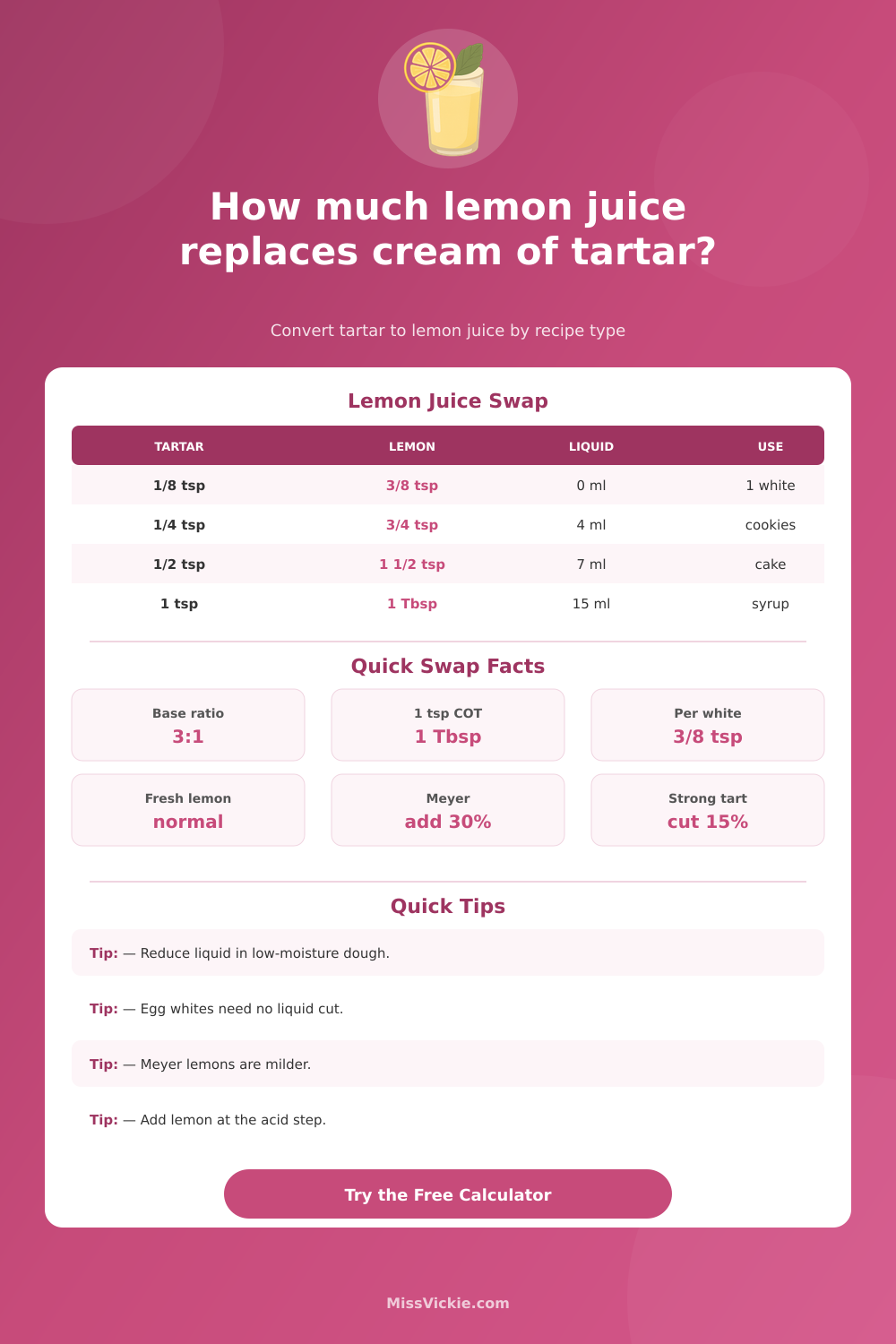
| Cream of Tartar Called For | Fresh Lemon Juice | Metric Equivalent | Moisture Adjustment |
|---|---|---|---|
| 1/16 teaspoon | 3/16 teaspoon lemon juice | About 0.9 ml | No adjustment for egg whites; tiny doughs may need a flour pinch. |
| 1/8 teaspoon | 3/8 teaspoon lemon juice | About 1.8 ml | Usually no liquid cut unless the dough is very stiff. |
| 1/4 teaspoon | 3/4 teaspoon lemon juice | About 3.7 ml | Reduce other liquid by 2 to 4 ml in cookies or icing. |
| 1/2 teaspoon | 1 1/2 teaspoons lemon juice | About 7.4 ml | Reduce other liquid by about 5 to 7 ml in cake batter. |
| 1 teaspoon | 1 tablespoon lemon juice | About 14.8 ml | Reduce measured liquid by 10 to 15 ml when texture is tight. |
| 2 teaspoons | 2 tablespoons lemon juice | About 29.6 ml | Scale liquid correction carefully in doubled baking batches. |
| Recipe Type | Lemon Juice Behavior | Liquid Reduction | Kitchen Cue |
|---|---|---|---|
| Egg whites and meringue | Stabilizes foam like a liquid acid | None; the amount is tiny and mixes into the whites | Add when whites look foamy, before sugar is fully added. |
| Sugar syrup and candy | Helps discourage crystallization | Usually none; water boils away during cooking | Add early so it disperses before the syrup concentrates. |
| Cookies and dry dough | Adds acid plus noticeable moisture | Reduce other liquid or add a little flour if dough softens | Chill dough if the lemon juice makes it sticky. |
| Cakes, muffins, quick bread | Works well when liquid is adjusted | Reduce milk or water by most of the lemon amount | Mix and bake promptly after acid meets baking soda. |
| Frosting, glaze, whipped cream | Can brighten flavor and loosen texture | Reduce milk, cream, or water in the icing | Add gradually and stop when texture is right. |
| Macarons and delicate foams | Useful but flavor and water matter | No direct liquid cut; reduce only if formula allows | Use the smallest rounded amount and keep notes. |
| Lemon Juice Type | Calculator Factor | Why It Changes | Best Use |
|---|---|---|---|
| Fresh regular lemon | 1.00x | Balanced everyday acidity and flavor | Most egg whites, cakes, syrups, and cookies. |
| Very tart lemon | 0.85x | Sharper juice needs a little less volume | Delicate recipes where extra water matters. |
| Bottled lemon juice | 1.05x | Often consistent but less bright in flavor | Reliable acid balance when fresh lemons are unavailable. |
| Meyer lemon or mild lemon | 1.30x | Milder acidity needs more liquid to do the job | Citrus-friendly batters, syrups, and frostings. |
| Old or diluted lemon juice | 1.20x | Weak flavor and acid need a larger dose | Only when the recipe can tolerate more liquid. |
No liquid reduction is usually needed because lemon juice becomes part of the foam.
Reduce other liquid by the lemon amount or add a small flour correction.
Cut most of the milk or water so the crumb does not turn loose.
Do not overcorrect syrup water because cooking drives off excess moisture.
| Batch Scale | Starting Tartar | Fresh Lemon Juice | Texture Note |
|---|---|---|---|
| Half batch | 1/4 tsp becomes 1/8 tsp | 3/8 tsp lemon juice | Round down for delicate vanilla batters. |
| Single batch | 1/2 tsp stays 1/2 tsp | 1 1/2 tsp lemon juice | Good everyday reference for cakes and fillings. |
| Double batch | 1/2 tsp becomes 1 tsp | 1 Tbsp lemon juice | Liquid correction starts to matter in doughs. |
| Triple batch | 1 tsp becomes 3 tsp | 3 Tbsp lemon juice | Use metric liquid reduction for cleaner scaling. |
| Small test batch | 1/8 tsp becomes 1/16 tsp | 3/16 tsp lemon juice | Use drops if measuring spoons are too large. |
Cream of tartar is an acid that is used in many recipes. Cream of tartar often help stabilize egg whites and to prevent sugar from crystallizing when cooking with those ingredients. Cream of tartar also often reacts with baking soda to create the leavening agents in many cookies and cakes.
Many people dont have cream of tartar in there kitchens, so many cooks must find an alternative ingredient that provides the same type of acid in the recipe, as well as provides a bright flavor to the food. One of the best substitutes for cream of tartar is lemon juice. Lemon juice contains the same type of acid as cream of tartar, but also contains water.
How to Use Lemon Juice Instead of Cream of Tartar
Cream of tartar does not contain water, but lemon juice does. Therefore, cooks must take into consideration how much liquid the recipe can absorb when using lemon juice as a substitute. If the recipe produces a loose batter, it is unlikely that using lemon juice will have any significant effect on the batter.
However, using lemon juice in a stiff dough could lead to cookies that contains too much moisture, or frosting that begins to slide off cakes. To assist cooks with determining the correct amount of lemon juice to use in their recipes in place of cream of tartar, such a calculator allows cooks to choose the type of recipe that they are creating, as well as to choose the liquid tolerance for the recipe. The type of recipe will change the liquid tolerance, therefore cooks must take the time to choose the correct liquid tolerance, as this will ultimataly change the amount of liquid that must be removed from the rest of the recipe.
Another factor that cooks must consider when using lemon juice in place of cream of tartar is the strength of the acid within the lemon juice, which can range depending on the type of lemon juice selected. Using freshly squeezed lemons will yield different results from different lemons due to the natural variation of lemons. Bottled lemon juice will be more consistent in terms of strength of lemon juice, but it will have a flatter taste.
Meyer lemons are far less acidic than regular lemons. Therefore cooks using Meyer lemon juice will have to use more Meyer lemon juice to achieve the same pH level as the amount of cream of tartar in the recipe that is being substituted. The calculator adjusts for this factor when cooks choose the type of lemon juice that they would like to use in their recipe.
Other factors that affect the use of lemon juice in place of cream of tartar is the flavor sensitivity of the cooks. Some cooks may be more sensitive to the flavor of lemon juice than others. A recipe that contains chocolate will mask the flavor of lemon juice, while a delicate vanilla meringue may highlight the flavor of lemon juice.
The calculator allows cooks to adjust for this difference in flavor sensitivity. Another factor that relates to lemon juice as a substitute for cream of tartar is the size of the batch of the recipe that is to be prepared. The larger the batch of the recipe, the more moisture that can be present in the batch of lemon juice.
The calculator accounts for this factor by first calculating the amount of cream of tartar that is required. The recipe factors and the strength of the lemon juice are also factored into these calculations. These calculations prevent cooks from having to measure the amount of lemon juice that the calculator calculates to the thousandth of a milliliter.
Other factors in the calculations is the number of egg whites that is to be used in the recipe. The amount of acid that is used in relation to the number of egg whites will remain the same as the recipe includes more egg whites or reduces the number of egg whites that are to be used in the recipe. When creating recipes that contain angel food cake or meringue recipes, the number of egg whites will be used in the calculation as a means of ensuring that the acid is in the proper proportion to the batch of egg whites to be used.
After the cooks add the lemon juice into the recipe, the lemon juice will continue to work within the recipe. In recipes that use syrup, the acid within the lemon juice will work to prevent crystals from forming in the syrup. In recipes that use cookies, the moisture that is present in the lemon juice will remain in the cookies.
This moisture may work to cause the cookies to spread too far on the cookie sheets. To adjust for this, cooks can chill the dough or add more flour to the dough. The calculator allows cooks to see the amount of lemon juice that should be used in the recipe, as well as the amount of other liquids that should be reduced in the recipe to balance the moisture from the lemon juice.
To use the calculator, cooks must first enter the amount of cream of tartar that the recipe requires. The cooks will also select the type of recipe that will be made, as well as the liquid tolerance for the recipe. The calculator will show the amount of lemon juice in the recipe, as well as the amount of other liquids that must be reduced in the recipe.
At this point, cooks can taste the food to see if the flavor is correct. If the batter is too loose due to the inclusion of lemon juice, the cooks can reduce the amount of other liquids in the recipe. If the flavor of the lemon juice is good, cooks can use the same settings for the next recipe that is to be prepared using these ingredients.
Using this recipe calculator many times will allow cooks to understand the way in which lemon juice will affect the flavor and texture of the recipes. Cooks will understand how much acid and how much water is contained in lemon juice. Cooks will understand the way in which the recipe must be adjusted to account for the presence of lemon juice as a substitute for cream of tartar.