Rainbow layer batter tinting, bake fade, and split math
Food Coloring for Rainbow Cake Calculator
Estimate gel, liquid, or powder food coloring for rainbow cake batter by total batter weight, number of color layers, color intensity, base batter color, bake fade, layer overage, and color-by-color allocation.
Pick a common rainbow cake setup, then tune batter weight, layer count, intensity, fade, and colorant style for your recipe.
Rainbow Coloring Breakdown
The list below updates from your layer count, palette, batter weight, color type, bake fade, and overage settings.
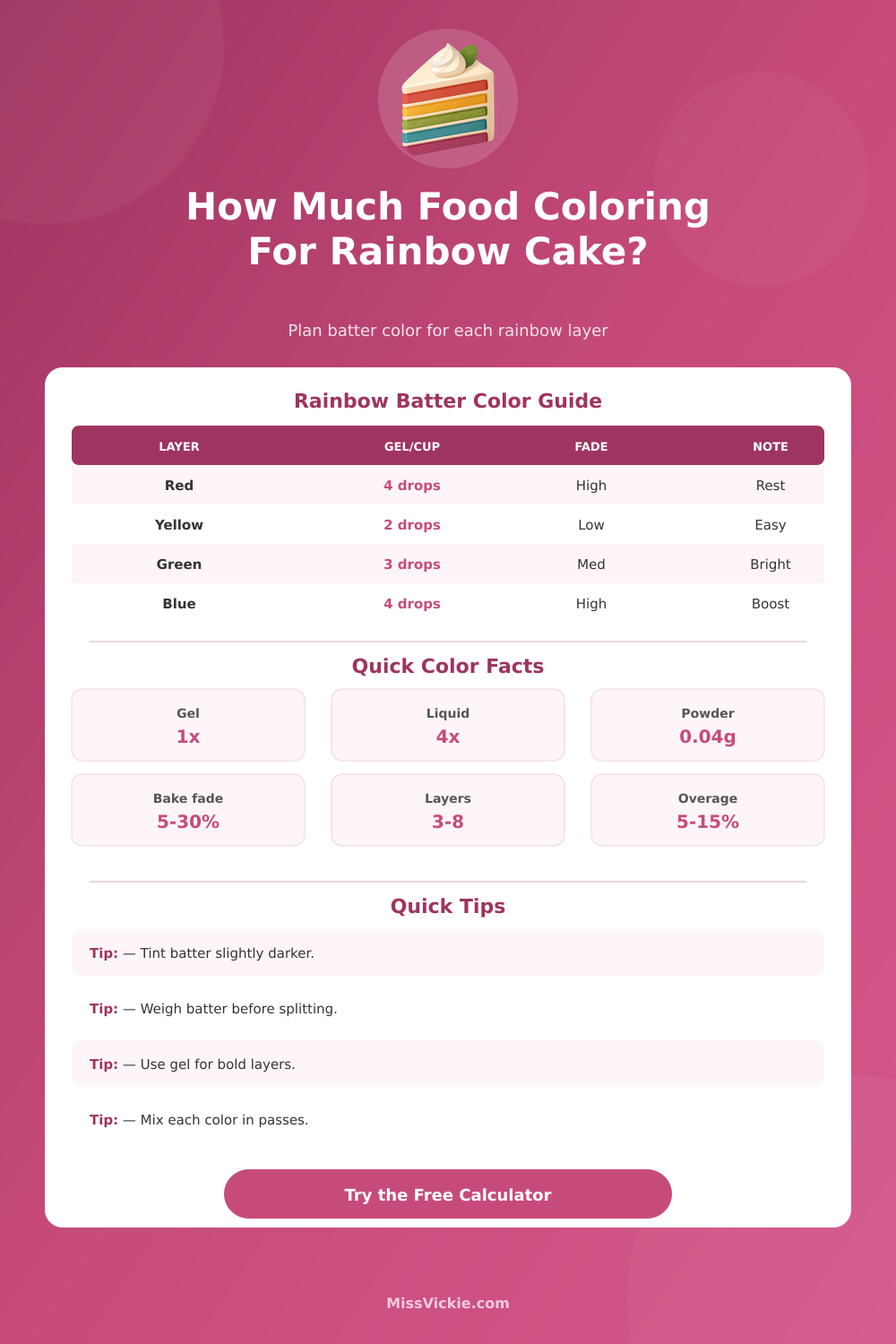
| Color layer | Gel drops per cup | Bake fade behavior | Adjustment note |
|---|---|---|---|
| Red | 3 to 6 | High fade | Red often bakes softer; start pink-red and var it deepen before adding more. |
| Orange | 2 to 4 | Medium fade | Yellow batter helps orange, so reduce slightly in egg-rich batters. |
| Yellow | 1 to 3 | Low fade | Yellow is forgiving and usually needs the least added color. |
| Green | 2 to 4 | Medium fade | Warm bases can turn green olive; add color in small passes. |
| Blue | 3 to 6 | High fade | Blue is muted by yellow butter and may need whitening or extra gel. |
| Violet | 4 to 7 | High fade | Violet shifts gray in yellow batter; use a clean white base when possible. |
| Coloring type | Compared with gel | Best rainbow use | Caution |
|---|---|---|---|
| Gel paste drops | 1x | Most rainbow cakes | Strong color with little added liquid. |
| Liquid food color | About 4x drops | Pastel or small batches | Large amounts can thin batter and affect crumb. |
| Dry powder color | About 0.04 g per gel drop | Macarons, sponge, vivid cake | Sift or hydrate to avoid specks in pale batter. |
| Natural plant color | About 5x volume | Muted pastel cakes | Heat, pH, and fat can fade or shift the color. |
| Airbrush color mixed in | About 3x drops | Light tint only | Usually better for surface color than batter. |
| Batter base | Color behavior | Calculator factor | Best correction |
|---|---|---|---|
| Bright white batter | Cleanest rainbow shades | 1.00x | Use standard color amounts and judge after mixing. |
| Off-white vanilla batter | Slightly warms blues and violets | 1.07x | Add cool colors slowly and accept a softer rainbow. |
| Yellow butter batter | Mutes blue, violet, and green | 1.18x | Use gel and consider whitening before dividing. |
| Buttermilk batter | Can dull natural colors | 1.10x | Choose heat-stable colors and avoid overmixing. |
| Egg-rich golden batter | Strong warm cast | 1.25x | Keep warm colors dominant or use a white cake recipe. |
| Total batter | 4 colors | 6 colors | 8 colors | Planning note |
|---|---|---|---|---|
| 4 cups / 960 g | 1 cup each | 0.67 cup each | 0.5 cup each | Good for a small test rainbow. |
| 6 cups / 1440 g | 1.5 cups each | 1 cup each | 0.75 cup each | Common two-pan home batch. |
| 8 cups / 1920 g | 2 cups each | 1.33 cups each | 1 cup each | Works well for thin layer cakes. |
| 12 cups / 2880 g | 3 cups each | 2 cups each | 1.5 cups each | Use weighed bowls for even layers. |
| 16 cups / 3840 g | 4 cups each | 2.67 cups each | 2 cups each | Scale color in passes, not all at once. |
Making an rainbow cake requires that you pay attention to the colors and the quantities of the cake batter. The color of the cake batter will change when the cake is baked. For instance, the color of the cake batter when it is first in the bowl may be different than the color of the cake batter after it has been baked in the oven.
The colors may become mute or they may become even after baking the cake batter. Therefore, you must account for the color of the cake batter, the way in which the colors change after baking, and the extra amount of batter that will remain in the bowl after baking. Many people will try to color there cake batter by guessing how many colorant to use.
How to Use the Rainbow Cake Color Calculator
Guessing the amount of colorant that will be used can lead to some colors being stronger than others. For instance, a yellow butter cake will contain blue and green colors to ensure that they are visible against the yellow cake batter. Due to the baking process, color will fade; therefore, people will have to add more colorant to the raw batter than they think is needed for the cake after baking.
Additionally, people can use either liquid colorant or gel colorants. Liquid colorant will add to the batter; gel colorant will not. The calculator provides math for the cake batter so that the user can calculate the colorant according to the measurement of the user.
The person must provide the weight or the number of cup of the cake batter, the number of layers of the cake, and the color palette that they wish to use. The baker will also have to select the type of colorant that they will use in the cake. The calculator will adjust for the color of the cake batter, the fade of the colors that will occur during baking, and the extra amount of batter that will remain in the bowl.
The style of the cake batter can change the color that is visible. For instance, a pound cake will hold its color different than a sponge cake. The calculator will adjust the amount of colorant according to the density of the cake batter.
Additionally, if some layers of the cake should be thicker than others the allocation setting can be used. This setting can be used to ensure that the middle layer of the cake are thicker than the top and bottom layers. Additionally, this setting can also be used to ensure that baking settings do not over-brown the top and bottom layer.
The overage setting can also be used to ensure that enough colorant is accounted for in the batter to prevent running out of colorant. Bakers must understand that coloring the cake batter take place in stages. If all of the colorant is added at once the cake batter may contain streak.
Colorant can be added in passes to allow the baker to judge the strength of the color. The calculator will provide the amount of colorant for each layer; however, the colorant should be added to the raw cake batter until it is slightly stronger than the color of the slice of cake that is targeted. The type of colorant can also impact the amount of colorant that is added to the cake batter.
For instance, gel colorant is more concentrated than liquid colorant. Using too much liquid colorant may thin the cake batter. Powdered colorant is not the same as liquid or gel colorant.
Powdered colorant must be sifted to ensure that it does not make speck within the cake batter. The calculator can convert these colorants so that bakers dont have to guess the proper amount of each type of colorant that will be used in their cake batter. To ensure that each layer of cake weigh the same amount, measured amount of cake batter will have to be used.
The calculator will provide the weight of each layer of cake batter before it must be poured into the baking pan. If the color of the cake is not correct once baked, the reference information will help the baker to find the proper adjustment for that type of cake. Using this calculator will allow bakers to make rainbow cakes that are even in color and have less time spent correcting the colors of the cake.
The math has been calculated prior to the baker beginning to create the cake.