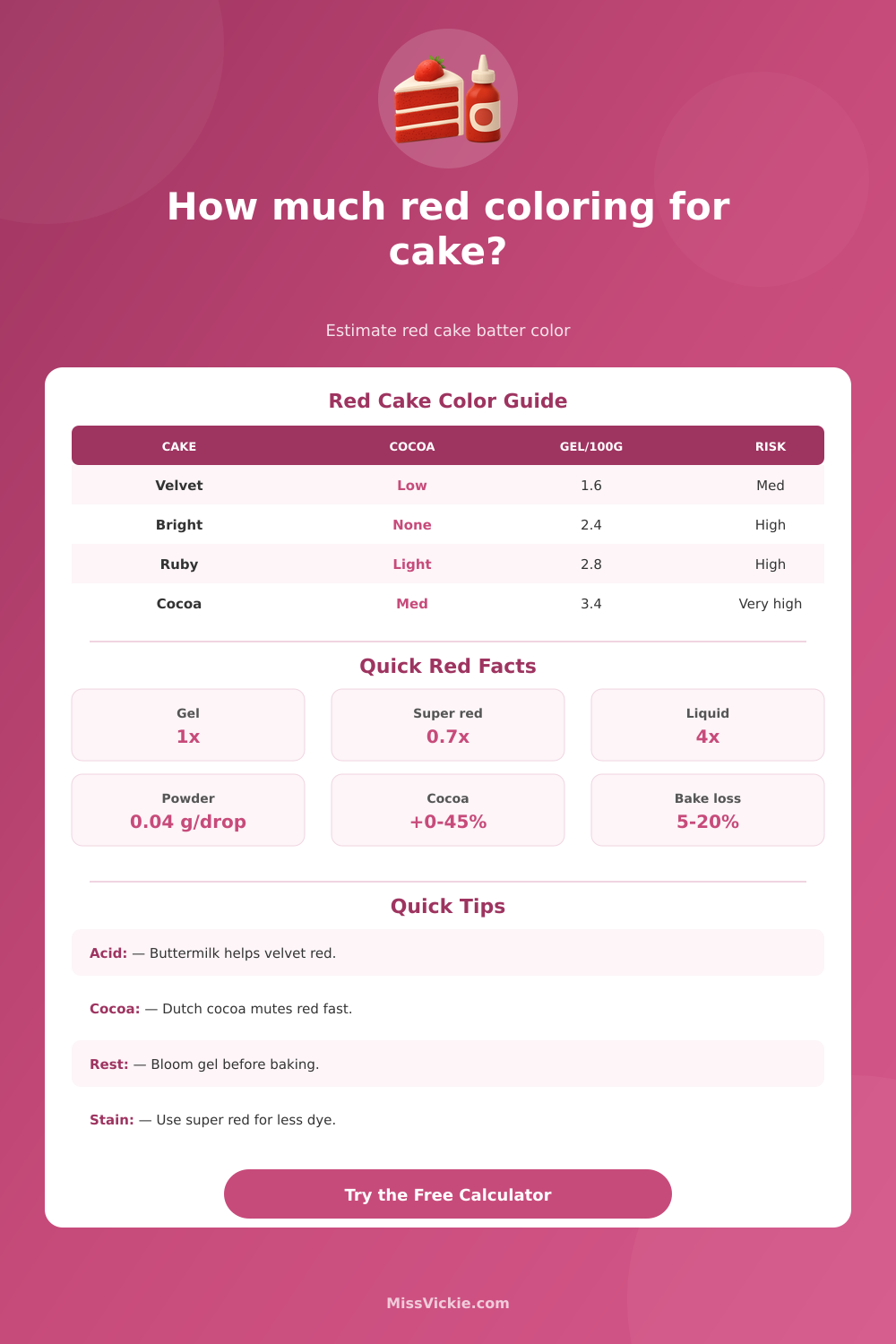
Red cake batter, cocoa, acidity, and bake color math
Food Coloring for Red Cake Calculator
Estimate red food coloring for cake batter by batter weight, cocoa amount, acidity, color type, target red depth, bake darkening, pan count, red velvet style, and stain risk.
Choose a real red cake scenario, then fine-tune the batter weight, cocoa load, colorant strength, pan count, and stain tolerance.
Red Cake Batter Breakdown
Gel drops per 100 g batter with natural cocoa and buttermilk acidity.
Minimal cocoa and stronger coloring for a party-cake red crumb.
Darker batters need more red, but risk moves up quickly.
Use super red gel, lower cocoa, and accept a softer baked red.
| Cake style | Typical cocoa | Acid profile | Starting gel equivalent | Best use |
|---|---|---|---|---|
| Classic red velvet | 12-25 g/kg batter | Buttermilk plus vinegar | 1.5-2.2 drops per 100 g | Traditional soft red crumb with cocoa flavor |
| Bright red vanilla cake | 0-8 g/kg batter | Neutral or lightly acidic | 2.2-3.2 drops per 100 g | Birthday cakes where color matters more than cocoa |
| Ruby red velvet | 8-18 g/kg batter | Buttermilk and vinegar | 2.2-3.5 drops per 100 g | Deeper red layers for photos and display cakes |
| Cocoa-forward red cake | 25-50 g/kg batter | Natural cocoa preferred | 3.0-4.5 drops per 100 g | Chocolate-leaning red cake with higher stain risk |
| Natural plant red | 0-12 g/kg batter | Acidic batter helps | Often 3-6x more by volume | Muted brick red or pink-red batters |
| Colorant type | Calculator output | Strength note | Batter behavior | Stain risk |
|---|---|---|---|---|
| Regular red gel | Drops | Baseline strength | Good for most red velvet cakes | Medium to high as dose rises |
| Super red gel paste | Drops | About 1.45x regular gel | Better vivid red with less added dye | Lower than regular gel at same color |
| Liquid red color | Drops or teaspoons | About one quarter gel strength | Can thin batter if used heavily | High for bright red cakes |
| Red powder color | Grams | Concentrated, no added liquid | Whisk into dry ingredients or slurry first | Medium, but dust stains tools |
| Red velvet emulsion | Teaspoons | Flavor plus color | Useful for classic bakery-style velvet | Medium, depends on brand strength |
| Natural beet or plant red | Teaspoons | Heat sensitive and muted | Best with low cocoa and acidic batter | Low to medium, color less vivid |
| Cocoa and acidity choice | Effect on red | Adjustment | Practical guidance |
|---|---|---|---|
| No cocoa or very low cocoa | Red reads brighter | Use less color than velvet | Best for true bright red birthday cake |
| Natural cocoa | Warm brown supports velvet | Moderate color boost | Pair with buttermilk and a little vinegar |
| Dutch-process cocoa | Muted, browner red | Increase color and acidity | Use carefully when chasing a bright crumb |
| Black cocoa blend | Strongly darkens crumb | Large color boost, high stain risk | Better for chocolate-red than classic velvet |
| Buttermilk plus vinegar | Helps red velvet tone | Small color reduction possible | Traditional red velvet base for balanced color |
| Alkaline batter | Can push red dull or brown | Needs more color | Avoid if you want a clean red slice |
To achieve the correct red shade in a cake, you must understand several variable. The variables include the cocoa content in the batter, the acidity level in the batter, and the type of colorant that you will use in the cake batter. The cocoa content in the cake batter can alter the red shade of the dye; cocoa can alter the red color to appear more brownish.
The acidity levels in the cake batter can play a role in how the red color develop. The type of colorant you use can impact how much dye will be required to obtain the desired shade of red. It is not uncommon for individuals to attempt to guess how much dye will be required to achieve the proper red shade; however, guessing can make the cake either too pale or too brown.
How to Get the Right Red Color in Your Cake
The calculator will mathematically calculate the proper amount of dye for your recipe. All you will have to do is enter the weight of the batter that you will use, the cocoa load for the batter, and the kind of color that you will use. The type of cocoa and the acidity of the batter will interact with the dye that you use.
If you use natural cocoa along with buttermilk and vinegar, you will get a soft red shade. If you use Dutch-process cocoa, the red shade will be muted, and the crumb of the cake will take on a brown hue. The more acidic your batter is, the cleaner the red color that will result from the reaction of the ingredient.
If you use extra acid in your batter, it will work well with natural cocoa or plant-based color. Neutral and alkaline batters will work against the chemistry of the red dye; hence, you will have to use more dye if you wish to achieve your desired red shade for the cake. Exposure to heat during the baking process will darken the crumb of the cake.
The red shade will not be as vibrant as when the batter was first in the bowl. The bake-darkening setting accounts for this. Depending on the type of pan in which you will bake your cake and the amount of time that it will bake in the oven, you will have to adjust the amount of dye accordingly.
Dark pans will brown the batch of cupcakes faster then if they were baked in sheet cakes. To avoid complications caused by the baking process, it is advisable to make a small batch of cupcakes with the same recipe before you begin baking your full batch of red cakes. The raw batter will yield a brighter red color when baked than the finished cake will display.
The amount of dye that you use will also impact how easy the cake will stain. If you use a strong red target and load the batter with cocoa, the cake will stain easily. The stain-tolerance setting for the calculator allows you to determine the balance between the vivid shade of red that you would like the cake to develop and the amount of staining that you are willing to have to clean up.
If you use super red gel paste, you can achieve the desired red shade with less dye than if you used regular gel paste. Using liquid color can result in a weaker shade of red than using gel color. Additionally, the liquid can change the texture of the cake if you are targeting a deep red shade for your cake.
The number of pans that you use will also play a role in the recipe. If you are making more than one batch of cake, you will have to divide the amount of dye by the total number of pans into which you will pour the batter. Each portion of the batter will receive less dye than the batch of batter that will be poured into a single cake pan.
The total amount of dye will remain the same, however. The overage setting allows for a small amount of extra dye to be allotted for test bakes of the batch of cake. This setting will ensure that you dont run short of dye once you have baked your batch of cakes.
After baking your batch of red cakes, you can use the reference tables to determine the proper amount of dye depending on the design of the cake that you are producing. These tables are not strictures that you must follow in your baker efforts. Instead, these tables are a start point for understanding how the red target will react to the components of the cake.
A bright birthday cake versus a red velvet cake will require different amount of dye. The calculator allows you to move between the different scenarios so that you dont have to calculate the math each time. After understanding the way that each component of the cake impacts the red color, you can make a decision regarding the amount of dye that must be added to achieve the desired red shade.