Event water tinting, dilution, and stain-risk math
Food Coloring per Gallon of Water Calculator
Estimate how many liquid drops, gel drops, milliliters, or grams of food coloring to use per gallon or liter of water for centerpieces, displays, sensory tables, ice buckets, and photo-ready batches.
Choose a common event-water setup, then adjust the volume, target opacity, dye type, water hardness, container color, dilution, and batch overage.
Water coloring breakdown
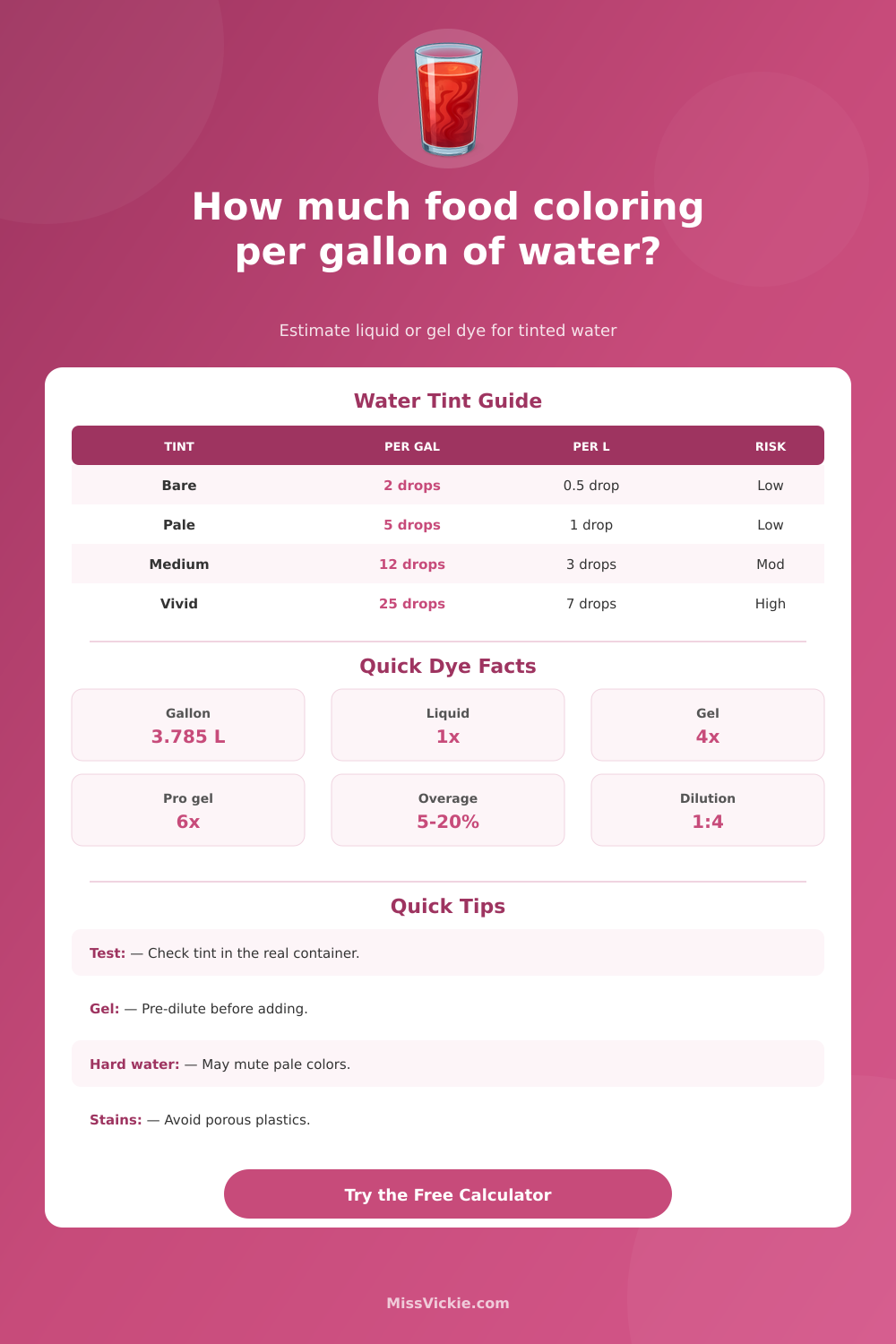
| Target opacity | Liquid drops per gallon | Best event use | Staining caution |
|---|---|---|---|
| Barely visible hint | 2 to 3 drops | Bud vases, clear water with a soft cast | Low, especially in glass |
| Pale transparent tint | 5 to 8 drops | Wedding bowls, table centerpieces, photo water | Low to moderate on plastic |
| Light event color | 8 to 12 drops | Colored water that still looks transparent | Test white linens and lids |
| Medium visible color | 12 to 18 drops | Party displays, sensory bins, deeper vases | Moderate stain risk |
| Vivid display tint | 25 to 35 drops | Stage lighting, dark rooms, holiday colors | High near porous surfaces |
| Very dark water | 45 or more drops | Short display use only | High stain and cleanup risk |
| Food coloring type | Calculator strength | Water mixing note | Best use |
|---|---|---|---|
| Liquid food coloring | 1x, counted in drops | Easy to disperse directly in water | Pale to medium transparent tints |
| Gel paste color | About 4 liquid drops per gel drop | Pre-dilute in a small cup before adding | Vivid color without adding much liquid |
| High-strength gel | About 6 liquid drops per gel drop | Use tiny additions and stir very well | Large event batches and deep colors |
| Airbrush color | Measured in milliliters | Thin and quick to blend into water | Photo props and even light tinting |
| Dry powder color | Measured in grams | Make a slurry to prevent specks | Controlled color in large containers |
| Natural plant color | Weaker, measured in milliliters | Can fade or shift with minerals | Soft colors where flavor scent is acceptable |
| Condition | Calculator effect | Why it matters | Practical check |
|---|---|---|---|
| Filtered or distilled water | Uses about 8% less dye | Clear water shows pale tint cleanly | Best choice for soft pastels |
| Hard water | Adds about 10% dye | Minerals can dull delicate color | Test in a glass before batch mixing |
| Amber or green glass | Changes perceived shade | Container color can warm or muddy water | Judge the tint inside the actual vessel |
| White bucket or liner | Needs more visible color | White backgrounds make pale tint look weaker | Use a small sample against the liner |
| Deep clear bowl | Needs less dye per gallon | More viewing depth makes color look stronger | Stop light, then adjust after filling |
| Backlit display | Needs more dye | Bright lighting washes out transparent color | Check under event lighting |
| Water volume | Pale tint | Medium tint | Vivid tint |
|---|---|---|---|
| 1 quart / 0.95 L | 1 to 2 liquid drops | 3 to 5 liquid drops | 6 to 9 liquid drops |
| 1 gallon / 3.8 L | 5 to 8 liquid drops | 12 to 18 liquid drops | 25 to 35 liquid drops |
| 3 gallons / 11.4 L | 15 to 24 liquid drops | 36 to 54 liquid drops | 75 to 105 liquid drops |
| 5 gallons / 18.9 L | 25 to 40 liquid drops | 60 to 90 liquid drops | 125 to 175 liquid drops |
| 10 gallons / 37.9 L | 50 to 80 liquid drops | 120 to 180 liquid drops | 250 to 350 liquid drops |
| 25 gallons / 94.6 L | 125 to 200 liquid drops | 300 to 450 liquid drops | 625 to 875 liquid drops |
To prepare colored water for decorative use, it is important to ensure that an amount of dye is properly measured, since using the wrong amount will result in colored water that is too pale, too dark, or too likely to stain the surfaces that it comes in contact with. Many peoples attempt to add the amount of dye that they think is appropriate for the desired color, but often the result of this process arent the desired colors. If you calculate the amount of dye that you are to use in creating the colored water, there is several variables that should be considered.
One of the variable that should be considered is the volume of the water that is to be dyed. The volume of the water that is to be dyed will determine the amount of dye that you should add to the water to achieve the desired color. For instance, a shallow tray will result in a more diluted color then deep containers when you add the same amount of dye to each container.
How to Measure and Mix Dye for Colored Water
Additionally, containers with amber glass will display different colors than those with white liners, each of which may impact the color that is visible in the container. Another of the variable that should be considered is the type of dye that is to be used. For instance, liquid coloring tend to dissolve easily in water, while gel paste contains more pigment per drop of dye than most other liquids, so you must pre-dilute it before it is added to the water.
Powder color does not dissolve instantly in water, so a slurry must be created prior to adding it to the water; otherwise, the powder will leave speck in the water. In addition to the type of dye, the hardness of the water is another variable that can impact the color of the water. For example, the mineral in water may mute the color of the dye.
For this reason, pale pastel colors may need to be added to hard water, so that the minerals in the water dont mute the color. The water can be tested in small amounts before you add the dye to the water in its final container. Another of the variable that should be considered is the potential for the colored water to stain porous material.
For example, colored water may stain the grout in tile or unfinished wood. The calculator takes into account the types of materials that will be exposed to the colored water, and adjust the amount of dye that is to be added if the colored water will come in contact with porous materials. This way, the colored water will have an impact on those nearby towels or materials without staining them.
Another variable that should be considered is how the dye is to be mixed. For example, it is important to add the dye in stage so that you dont add too much dye to the water. Half of the dye can be added to the water first.
You can view the color in the container and with the event lighting. If the color is not dark enough, you can add the remainder of the dye to achieve the desired result. It is also important to plan for the potential overage of the colored water.
For instance, colored water may need to be added to a centerpiece if the water evaporates. Additionally, it may be necessary to refill a second display that may not be of the same color as the first display. Five to twenty percent of overage of the colored water will ensure that the colored water remain consistent throughout the event.
By understanding the impact of different types of containers upon the color of the water, the type of dye that can be used, and the other variable described above, it is possible to more quick judge how much dye to add to water to achieve the desired color. However, until such understanding is attained, a calculator will ensure that the first attempted addition of dye to water is succesful.