Icing tint, dry color, thinning, and split-batch math
Food Coloring for Icing Calculator
Estimate how much gel, liquid, or powder food coloring to use for royal icing, buttercream, glaze, cookie icing, and cream cheese icing by batch size, base color, target shade, drying time, and bowl splits.
Choose a decorating scenario, then fine-tune the icing amount, target shade, dry darkening, and split batch settings.
Calculation Breakdown
| Icing Type | Approx Weight | Color Behavior | Thinning Sensitivity |
|---|---|---|---|
| Royal icing, medium consistency | 240 g per cup | Often dries darker, especially reds, blues, and black. | Medium; liquid color can loosen details. |
| Royal icing, flood consistency | 250 g per cup | Dries smoother and slightly darker after crusting. | High; extra liquid changes flow quickly. |
| Buttercream icing | 190 g per cup | Blooms while resting as color disperses through fat. | Medium; gel is safest for deep color. |
| Powdered sugar glaze | 310 g per cup | Can look lighter on baked goods once set thinly. | High; liquid color changes drizzle thickness. |
| Cookie icing | 275 g per cup | Dries with a glossy finish and moderate darkening. | Medium-high; add color before final thinning. |
| Cream cheese icing | 205 g per cup | Ivory base warms colors and mutes cool shades. | Medium; avoid watery deep colors. |
| Whipped icing | 120 g per cup | Light, airy base shows pastels best. | High; liquid can deflate texture. |
Concentrated and low moisture, so it is the best starting point for most royal icing and buttercream colors.
Useful for pale shades, but deep colors can thin royal icing, glaze, and whipped icing faster than expected.
Dry and strong, especially helpful for black, red, navy, and other deep shades where moisture matters.
Can be mixed in lightly, but it behaves more like liquid color and may soften fine piping or flood control.
| Decorating Goal | Gel Starting Point | Rest or Dry Check | Batch Split Advice |
|---|---|---|---|
| Pastel cookie icing or glaze | 0.5 to 1 drop per cup | Check after 2 hours for royal icing. | Split first, then tint tiny bowls carefully. |
| Medium buttercream flowers | 1.5 to 3 drops per cup | Rest 6 hours for color bloom. | Make one master color before dividing bags. |
| Bold royal icing details | 4 to 6 drops per cup | Dry a test dot before flooding cookies. | Keep extra untinted icing for consistency fixes. |
| Deep navy, red, or black accents | 7 to 10 drops per cup | Rest overnight before final adjustment. | Color a smaller detail batch to reduce staining. |
| Base Color | Best For | Adjustment Effect | Watch Point |
|---|---|---|---|
| Bright white icing | Pastels, cool colors, and clean brights | Uses the baseline estimate. | Very white bases can make ivory look flat. |
| Off-white vanilla icing | Pink, peach, yellow, ivory | Adds about 8% for cool shades. | Blue and purple may need correction. |
| Yellow butter base | Warm colors and buttercream | Adds about 18% for cool shades. | Lavender can turn gray without whitening. |
| Cream cheese ivory base | Warm wedding tones | Adds about 14% for vivid shades. | Deep colors may taste stronger. |
| Cocoa-tinted base | Black, burgundy, deep brown | Reduces black color needs. | Not suitable for clean pastels. |
| Already lightly tinted icing | Adjusting leftover icing | Adds uncertainty to the estimate. | Test a spoonful before tinting all. |
The food coloring that will be used for the icing will determine the appearances of the baking project. The amount of food coloring that are used for icing will determine whether or not the color of the icing appears to be correct or incorrect. A person must consider factors like the amount of food coloring for icing that will be added to the icing, the types of icing that will be used, and how the food coloring for icing will interact with the icing as it dries.
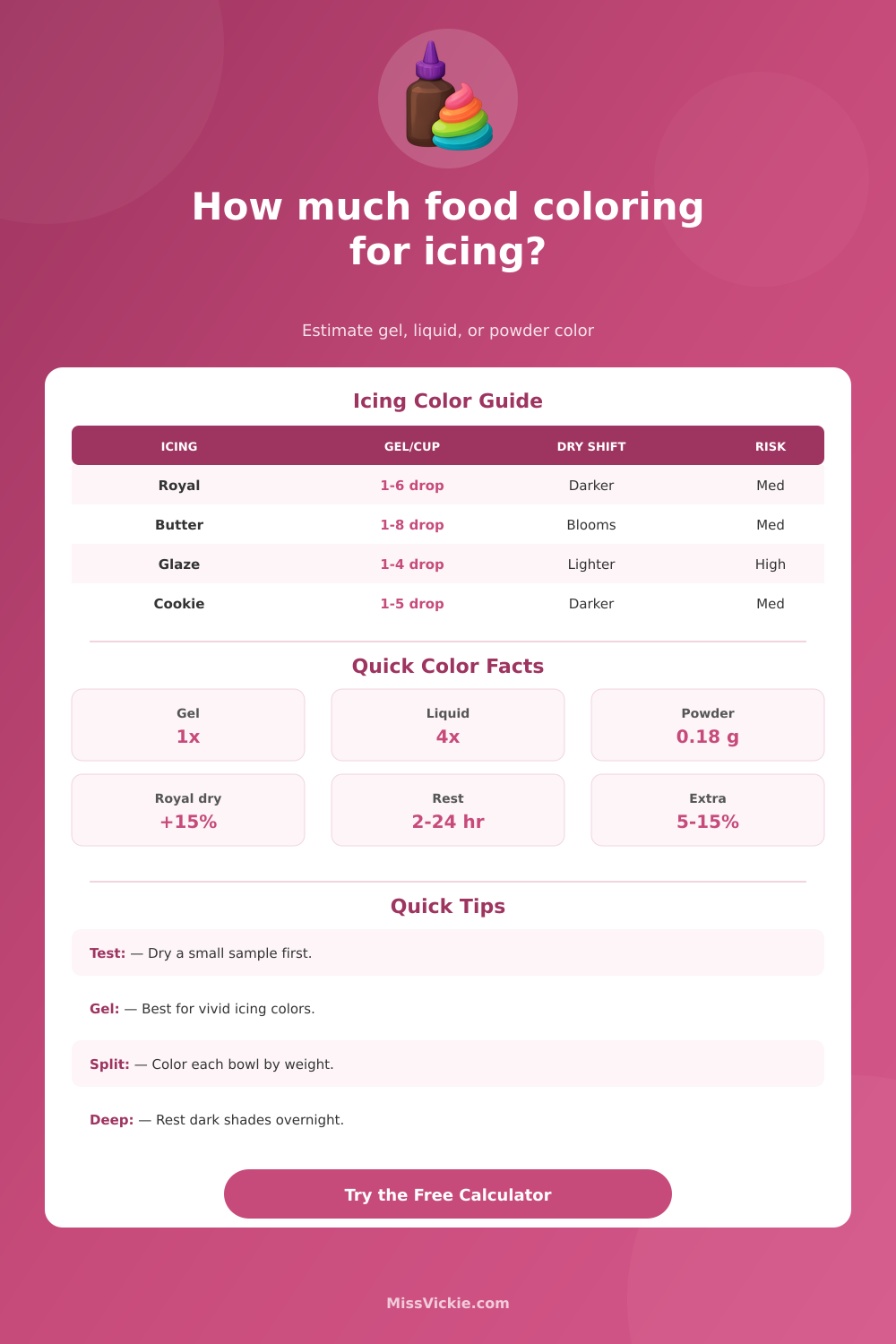
The amount of food coloring for icing that is required will vary depending on the type of icing that will be used. Royal icing, which is mostly sugar and egg white, accept food coloring well, but the royal icing can become darker as it dries. Buttercream icing contains fat that holds the food coloring, so buttercream will often darken over several hours after it is mixed.
How Much Food Coloring to Use for Icing
Glaze and flood icing have a thinner consistency to them, so food coloring for icing with liquid can have an impact upon that icing. Cream cheese icing has a warm color base to it, so more food coloring of cool colors must be added to ensure visibility of those cool colors in the icing. The calculator provide the math necessary for determining the amount of food coloring for icing to be used once the person using the tool selects the icing type, batch size, and desired color.
This calculator will assist the person in avoiding guessing the amount of food coloring for icing to be used for icing bases that is yellow like butter or cream cheese icing. The colorant to be used in the icing also has an impact upon the baking project. The amount of moisture contained in the colorant can impact the icing in various ways.
Gel paste contains a high amount of coloring relative to the amount of liquid in the gel paste. Thus, a small amount of the gel paste will not impact the thickness of icing containing the gel paste. Liquid food coloring contains a small amount of coloring relative to the amount of liquid in the liquid food coloring.
Thus, it is easy for icing that contains this food coloring to thin easy. Powder food coloring is often used in creating deep colors in icing, and the powder does not thin icing if it is added to icing. The tool allows colorants of each of these types to be selected, and each colorant contains a risk of thinning icing.
If icing is selected that has a high risk of thinning due to the food coloring, the amount of liquid within the icing recipe can be reduced, or the person can add the food coloring to the icing prior to the thinning of the icing due to other ingredients. Icing take time to dry, and the depth of shade for icing can interact with the drying time for the icing. Therefore, an individual should realize that the color of icing can change after the icing has dried.
For instance, red and black food coloring can deepen after the icing has dried. Additionally, icing may appear to be a lighter color when the icing has dried compared to when the icing is wet. The calculator includes adjustments for these color shifts.
For instance, if an individual is making royal icing with food coloring, they may need less food coloring if the royal icing will sit for twelve hour before use. An individual might choose to split a batch of icing into multiple colors. In this case, an individual will need to use a scale to measure the icing that the person will tint into multiple bowls to ensure that each portion has the same shade of icing.
An individual can type the number of splits into the calculator, as well as the percentage of icing that will be colored. The calculator will provide the amount of food coloring for icing that should be used for each split to ensure that each portion of icing contain the same color. Although the calculator will provide an individual with the amount of food coloring for icing that is needed to achieve the desired color, this is only a starting point.
An individual should perform a test of the food coloring for icing prior to using the food coloring for icing in their icing batch. If the color appears to be too light after the icing has rested, an individual can add a small amount of food coloring for icing to the batch and allow the icing to rest again prior to using the icing. The goal of this calculator is to allow an individual to have control over the color of their icing without wasting the icing or food coloring for icing.
An individual want enough food coloring for icing to achieve the desired color of icing, but does not want to use so much food coloring for icing that the icing is too thin or the flavor of the icing is too strongly. By accounting for the batch size, icing type, colorant, and drying time, an individual can be sure that the food coloring for icing will produce the desired color of icing.