Red-yellow orange mixing, base correction, acidity, and bloom math
Food Coloring for Orange Calculator
Estimate how much red and yellow food coloring to add for peach, soft orange, pumpkin, tangerine, or deep orange in frosting, icing, batter, glaze, fondant, and candy coating.
Choose a common orange decorating job, then adjust the batch amount, target shade, red-yellow ratio, color type, base correction, rest time, acidity, and overage.
Orange Coloring Breakdown
Use yellow-heavy ratios and stop while the base still looks soft.
Use enough red to warm the yellow without turning the mix coral.
Works best in buttercream and fondant with several mixing passes.
Needs concentrated color, a rest period, and a small touch-up reserve.
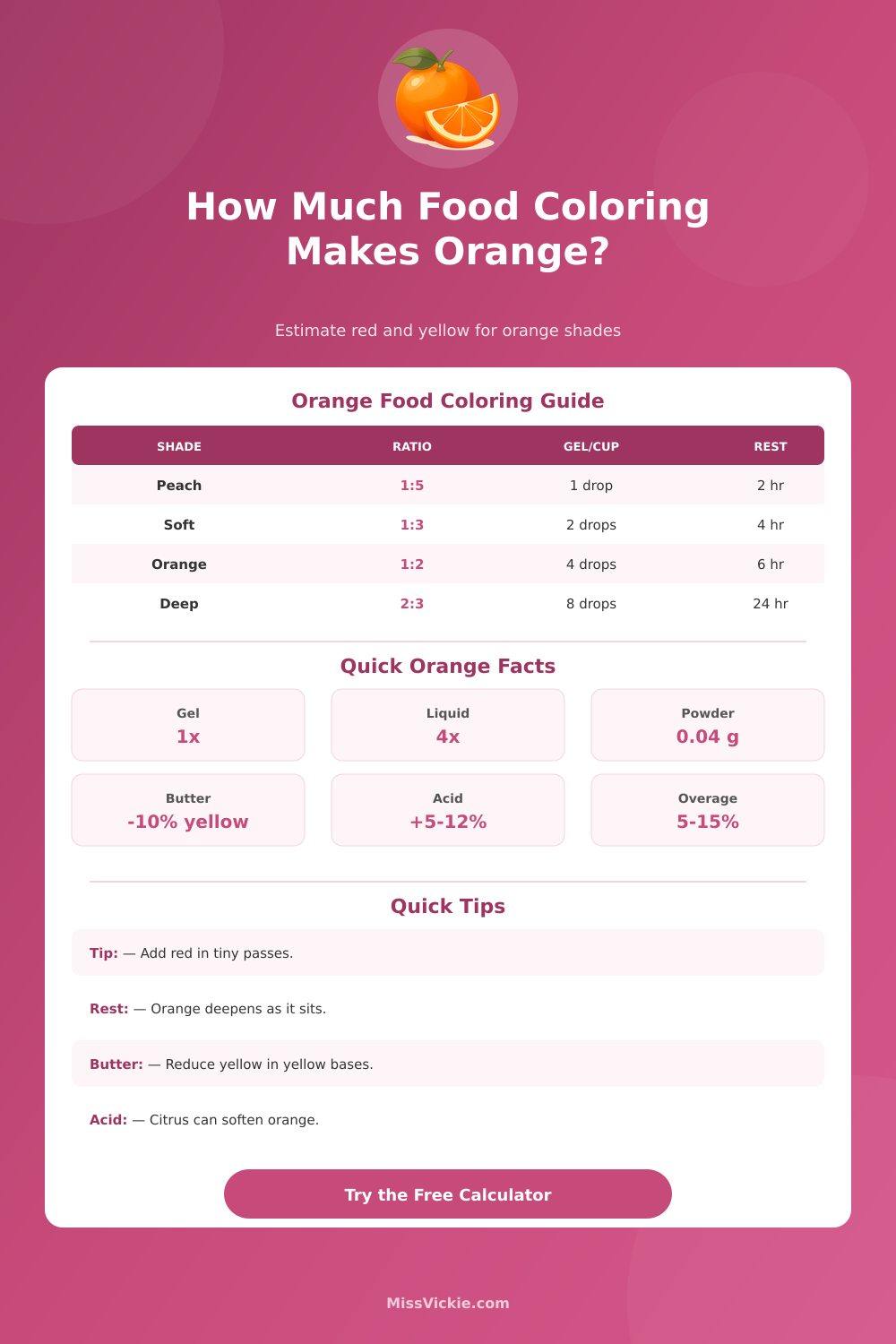
| Target shade | Red-yellow ratio | Gel drops per cup | Best use |
|---|---|---|---|
| Pale peach | 1 part red, 6 parts yellow | 0.5 to 1 drop | Whipped topping, glaze, baby shower cupcakes |
| Peach orange | 1 part red, 5 parts yellow | 1 to 1.5 drops | Buttercream flowers, macarons, light cookie icing |
| Soft orange | 1 part red, 4 parts yellow | 1.5 to 2.5 drops | Sheet cakes, pastel borders, tinted batter |
| True orange | 1 part red, 2 parts yellow | 3 to 5 drops | Classic orange frosting, royal icing, glaze |
| Pumpkin orange | 2 parts red, 3 parts yellow | 5 to 7 drops | Fall cakes, fondant pumpkins, bold piping |
| Deep orange | 3 parts red, 4 parts yellow | 7 to 10 drops | Small accents, deep borders, candy coating |
| Medium | Color behavior | Calculator factor | Mixing note |
|---|---|---|---|
| American buttercream | Opaque and warm from butter | 1.00x | Reduce yellow if the buttercream is already buttery yellow. |
| Swiss meringue buttercream | Absorbs color slowly | 1.10x | Rest before adding more red because orange blooms. |
| Royal icing | Shows color clearly | 0.85x | Drying can darken orange; stop slightly light. |
| Cake batter | Baking softens orange | 1.35x | Use gel or powder and expect a muted baked crumb. |
| Fondant | Kneading spreads pigment slowly | 1.25x | Add color paste in tiny smears, especially red. |
| Whipped topping | Looks pale and airy | 0.72x | Use less color to avoid thinning the topping. |
| Color type | Compared with gel | Best for orange | Caution |
|---|---|---|---|
| Gel paste | 1x | Buttercream, fondant, batter | Best all-purpose choice for bright orange. |
| Liquid drops | 4x drops | Small glaze and pale peach | Can loosen icing when deep orange needs many drops. |
| Dry powder | 0.04 g per gel drop | Macarons and dry mixes | Sift or hydrate to avoid orange specks. |
| Airbrush color | 3x drops | Light frosting tint or surface color | Mixed-in use is weaker than surface spraying. |
| Oil-based color | 1.2x | Candy coating and chocolate | Use oil-based colors for fat-rich coatings. |
| Natural orange color | 5x volume | Peach and soft orange | May fade with heat or high acidity. |
| Condition | Likely orange shift | Correction | Practical fix |
|---|---|---|---|
| Bright white base | Cleanest orange | None | Follow the red-yellow ratio and add color in passes. |
| Yellow butter base | Orange can look too golden | Reduce yellow 8% to 12% | Add red first, then sneak in yellow if needed. |
| Already yellow base | Peach becomes apricot | Reduce yellow 15% | Choose a warmer red-heavy ratio for pumpkin shades. |
| Cream cheese ivory | Orange looks muted | Add 8% more color | Use gel and rest before making final additions. |
| High-acid citrus | May soften or fade | Add 8% to 12% | Judge final color after a short rest. |
| Spiced brown base | Orange turns burnt | Use less total color | Lean yellow only if the shade looks muddy. |
To create the more perfect orange color for your frosting or cake, there are a few variable to consider because the color of orange depends on more than the red and yellow coloring bottle. The color of the final product will depend on the base color of the frosting, the level of acidity in the cake batter, how long the coloring will sit, and the type of coloring you use to create your desired orange color. Using a dedicate calculator will allow you to take all of these variable into account and find the perfect ratio for your coloring to create the perfect orange color.
The base color of your frosting will dramatic affect the amount of each coloring that you need. Buttercream will have a yellow tint due to the butter. Royal icing and whipped topping will be closer to white because they will not have the same yellow tint as buttercream frosting.
How to Make the Right Orange Color for Your Frosting
Because your base color will be yellow, the calculator will reduce the amount of yellow and increase the amount of red coloring need to achieve an orange color that isnt too golden in color. Additionally, if you are using cream cheese or lemon-based frosting, the color will become light. The calculator will adjust for that so you dont have to remember the different color correction that will happen due to these ingredient.
The amount of time that the coloring will sit and the level of acidity will play a role in the frostings final color. Gel coloring will become darker the longer that it sit. Therefore, if you use the calculator, it will automaticly reduce the amount of coloring that you need to account for the sitting time of the coloring.
Additionally, the level of acidity in the baking mix will also play a role in the color. The more acidic your product, the lighter the color. To counter this, the calculator will account for acidity by adding extra coloring to ensure that the final product retain the color you envisioned.
The calculator will not provide an exact recipe. However, it will show you where to start mix the coloring so that you can taste and adjust the color to your desired shade. This will ensure that you do not add too much or too little of the coloring to your product.
The type of coloring will change how you calculate the coloring need to achieve your desired orange color. Powder coloring is four hundredths of a gram per drop of gel coloring. Liquid coloring will be four times more weak than gel coloring by volume.
The calculator will automatically change the measurement from one coloring type to the other for you, so you dont have to do the math twice. The calculator will account for batch overage so that you will not run out of the coloring during the baking process. The reference table will show you the red to yellow coloring ratio and the different medium of coloring.
The calculator will ultimately be more useful to you than the reference tables because the calculator will allow you to experiment with the different variable. For example, you can experiment with the amount of acidity and the color will change. You can also change the type of base color to a white butter base and see the effect on the total number of drop of coloring needed.
Common mistake with frosting coloring include adding all of the coloring at once rather than incrementally, and not considering the base color of the frosting. The red coloring will move the frosting color faster than yellow coloring. If you use too much red coloring, your frosting may go from a peach color to a coral color too quick.
The calculator will help you avoid this mistake by showing you the total amount of coloring as well as the amount of coloring needed per pass. Another common mistake is forgetting that royal icing will become darker when it dry. Therefore, you will have to stop adding color to the icing when it is close to the target color because the royal icing will deepen in color when it dries.
The main benefit of using this calculator will ensure that every batch of frosting that you make will be the same. The variable for each ingredient will remain visible as you create your frosting so that you will not have to remember the different variable of the color. You will decide the final color of the frosting with your eye.
However, the starting color will take into account the type of medium, the depth of color, the type of coloring, and the effect that the ingredient will have on the coloring. Using the calculator will ultimately give you consistency with your frosting coloring, reduce the amount of coloring waste, and allow you to create your frosting faster to decorate your cake as quickly as possible.