Purple food coloring ratio, base correction, rest bloom, and batch split math
Food Coloring for Purple Calculator
Estimate red, blue, and magenta food coloring for lavender, violet, grape, or deep purple in frosting, batter, glaze, fondant, and candy bases.
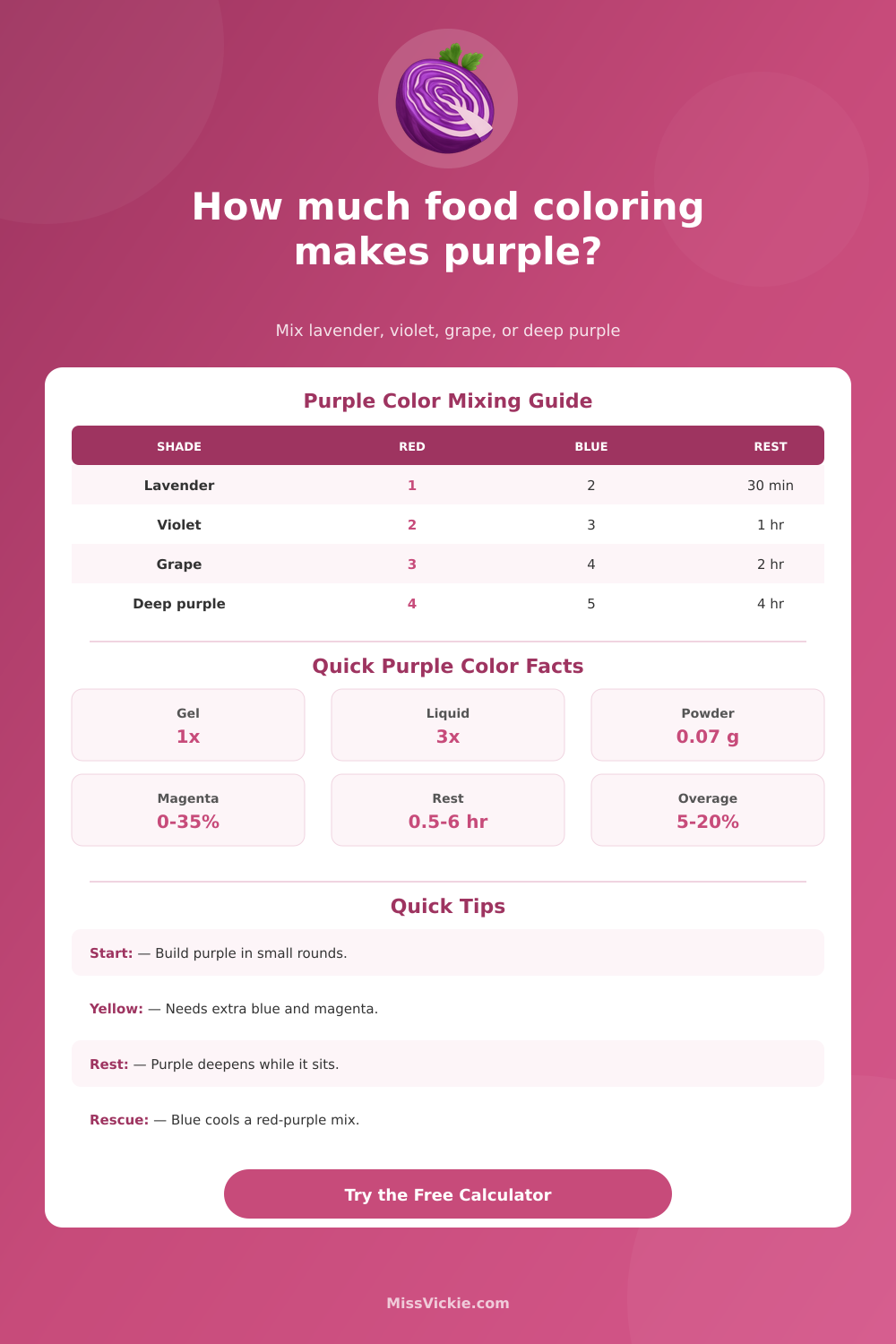
Pick a starting point for common purple coloring jobs, then adjust the base, target shade, colorant strength, rest time, and batch split.
Purple Coloring Breakdown
Food coloring brands vary, so use the calculator as a starting formula and test a spoonful before tinting the full batch.
| Target Shade | Base Gel per Cup | Red Blue Magenta Ratio | Best Mediums | Rest Advice |
|---|---|---|---|---|
| Lavender pastel | 2 to 3 drops | 1 red, 2 blue, tiny magenta | Buttercream, whipped topping | Rest 30 minutes; it darkens gently. |
| Balanced violet | 4 to 5 drops | 2 red, 3 blue, 1 magenta | Frosting, royal icing, fondant | Rest 1 to 2 hours before final correction. |
| Grape purple | 6 to 7 drops | 3 red, 4 blue, 1 magenta | Royal icing, fondant, macaron batter | Rest 2 hours to check blue strength. |
| Deep purple | 9 to 11 drops | 4 red, 5 blue, 2 magenta | Fondant, candy color, firm frosting | Rest 4 hours; add in rounds. |
| Plum purple | 7 to 9 drops | 4 red, 3 blue, 1 magenta | Buttercream, cocoa frosting | Rest 2 hours; cocoa may mute the color. |
| Amethyst purple | 5 to 7 drops | 1 red, 4 blue, 1 magenta | Royal icing, glaze, white chocolate | Rest 1 hour; watch for gray cast. |
| Starting Base | Likely Shift | Correction | Use With Care |
|---|---|---|---|
| Bright white | Clean purple | Use the recipe ratio | Stop early for lavender. |
| Warm vanilla white | Slightly muted | Add 6% more blue | Rest before judging. |
| Yellow butter base | Brownish purple | Add blue plus magenta | Avoid too much liquid color. |
| Cream cheese base | Soft gray violet | Increase magenta | Acid can push pink. |
| Cocoa or beige base | Plum or muddy | Add magenta, reduce red | Deep shades work best. |
| Pink base | Red-purple | Add blue in small rounds | Skip extra red at first. |
| Condition | Color Change | Calculator Adjustment | Kitchen Move |
|---|---|---|---|
| Use immediately | Looks lighter | No bloom credit | Mix close to final shade. |
| 30 to 60 minutes | 5% to 8% darker | Small dye reduction | Good for lavender and violet. |
| 2 to 4 hours | 10% to 16% darker | Medium dye reduction | Best for grape and deep purple. |
| Overnight rest | Up to 20% darker | Strong bloom credit | Stop short, then correct later. |
| Citrus or vinegar | Pink shift | More blue, less red | Add purple after acid is mixed in. |
| Alkaline cocoa | Duller blue cast | More magenta | Use plum or deep targets. |
| Problem | Add This | Avoid This | Check After |
|---|---|---|---|
| Too red or pink | Blue, one drop at a time | More red or acid | 10 minutes |
| Too blue or gray | Red plus a touch of magenta | Black coloring | 10 minutes |
| Too pale | Same ratio, half dose | Random single colors | 20 minutes |
| Too dark | Untinted base | White liquid color first | After blending |
| Muddy from yellow | Magenta and blue | Extra red | 30 minutes |
Purple food coloring can be difficult to make because mixing red and blue food coloring makes purple food coloring, but the two color behave differenty when food coloring is added to fat, sugar, or acid. Purple food coloring may look correctly when mixed together, but can change it’s color after sitting for a period of time or after baking. Therefore, a calculator is used to determine the proper ratio of the food coloring pigments that will create the proper shade of purple.
The calculator considers the type of medium in which the purple food coloring are to be used, the color of that medium, the acidity of the medium, and the amount of time that the purple food coloring is to be set aside after mixing to determine that proper ratio. The type of medium in which purple food coloring is to be used will impact the density of the medium, as well as the ability of the purple food coloring to bind to that medium. For instance, buttercream contains fat that will soften the food coloring pigment that are contained within the purple food coloring.
Make the Right Shade of Purple Food Coloring
Royal icing contains egg whites that will allow the purple food coloring to appear more darker once the royal icing has dried. The color of the medium can also impact the outcome of the purple food coloring. For instance, yellow-based medium like butter or cocoa will cause the purple food coloring to appear muddy or pulled toward brown colors.
To compensate for this pulled color, the purple food coloring calculator will indicate the amount of blue and magenta food coloring to add to the purple food coloring to even out the color of the food coloring. In mediums with acidity, the purple food coloring will shift towards pink. To even out the color, the purple food coloring calculator will suggest the addition of blue food coloring to the mixture.
Another factor to consider in the creation of purple food coloring is the amount of time that the food coloring will be sitting aside after being mixed. Purple food coloring does not remain static after mixing; instead, the color deepen as the dye even out and the moisture of the food coloring evaporates. The food coloring calculator accounts for this deepening shade by adding a bloom credit to the food coloring; this bloom credit prevents the addition of too much purple food coloring to the food products.
If you add too much purple food coloring, the color will be several steps deeper in shade then that which was intended to be created. This calculation is helpful for any recipe that requires the splitting of the batch of purple food coloring into multiple portion for individual food items. If the color of the purple food coloring becomes too red, too blue, or too muddy, there is a chance to rescue the purple food coloring.
Food coloring calculators provides information regarding how much blue, red, magenta, or base food coloring should be added to rescue the food coloring from becoming too of any one color. Furthermore, the calculator will indicate the amount of purple food coloring to be added to each bowl or piping bag for the food items to be prepared. It is also important to know when to stop adding purple food coloring.
Adding too much purple food coloring will alter the taste of the food. Deep shades of purple food coloring may have a bitter taste when too much purple food coloring is added. Pastel shades of purple food coloring may appear gray when too much purple food coloring is added to the food items.
To avoid this issue, it is best to test the purple food coloring in a small spoonful of food product prior to adding the food coloring to the food items. The spoonful of food item should be rested for the amount of time that is indicated in the food coloring recipe, and the amount of purple food coloring can then be scaled to account for the result. Patience is another important ingredient in the creation of purple food coloring.
Food coloring may appear pale when mixed together, but deepens to the proper shade after the food coloring has sat for one or two hour. Food coloring created in a rush often becomes too dark. Because food coloring changes while the food coloring sits, the number provided in the food coloring calculator should of been considered a guide to create the proper amount of purple food coloring.