Edible Glitter to Cover a Cake Calculator
Estimate edible glitter for cake coverage by cake surface area, glitter type, intensity, application method, icing surface, overspray loss, layer count, and stencil area.
Choose a decorating scenario, then adjust the dimensions, stencil coverage, finish intensity, and loss factors for your cake.
Coverage Breakdown
Best for pearl sheen, fondant panels, and soft buttercream sparkle.
Best for chunky accents, drip highlights, and top-only sparkle.
Best for fast misting when overspray is controlled with a box.
Best for stencils, borders, and dense details that need clean edges.
| Glitter Type | Base Yield | Useful Unit | Best Coverage Style |
|---|---|---|---|
| Fine edible luster dust | 90 in² per g | 0.1 g increments | Soft pearl coat over fondant or crusted buttercream. |
| Sparkle dust blend | 75 in² per g | 0.1 g increments | Visible party sparkle without a heavy flake texture. |
| Chunky edible flakes | 55 in² per g | 0.5 g increments | Top accents, drip lines, side bands, and scattered shimmer. |
| Sanding glitter sugar | 42 in² per g | 1 g increments | Crunchy sparkle for tops, borders, and cupcake-style finishes. |
| Pump spray edible glitter | 9 in² per pump | Whole sprays | Large cake misting, fast side coverage, and ombre effects. |
| Airbrush shimmer liquid | 120 in² per ml | 0.5 ml increments | Even full-coat shimmer with the least visible grain. |
| Glitter paint gel | 35 in² per g | 0.5 g increments | Stencil work, lettering, painted rims, and sharp accents. |
| Cake Surface | Coverage Factor | Prep Cue | Glitter Behavior |
|---|---|---|---|
| Fondant, lightly tacky | 0.92x | Brush with clear extract or steam briefly. | Smooth surface gives even shine with less product. |
| Crusted buttercream | 1.05x | Chill, then apply with a dry brush or shaker. | Needs a bit more dust to show through the crust. |
| Fresh buttercream | 1.15x | Apply lightly before the surface fully sets. | Holds glitter well but can grab uneven patches. |
| Ganache or chocolate glaze | 1.08x | Wait until slightly tacky, not wet. | Dark base needs stronger sparkle for visibility. |
| Whipped cream frosting | 1.25x | Use very light coats and keep chilled. | Soft surface absorbs sparkle and marks easily. |
| Mirror glaze | 1.18x | Use mist or airbrush after glaze stops flowing. | Slick surface causes more sliding and overspray. |
| Dry fondant | 1.30x | Add a tacky medium before dusting. | Dry surfaces shed dust unless lightly moistened. |
| Method | Built-In Loss | Good For | Control Note |
|---|---|---|---|
| Dry brush or puff | 8% | Fondant, edges, and small areas. | Tap off the brush before touching the cake. |
| Fine sieve or shaker | 12% | Even top coverage and light sparkle. | Shield the cake board to reuse clean fallout. |
| Pump spray mist | 22% | Sides, ombre effects, and fast all-over shine. | Spray inside a tall box to reduce airborne loss. |
| Airbrush shimmer coat | 18% | Thin liquid shimmer over large surfaces. | Use multiple light passes instead of flooding. |
| Hand-patted flakes | 15% | Chunky flakes, drip edges, and accent bands. | Press with dry fingertips or food-safe tweezers. |
| Painted with clear extract | 10% | Metallic seams, rims, and small dense zones. | Mix a small paste and repaint after drying. |
| Stencil dusting | 20% | Logos, borders, monograms, and lace patterns. | Hold the stencil flat and lift straight upward. |
| Cake Size | Top Area | Sides at 4 in | Full Coat Area |
|---|---|---|---|
| 6 inch round | 28 in² | 75 in² | 104 in² |
| 8 inch round | 50 in² | 101 in² | 151 in² |
| 10 inch round | 79 in² | 126 in² | 204 in² |
| 8 inch square | 64 in² | 128 in² | 192 in² |
| 9 by 13 sheet | 117 in² | 176 in² | 293 in² |
| 12 by 18 sheet | 216 in² | 240 in² | 456 in² |
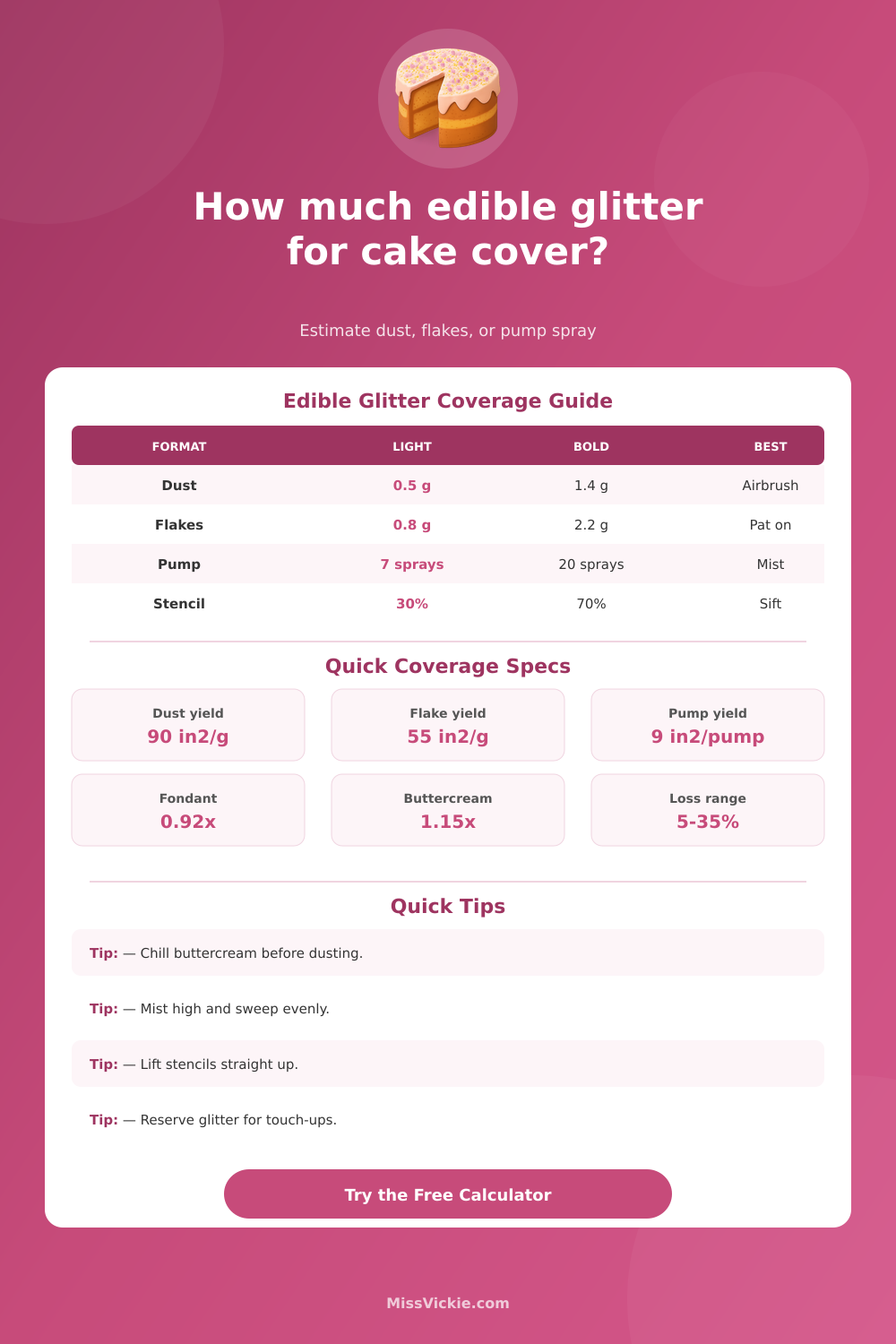
Applying edible glitter to a cake requires the use of a specific amount of edible glitter. The amount of edible glitter that will be needed for a particualr cake design and décor depends upon many different factors. Factors to consider prior to use the edible glitter calculator include the type of cake surface, the method for applying the edible glitter, the intensity of the edible glitter finish that is desired, and the amount of edible glitter that can be lost during the application process.
Failure to consider and account for these different factor may result in either not having enough edible glitter to finish the cake, or in using too much edible glitter for the cake decorations. One of the factor to consider is the type of surface that will be utilized for the cake. Cake surfaces can include fondant, buttercream, and ganache decorations.
How to Know How Much Edible Glitter to Use
Fondant that is still tacky will allow edible glitter to adhere to the cake decorations, but dried fondant will allow for less edible glitter to adhere to the cakes decorations. Buttercream decorations will tend to quickly grab edible glitter, but may create patches of edible glitter if too much are applied to the buttercream. Ganache decorations will allow edible glitter to adhere to the cakes decorations, but you’ll require more edible glitter due to the color of ganache that hides the edible glitter decorations.
The type of cake surface that will be decorate must be selected in the edible glitter calculator in order to obtain an accurate measurement of the amount of edible glitter that will be required. Another of the factors to consider is the method that will be used to apply the edible glitter to the cake decorations. Edible glitter can be applied using a dry brush, a pump spray, or even using stencils.
Using a dry brush to apply edible glitter provides the most control in the amount of edible glitter that is applied to the cake decorations, and results in the lowest loss of edible glitter. Using a pump spray to apply edible glitter allows for larger areas to be covered quick, but loses the most edible glitter to the air and to the cake decorating board. Using stencils to apply edible glitter allows for edible glitter to be applied to only certain portions of the cake, but results in the loss of edible glitter to the stencil decorations.
These different methods of applying edible glitter can be selected in the edible glitter calculator to determine the amount of extra edible glitter that you should of purchase for the cake decoration. Another of the factors to consider is the intensity of the edible glitter. Edible glitter can be applied in a sheer veil to the decorations, which require less edible glitter, or edible glitter can be applied in a bold and opaque fashion to the cake decorations that requires a greater amount of edible glitter.
Additionally, if you apply edible glitter in multiple layers, edible glitter will be required for each layer of edible glitter decorations. An edible glitter calculator will account for this factor in that edible glitter will be calculated for each layer of edible glitter that is to be applied to the cakes decorations. Another of the factors to consider is the percentage of the stencil decorations that are to be utilized, as well as the amount of edible glitter that should be set aside in case of touch-ups of the edible glitter decorations.
In most instances, edible glitter will be applied to only portion of a cake that is decorate using stencils. While the active area of the cake will be less when using stencils, the percentage of edible glitter that will be lost to the stencil will be higher. In addition to the touch-up of edible glitter decorations that may be required after the cake has been assembled, edible glitter may be lost due to the fact that edible glitter decorations may need to be touched up in the final stages of cake decorating.
Setting aside a portion of edible glitter up front will ensure that there is enough edible glitter for the cake decorations. Finally, external factors in the decorating environment may impact edible glitter. Humidity may cause edible glitter to clump together, and the temperature of the décor may impact how edible glitter adhere to buttercream decorations.
Though these factors may be difficult to calculate in advance, knowing the base amount of edible glitter that will be required will allow for the decorations to be design with edible glitter in mind. Overall, the edible glitter calculator will allow for an understanding of the various factor regarding edible glitter and how they may impact the amount of edible glitter that will be used in the decoration of a cake.