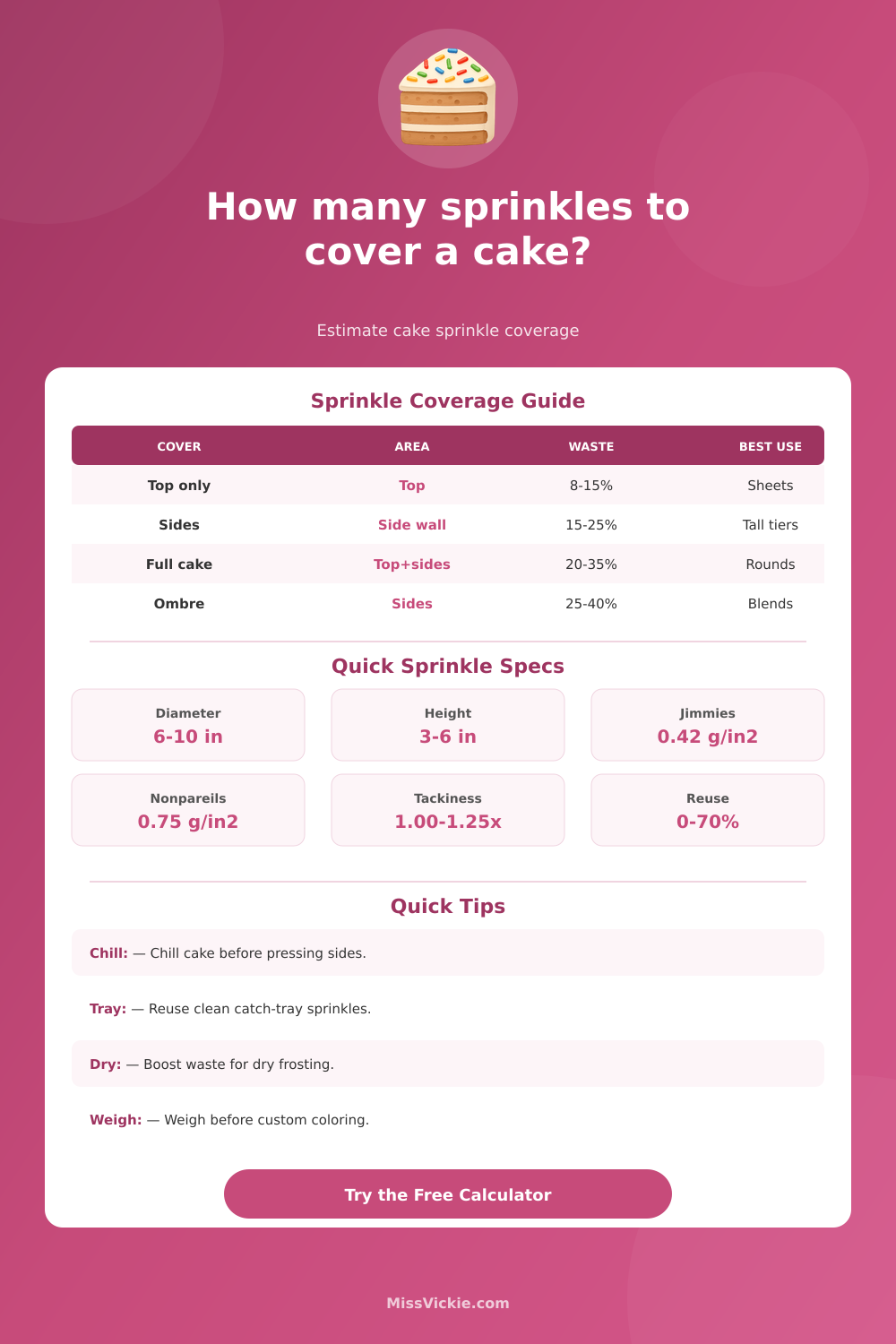
Cake Sprinkle Planning
Sprinkles to Cover a Cake Calculator
Estimate how many sprinkles you need for a top-only, side-only, or full-cover cake using cake geometry, sprinkle density, frosting tackiness, application method, catch-tray reuse, and waste.
🍰Choose a sprinkle cake preset
Start with a common decorating job, then adjust cake size, sprinkle type, frosting tackiness, and recovery settings.
⚖Units
🧁Cake and sprinkle inputs
Sprinkle calculation breakdown
🍭Sprinkle density quick cards
📋Reference tables
| Sprinkle type | Typical cover density | Cup weight estimate | Best cake use |
|---|---|---|---|
| Classic jimmies | 0.42 g per sq in | 145 g per cup | Fast full-cover cakes and kid-party finishes |
| Nonpareils | 0.75 g per sq in | 190 g per cup | Dense texture, top coats, and small cakes |
| Sanding sugar | 0.34 g per sq in | 200 g per cup | Light sparkle on tops, borders, and sheet cakes |
| Confetti quins | 0.28 g per sq in | 105 g per cup | Partial sides, top scatter, and shaped accents |
| Rod sprinkles | 0.52 g per sq in | 130 g per cup | Bold texture when hand-pressed into buttercream |
| Small sugar pearls | 0.90 g per sq in | 215 g per cup | Pearl bands and packed mosaic-style coverage |
| Coverage style | Top multiplier | Side multiplier | Typical use |
|---|---|---|---|
| Top-only cover | 100% of top setting | 0% | Sheet cakes, number cakes, and simple party cakes |
| Side-only cover | 0% | 100% of side setting | Sprinkle walls with a smooth piped or written top |
| Full cover | 100% of top setting | 100% of side setting | Rainbow cakes, smash cakes, and celebration tiers |
| Half-height band | 0% | 50% before side coverage adjustment | Bottom bands, fade effects, and sprinkle borders |
| Top rim or border | 35% before top coverage adjustment | 0% | Rings, crescents, and top-edge sprinkle frames |
| Bottom sprinkle band | 0% | 30% before side coverage adjustment | Lower cake border where frosting is still tacky |
| Frosting or surface | Stick factor | Waste pressure | Decorator note |
|---|---|---|---|
| Fresh soft buttercream | High tack | Lower | Sprinkles grab quickly, so work in sections before crusting. |
| Chilled but tacky buttercream | Balanced tack | Medium | Good for clean sides when the cake is firm enough to handle. |
| Crusted buttercream | Weak tack | Higher | Mist lightly or add a thin fresh frosting layer before pressing. |
| Ganache with tack coat | Moderate tack | Medium | Use a very thin buttercream, syrup, or piping gel tack coat. |
| Fondant brushed with syrup | Patchy tack | Higher | Apply in small zones so syrup does not dry before coverage. |
| Dry crumb coat | Poor tack | Highest | Expect more falloff unless you refresh the surface first. |
| Cake size | Top area | Side area at 4 in tall | Full jimmies estimate |
|---|---|---|---|
| 6 in round | 28 sq in | 75 sq in | About 1.7 oz on cake before loss |
| 8 in round | 50 sq in | 101 sq in | About 2.2 oz on cake before loss |
| 9 in round | 64 sq in | 113 sq in | About 2.6 oz on cake before loss |
| 10 in round | 79 sq in | 126 sq in | About 3.0 oz on cake before loss |
| 8 in square | 64 sq in | 128 sq in | About 2.8 oz on cake before loss |
| 9 x 13 sheet top | 117 sq in | Not used | About 1.7 oz on cake before loss |
🧮Application method comparison
💡Practical sprinkle coverage tips
To calculate the correct amounts of sprinkles for a cake, you must have an understanding of how the surface area of the cake will determine how many sprinkle will be required. A tall round cake will require more sprinkles then a short round cake due to the fact that there is more surface area on the sides of the tall cake. A square cake will require more sprinkles than a round cake of the same width because a square cake will have a larger perimeter than a round cake.
The calculator on this page calculate the amount of sprinkles that will be needed for a cake because it takes into consideration the cake’s shape, the types of sprinkles that will be used, the tackiness of the frosting, and the method in which you will apply the sprinkles to the cake. The type of sprinkles that you use will impact the amount of sprinkles that are required to cover the cake. For instance, jimmies are lighter than nonpareils.
How Many Sprinkles Do You Need
Thus, jimmies will cover more of the cake’s surface area with less weight than nonpareils. Additionally, nonpareils and sugar pearls is denser than jimmies, so more weight of sprinkles in each category will be required to cover the same amount of surface area as jimmies. If the sprinkles that are to be used are a mixed medley of sprinkles, the density of that mixture will be somewhere between the density of jimmies and nonpareils.
These different types of sprinkle densities are accounted for in the sprinkle calculator to ensure that you dont purchase too many or too few sprinkles for you’re cake. The type of frosting that you will use on the cake can impact the amount of sprinkles that will stick to the cake. If the frosting is fresh and soft buttercream, it will be tacky which will help the sprinkles to stick to the cake.
However, if the cake is frosted with a dry crumb coat or if it is coated in frosting that has set and become crusted on the cake’s surface, the sprinkles will not adhere to the cake as well. If many sprinkles will fall off of the cake due to the type of frosting, the calculator will factor in the need for more sprinkles to be prepared prior to decorating the cake. The method in which you apply the sprinkles to the cake will also impact the number of sprinkles that will be required.
For example, sprinkles will naturally fall off of a cake if you pour them over the cake. Thus, hand-pressing the sprinkles onto the sides of the cake will require fewer sprinkles than if you are to pour the sprinkles over the cake. In addition to the factors mentioned above, it is also necessary to account for waste when calculating the amount of sprinkles that will be required for the cake.
It is inevitable that some sprinkles will fall off of the decorator’s bowl, the decorators hands, and the decorating counter. Thus, it is necessary to include a small percentage in excess to the number of sprinkles that are calculated due to the fact that the extra sprinkles can be used to touch up any portion of the cake that may not be covered in sprinkles. Therefore, the sprinkle calculator includes a buffer for the sprinkles that may become wasted in the decorating process.
Furthermore, the calculator also accounts for the possibility of reusing some of the sprinkles after they have been applied to the cake. For example, sprinkles that land on a lined tray may be rinsed and reused. However, sprinkles that become mixed with the crumbs and frosting of the cake should not be reused to avoid the spread of food-borne illness.
The coverage style of the cake will also impact the number of sprinkles that are required. For instance, a cake that only has sprinkles on its top will require fewer sprinkles than a cake that has sprinkles on both the top and sides of the cake. Similarly, a cake that only has a border of sprinkles on the bottom of the cake will require fewer sprinkles than a cake that has side coverage with sprinkles.
These percentages can be adjusted in the calculator to account for the coverage style of the cake that is to be decorated with sprinkles. Using this sprinkles calculator allow for the decorator to move away from guesswork in determining the amount of sprinkles that will be required for the cake. All that is necessary is for the decorator to enter the information regarding the type of cake, the type of sprinkles, and the desired coverage style for the cake.
The calculator will provide a number to the decorator indicating the amount of sprinkles that will be required to cover the cake, account for waste, and allow for touch-ups during the decoration process. Once the decorator obtains this number, the decorator will know for certain the amount of sprinkles that should of be prepare before decorating the cake.