Cake Ganache Planning
Ganache for Cake Calculator
Estimate ganache by cake size, chocolate type, cream ratio, coating thickness, filling depth, drip style, set temperature, overage, and usable yield.
1.Choose a cake preset
Each preset loads a real ganache scenario, then you can adjust every field.
2.Units and ganache style
3.Cake and ganache inputs
Ganache Breakdown
4.Quick ganache reference
5.Chocolate ratio table
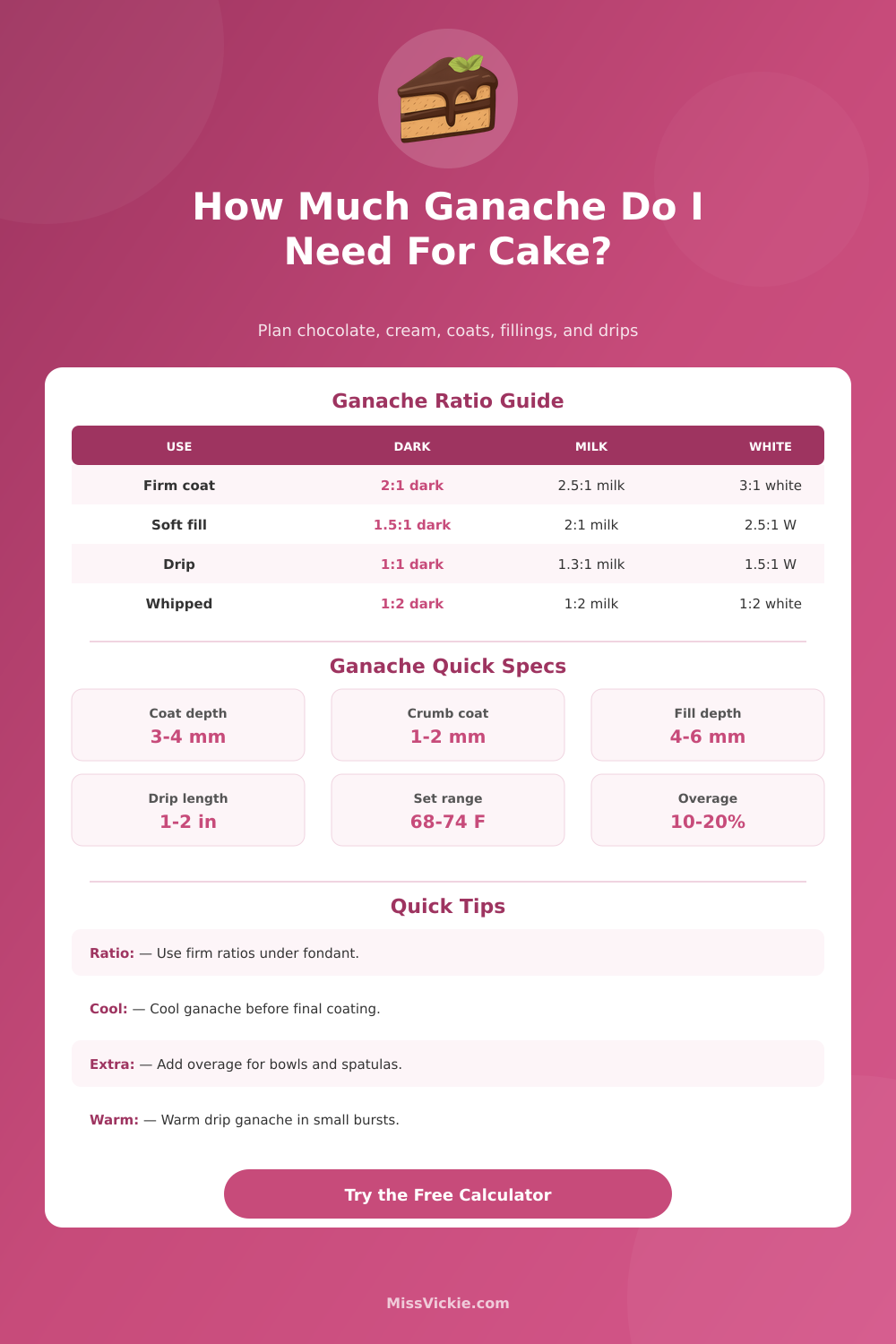
| Ganache use | Dark chocolate | Milk chocolate | White chocolate |
|---|---|---|---|
| Firm coat under fondant | 2:1 chocolate to cream | 2.5:1 chocolate to cream | 3:1 chocolate to cream |
| Soft filling | 1.5:1 chocolate to cream | 2:1 chocolate to cream | 2.5:1 chocolate to cream |
| Drip or pour glaze | 1:1 chocolate to cream | 1.3:1 chocolate to cream | 1.5:1 chocolate to cream |
| Whipped ganache | 1:2 chocolate to cream | 1:2 chocolate to cream | 1:2 chocolate to cream |
6.Cake size starting points
| Cake size | Smooth coat | Fill and coat | Drip add-on |
|---|---|---|---|
| 6 in round, 4 in tall | 12 to 15 oz | 18 to 22 oz | 3 to 4 oz |
| 8 in round, 4 in tall | 20 to 26 oz | 30 to 38 oz | 4 to 6 oz |
| 10 in round, 4 in tall | 32 to 40 oz | 48 to 58 oz | 6 to 8 oz |
| 9 x 13 in sheet, 2 in tall | 30 to 38 oz | 40 to 50 oz | 8 to 10 oz |
7.Thickness and use guide
| Use | Typical thickness | Texture target | Best check |
|---|---|---|---|
| Crumb coat | 1 to 2 mm | Thin and tacky | Chill until set |
| Final coat | 3 to 4 mm | Smooth and firm | Scraper edge |
| Layer filling | 4 to 6 mm | Sliceable | Dam if soft |
| Drip | 1 to 2 in drop | Slow ribbon | Test on cup |
8.Temperature reference
| Temperature | Ganache behavior | Useful for | Watch for |
|---|---|---|---|
| 60 to 65 F | Firm and slow | Sharp edges | Dragging |
| 68 to 72 F | Spreadable | Coating cakes | Quick setting |
| 75 to 82 F | Loose ribbon | Drips and glaze | Runaway drips |
| 85 F plus | Thin and glossy | Pouring only | Separation |
9.Ganache comparison grid
10.Practical ganache tips
Ganache is a mixture of chocolate and cream that can be used for cake decorating. Ganache can be used as a coating or as a filling within a cake. Ganache can be used to hide crumbs on a cake.
Ganache can be used to create a glossy finish on the side of a cake. You must use the correct amount of ganache for the cake you are decorating so that you dont run out of ganache before you finish the cake. The calculator included in this article will calculate for you the amount of ganache you need by asking you about the dimensions of the cake and the type of chocolate you will use.
How Much Ganache Do You Need?
Using the calculator account for the ganache that will remain on the bowl and bench scraper. Many people attempts to calculate the amount of ganache they will need by measuring the surface areas of the cake. However, measuring the area of the cake isnt enough to calculate the amount of ganache needed.
The ratio of the chocolate to the cream will determine the firmness of the ganache. If you use dark chocolate, the ganache will be firmer then if you use milk or white chocolate. The calculator will adjust for these difference in chocolate to provide an amount of ganache that will have the proper firmness for your specific cake.
Another factor to consider when making ganache is the thickness. If you use the ganache as a crumb-coat, it will need to be thinner then if it is to be used as a final coat on a cake. If the ganache is to be used as a filling, it will need to be firm so that it does not squeeze out of the cake when people cuts into it.
However, drip ganache will need to be more softer and warmed so that it will drip down the side of the cake. Each of these use requires a different amount of ganache. Therefore, you will need to take into consideration the number of layers that your cake will have.
Another thing to consider is overage and yield. Overage refers to the amount of ganache that will remain on the spatula, bowl, and bench scraper. You need to account for this so that you have an adequet amount of ganache to complete your cake.
However, the yield will take into account the amount of ganache that will actualy go on the cake. You should calculate both overage and yield so that you can avoid the issue of running out of ganache while you are decorating your cake. The temperature at which the ganache will set will also affect how much ganache you will need to use.
Ganache will set between 68 and 72 degree. If the room in which you are preparing the ganache is warm, the ganache will be softer. However, if the room is cool, the ganache will be thicker.
The calculator allows you to input the temperature of the room that you will be using for your ganache so that the recipe will account for the setting of the ganache. Before you begin to melt your chocolate, you should of run the numbers in the ganache calculator. You can use the calculator to determine the amount of ganache needed if you will be adding more layer to your cake.
Alternatively, you can use the calculator to determine the amount of ganache needed if you are changing the type of chocolate that you are using. Because changing the type of chocolate will change the weight of the chocolate and the volume of the cream that you need, you will find it difficult to do this in your head. However, the ganache calculator will ensure that you have the correct amount of each ingredient.
Measure your cake and decide what type of finish you would like on your cake before you begin decorating. Once you have the dimension of the cake and the type of finish, use the ganache calculator to determine the amount of chocolate and cream that you need to use on your cake. Using the calculator will remove the stress of having an insufficient amount of ganache for decorating your cake.
Additionally, the calculator will ensure that you have the correct amount of each ingredient to make ganache for your cake.