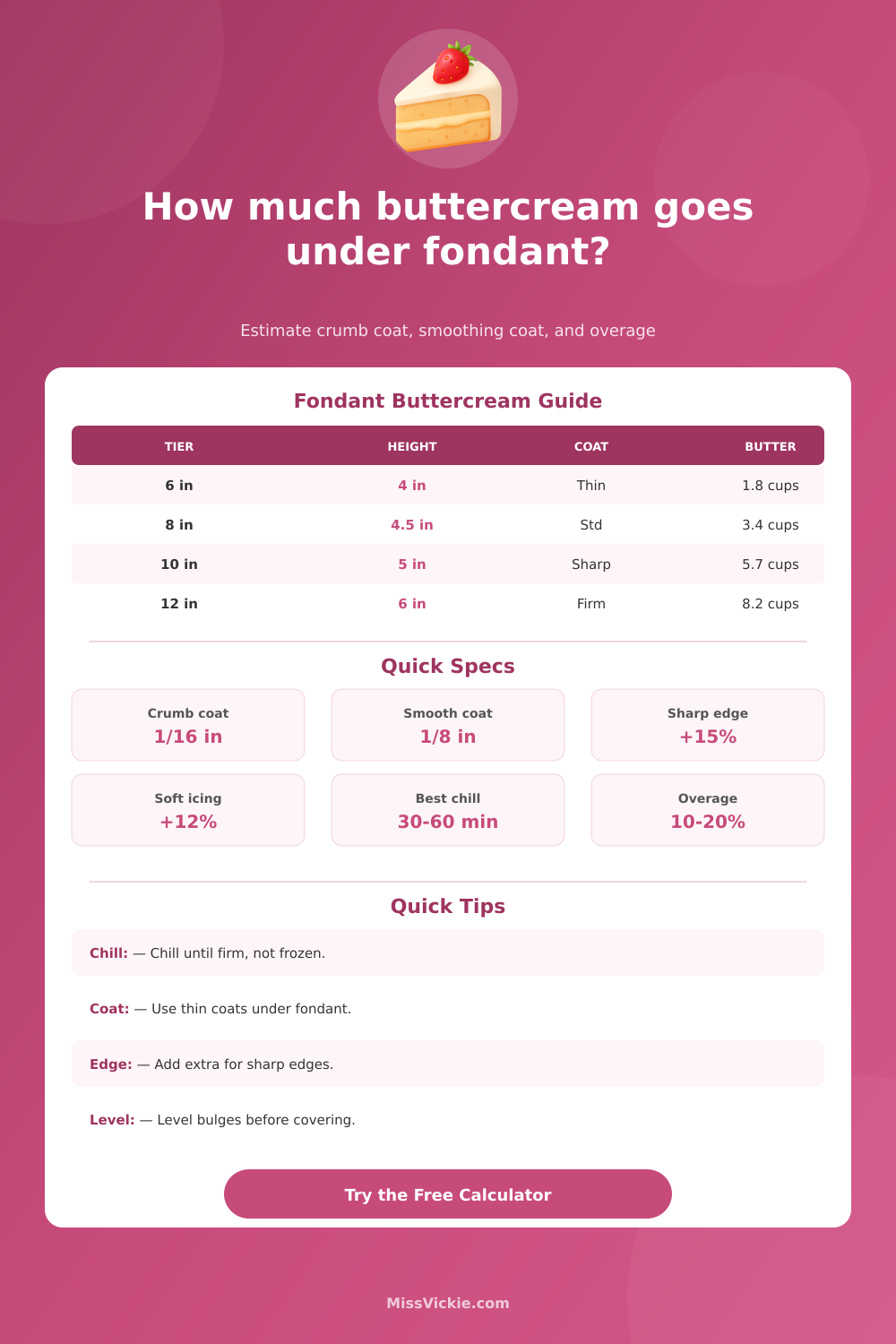
Fondant base coat planning
Buttercream Under Fondant Calculator
Estimate the buttercream needed for a crumb coat and smoothing coat before fondant, with adjustments for cake diameter, height, layers, grip style, chill time, frosting firmness, and overage.
Choose a common fondant cake setup, then fine tune the coat thickness and handling settings for your kitchen.
Fondant Base Breakdown
| Coat Purpose | Typical Thickness | Use Under Fondant | Texture Goal |
|---|---|---|---|
| Seal crumb coat | 0.04 to 0.06 in | Lock crumbs, fill pinholes | Barely opaque |
| Standard smoothing coat | 0.10 to 0.13 in | Give fondant a level grip | Scraper smooth |
| Sharp edge build | 0.14 to 0.18 in | Create a crisp top shoulder | Firm and square |
| Carved cake correction | 0.16 to 0.22 in | Bridge uneven surfaces | No dips showing |
| Round Tier Size | 4 Inch Height | 5 Inch Height | 6 Inch Height |
|---|---|---|---|
| 6 inch diameter | 1.8 to 2.2 cups | 2.1 to 2.6 cups | 2.5 to 3.0 cups |
| 8 inch diameter | 3.0 to 3.7 cups | 3.6 to 4.4 cups | 4.2 to 5.1 cups |
| 10 inch diameter | 4.8 to 5.8 cups | 5.5 to 6.7 cups | 6.3 to 7.7 cups |
| 12 inch diameter | 6.8 to 8.2 cups | 7.8 to 9.5 cups | 8.9 to 10.9 cups |
| Grip Style | Best For | Buttercream Change | Fondant Handling Note |
|---|---|---|---|
| Thin seal only | Practice cakes and thick fondant | Use about 10% less | Less cushion for flaws |
| Standard smooth grip | Most birthday and event cakes | Baseline amount | Reliable, even adhesion |
| Slightly tacky grip | Dry fondant or cool rooms | Add about 8% | Cover before surface dries |
| Sharp edge build | Wedding tiers and clean tops | Add about 15% | Chill firm before covering |
| Chill and Firmness | What It Means | Calculator Effect | Kitchen Cue |
|---|---|---|---|
| Under 20 minutes | Base may still smear | Adds rework allowance | Finger leaves a mark |
| 30 to 60 minutes | Ideal fondant timing | Baseline estimate | Firm but not icy |
| Soft buttercream | Warmer or looser icing | Adds scraper loss | Needs gentle pressure |
| Firm crusting base | Stable, chilled, smooth | Reduces excess | Sharp scraper lines hold |
Best when the cake is already flat and the fondant is forgiving.
Good everyday choice for clean sides, tidy corners, and steady adhesion.
Useful when fondant is dry or the cake surface has chilled a little too firm.
Uses extra buttercream to build the top shoulder before fondant smoothing.
The amount of buttercream that is applied to a cake will determine the way that the fondant will appear once the decorator applies the fondant to a cake. The amount of buttercream that is applied to a cake will also determine whether the fondant will slide or wrinkle. If there is too little buttercream applied to the cake, the fondant will either slide off of the cake or it will wrinkle.
If there is too much buttercream applied to the cake, the buttercream will prevent fondant from properly adhere to the cake because the buttercream will create a soft cushion beneath the fondant. Thus, it is necessary to decide the thickness of each coat of buttercream, the way that the cake will behave when chilled, and how much extra buttercream to mix in order to avoid running out of buttercream during the decorating process. The amount of buttercream required to cover a cake will depend upon the dimension of the cake.
How Much Buttercream to Use Under Fondant
Not only will the diameter and the height of the cake determine the amount of buttercream required to cover the cake, but the number of layers of the cake will affect the amount of buttercream applied to the cake. The more seams between the layers of the cake, the more buttercream will be required for smoothing the cake. If the sides of the cake are crumbly or if the cake has bulges in the filling, more buttercream will be required to level the cake.
Additionally, a cake that has been trimmed to create a straight appearance will require less buttercream than a cake that dont have straight sides. Fondant will hide the color of the cake but will not hide the shape of the cake. Thus, fondant will reveal any dip in the cake or bulges in the buttercream.
The thickness of the buttercream coats will be an important factor in the buttercream needed for a cake. Many cake decorators do not correctly estimate the thickness of the buttercream that should be applied to a cake. Thin coats of buttercream will be applied to seal the crumb of the cake and to fill in pinholes that might form in the cake.
Additionally, a thin crumb coat will not add much bulk to the cake. However, the smoothing coat of buttercream will need to be thick enough to allow the fondant to have an even grip upon the cake, yet thin enough that it does not squeeze out of the fondant when the fondant is applied to the cake. More buttercream will be required to build up the top shoulder of the cake in order to create a sharp edge.
Additionally, if any additional tacky grip to the cake are required, more buttercream will be required. Another factor to consider is the firmness of the buttercream and the time that the buttercream will be chilled. If the buttercream is too soft, the fondant will drag across the buttercream.
If it is too firm, the fondant will have difficulty in adhering to the buttercream. Soft buttercream will require more time to chill or more buttercream will be required for coverage of the cake. Firmer buttercream will require less buttercream than soft buttercream because less buttercream will be lost during the decorating process.
It is always a good idea to prepare more buttercream than is calculated to be the exact amount that will be required. Some buttercream will be lost to the buttercream scraper. Some buttercream will be lost when trimming the sides of the cake.
Additionally, some buttercream will be lost when making small repairs to the cake. Many decorators will prepare ten to twenty percent more buttercream than is mathematically required. However, if the cake is to be carved or if the buttercream is soft like American buttercream, even more buttercream than twenty percent will be required.
This calculator will allow the decorator to enter the dimensions of the cake. Additionally, the decorator will also be able to select the type of grip that will be utilized for the fondant, the chill time for the buttercream, and the condition of the cake’s surface. Based off these selections, the calculator can adjust the amount of buttercream that will be applied to the cake for each of these factor.
Thus, separate amounts of buttercream will be shown for the crumb and smoothing coats. By utilizing this buttercream calculator, the decorator can consider the type of cake that is to be made and the amount of buttercream that will be required. A double barrel cake that is supposed to have sharp edges and soft icing will require more buttercream than a round cake that has medium firmness buttercream.
Additionally, the decorator will become more aware of how each factor will impact the other, which will aid the decorator when scaling the recipe or when considering whether or not an extra half-batch of buttercream will be needed. The intention of the buttercream calculator is to find a range of buttercream that is sufficient for the cake. It is important to have enough buttercream for the decorator to cleanly apply the fondant to the cake.
However, it is also important to ensure that there is not an excessive amount of buttercream that will be left over after the decorating process. Once the crumb and smoothing coats of buttercream have set, the decorator will apply the fondant to the cake. The calculator will allow the decorator to remove the guesswork from the decorating process.
Thus, the decorator will be able to decide when to take the cake out of the fridge and to apply the fondant to the cake before it dry.