Buttercream whitening, slurry, rest, and split math
Titanium Dioxide in Buttercream Calculator
Estimate edible titanium dioxide powder for buttercream by frosting weight, butter tint, target whiteness, powder strength, mixing liquid, rest time, overage, and batch splits.
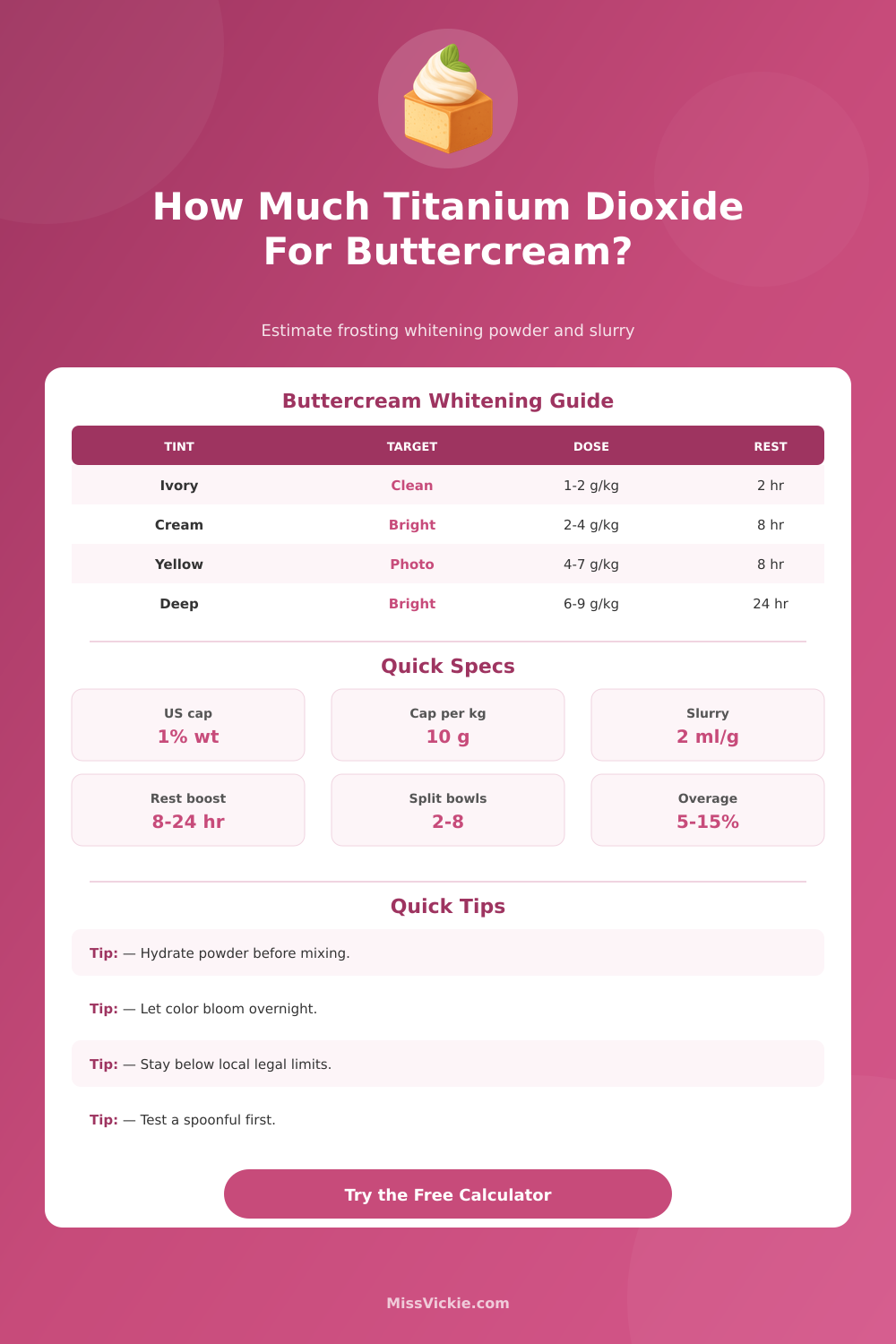
Use food-grade titanium dioxide only. The calculator estimates a practical starting dose and checks it against the U.S. color-additive cap of 1% titanium dioxide by weight of finished food.
Light Powder
1.25x
Needs a little more powder to mute yellow butter tones. Best for gentle ivory correction.
Standard Powder
1.00x
Good default for American buttercream, meringue buttercream, and small bakery batches.
High Opacity
0.78x
Stronger whitening, so the same visual target usually needs a smaller gram dose.
White Gel
1.60x
Paste and gel are diluted, so use label strength and treat this as a starting estimate.
| Buttercream Style | Typical Tint | Dose Behavior | Mixing Note |
|---|---|---|---|
| American Buttercream | Ivory to yellow | Moderate dose | Beat slurry into a small portion, then combine with the full batch. |
| Swiss Meringue Buttercream | Pale cream | Lower dose | Rest helps the color settle without overbeating the emulsion. |
| French Buttercream | Warm yellow | Higher dose | Egg yolks need more opacity; test a spoonful before adding all powder. |
| Cream Cheese Buttercream | Off-white | Moderate-high dose | Use minimal liquid because soft frosting loosens quickly. |
| White Chocolate Ganache Buttercream | Warm cream | Higher dose | Hydrate well so powder does not streak against cocoa butter. |
| Vegan Buttercream | Varies by fat | Variable dose | Plant fats can gray slightly, so start lower and rest before adding more. |
| Current Tint | Clean White | Bright White | Photo White |
|---|---|---|---|
| Almost white | 0.8-1.5 g/kg | 1.3-2.2 g/kg | 2.0-3.0 g/kg |
| Ivory | 1.2-2.4 g/kg | 2.0-3.5 g/kg | 3.0-4.8 g/kg |
| Cream | 2.0-3.6 g/kg | 3.0-5.2 g/kg | 4.4-6.8 g/kg |
| Yellow butter | 3.0-5.0 g/kg | 4.6-7.0 g/kg | 6.0-9.0 g/kg |
| Deep yellow butter | 4.5-7.0 g/kg | 6.5-9.0 g/kg | Use caution |
| Mixing Liquid | Liquid Ratio | Best Use | Caution |
|---|---|---|---|
| Vodka or clear alcohol | 2 ml per g | Fast dispersion | Let aroma evaporate before final tasting. |
| Clear vanilla extract | 1.8 ml per g | Vanilla buttercream | Can add sweetness and flavor. |
| Lemon juice | 1.6 ml per g | Small batches | Acid can sharpen flavor and loosen frosting. |
| Heavy cream | 2.5 ml per g | Soft American buttercream | Add slowly to avoid thinning the batch. |
| Warm water | 2.2 ml per g | Alcohol-free slurry | May leave more visible specks if rushed. |
| Dry blend small portion | 0 ml per g | Firm frosting | Sift first and mix longer to prevent streaks. |
| Frosting Weight | 1% Cap | Common Working Range | Batch Note |
|---|---|---|---|
| 1 lb / 454 g | 4.5 g | 0.5-3.5 g | Useful for a small test batch. |
| 2 lb / 907 g | 9.1 g | 1.0-6.5 g | Enough for a 6 inch cake or cupcakes. |
| 5 lb / 2.27 kg | 22.7 g | 3.0-16 g | Split into bowls for even mixing. |
| 10 lb / 4.54 kg | 45.4 g | 6.0-32 g | Make a master slurry before dividing. |
| 25 lb / 11.34 kg | 113 g | 15-80 g | Weigh powder; do not use spoon estimates. |
Titanium dioxide is a white powder that can be added to frosting to change the colors of the frosting. In frosting that contains yellow tones from butter or yellow tones from egg yolks, adding titanium dioxide is necessary to ensure that the cake appear correct with the design requirements. By using titanium dioxide, you can change the color of the frosting to a neutral white.
To determine the amounts of titanium dioxide to add to frosting, several parameter of the frosting must be entered into the calculator. Parameters include the weight of the frosting and the style of buttercream that will be used, the tint of the frosting, and the target whiteness of the frosting and the strength of the titanium dioxide powder that will be used. The strength and whiteness of the frosting will affect the amount of titanium dioxide that are needed for the frosting to reach the target whiteness.
How to Use Titanium Dioxide to Make Frosting White
For example, a Swiss meringue buttercream is generally more paler than a French buttercream. In this case, less titanium dioxide would be needed in the Swiss meringue buttercream than in a French buttercream. Another example would be the difference in strength between high opacity titanium dioxide powder compared to light grade titanium dioxide powder.
More titanium dioxide powder of the high opacity would be needed compared to the light grade powder. Beyond the parameters required for the calculator to provide the correct amount of titanium dioxide powder to add to the frosting, there are additional factors related to mixing that will affect the color of the resulting frosting. Creating a slurry with vodka will allow the vodka to easily disperse into the frosting and subsequently evaporate.
Heavy cream, on the other hand, will add body to the frosting but may thin the frosting if added in excessive amount. Additionally, allowing the frosting to rest after adding titanium dioxide will allow for the titanium dioxide to fully hydrate and bloom to show it’s true color. Often, resting the frosting will reduce the amount of titanium dioxide need.
These factors are accounted for in the calculator so that the amount of titanium dioxide indicated will not be exceeded when first mixing the frosting together. The batch size of frosting that will be prepared and the division of frosting into multiple bowls will impact the use of titanium dioxide powder. If dividing a batch of frosting into several bowls, the titanium dioxide must be distributed evenly among each bowl.
The calculator ensures that each bowl will receive the same amount of titanium dioxide. An overage of titanium dioxide is included in the amount calculated for each batch to account for lost frosting when scraping bowl or moving frosting between containers. Finally, regulations regarding the amount of titanium dioxide that can be contained within food products varies by region.
In the United States, for example, the weight of titanium dioxide in food cannot exceed one percent of the total weight of the food. The calculator will alert cooks of the results if the calculated amount of titanium dioxide reach the one percent limit. Different regions have different regulations about titanium dioxide in food, therefore, it is essential to be aware of and to check the regulations in the specific region where the frosting will be prepared.
Common mistakes when adding titanium dioxide to frosting include adding the titanium dioxide as a dry powder to the frosting. Titanium dioxide powder in a dry state often leaves white speck in the frosting. Another common mistake is to skip the resting period of the frosting.
If titanium dioxide is added to frosting but the frosting is not allowed to rest, the frosting may appear whiter than it should of be when viewed after resting. If this is done, frosting may end up being over whitened. Therefore, it is important to test a small spoonful of the frosting before adding the full calculated amount of titanium dioxide.
By using the formula and calculator described in this article, it is possible to prepare frosting with the appropriate amount of titanium dioxide powder to achieve the necessary whiteness to the frosting. If the base frosting is pale, less titanium dioxide is needed than if the butter contains alot of yellow color or if the recipe contains a lot of egg yolks. The amount of titanium dioxide indicated will be proportional to the amount of yellow color in the frosting.
By using the calculator or other method to calculate the amount of titanium dioxide to add to frosting, it is possible to ensure the frosting reach the appropriate and correct shade of white.