How Much Butter for Buttercream Frosting?
Estimate the butter, sugar, finished frosting yield, and coverage needed for cakes, cupcakes, filling layers, borders, piping swirls, and warm-kitchen adjustments.
Choose a common frosting job, then fine-tune the buttercream style, sugar ratio, filling amount, piping detail, and room temperature.
Buttercream Breakdown
| Buttercream | Butter Share | Sugar Ratio | Yield Note |
|---|---|---|---|
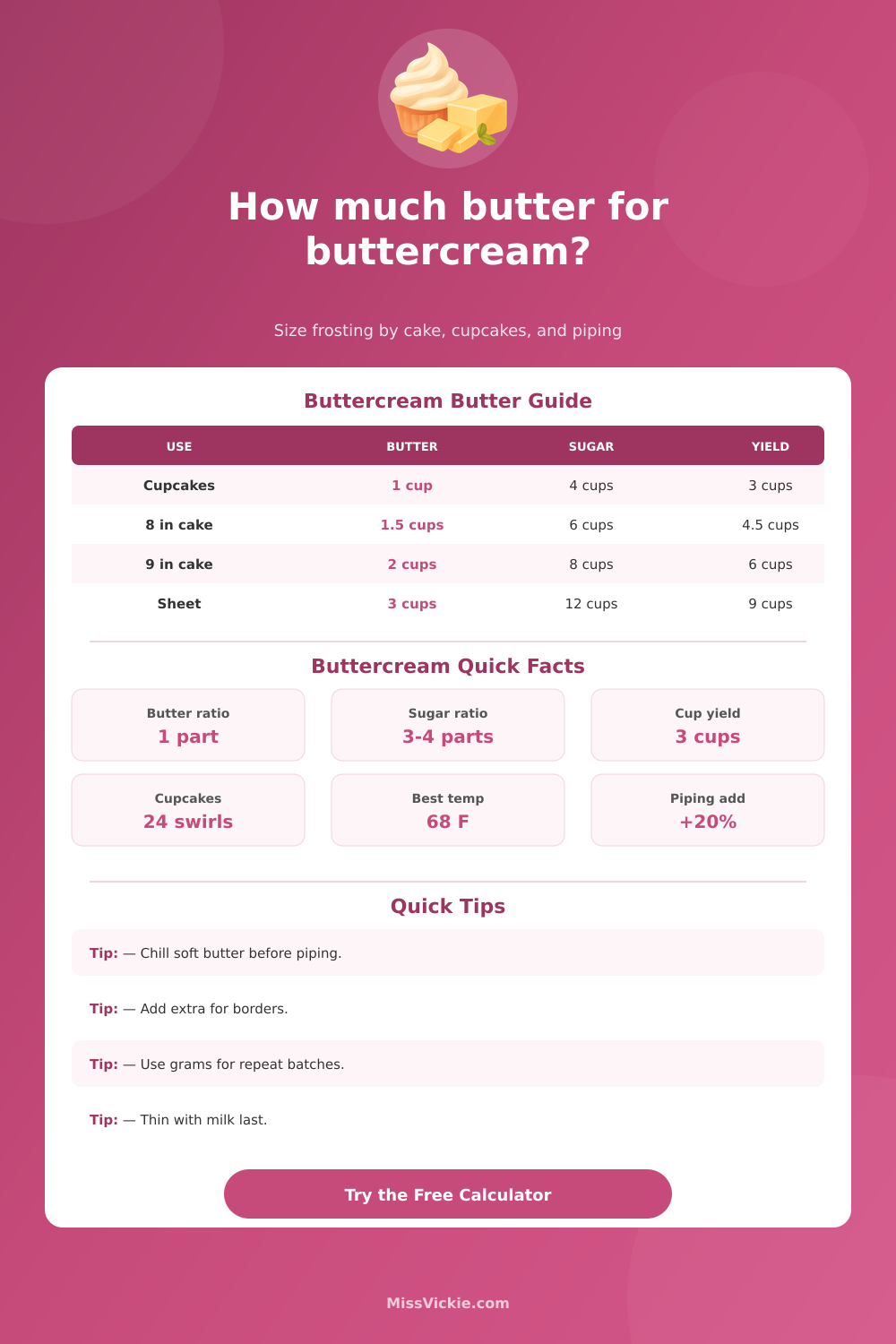
| American buttercream | High | 1:3.5 to 1:4 | 1 cup butter makes about 3 cups frosting. |
| Less-sweet American | High | 1:3 | Softer texture; add less liquid before judging consistency. |
| Swiss meringue buttercream | Very high | 1:1.2 to 1:1.5 | Denser and silkier; butter weight is the main driver. |
| Italian meringue buttercream | Very high | 1:1.1 to 1:1.4 | Stable for piping when mixed at room temperature. |
| French buttercream | Very high | 1:1 to 1:1.3 | Rich, egg-yolk base; excellent for filling. |
| German buttercream | Medium | 1:0.6 to 1:0.9 | Pastry cream lightens the batch and lowers sugar volume. |
| Cream cheese buttercream | Medium | 1:3 to 1:3.5 | Chill before detailed borders or warm-room service. |
| Chocolate buttercream | High | 1:3.5 plus cocoa | Cocoa thickens the batch; save a little liquid for the end. |
| Frosting Job | Typical Yield | Butter Estimate | Best Use |
|---|---|---|---|
| 12 flat cupcakes | 1.1 to 1.4 cups | 0.4 to 0.5 cup | Lunchbox cupcakes with a spatula finish. |
| 12 swirl cupcakes | 1.5 to 1.9 cups | 0.5 to 0.7 cup | Standard star-tip swirl with a modest peak. |
| 8 inch two-layer cake | 4 to 5 cups | 1.3 to 1.7 cups | Filling, crumb coat, and smooth outside coat. |
| 9 inch three-layer cake | 5.5 to 7 cups | 1.8 to 2.4 cups | Tall cake with filling and decorative borders. |
| 9 by 13 sheet cake | 3 to 4 cups | 1 to 1.4 cups | Top-only sheet cake or shallow side coat. |
| Rosette layer cake | 7 to 9 cups | 2.4 to 3 cups | Full outside rosettes with extra overlap. |
| Butter | Sticks | Weight | Powdered Sugar at 1:4 |
|---|---|---|---|
| 1/2 cup | 1 stick | 113 g or 4 oz | 2 cups, about 240 g |
| 1 cup | 2 sticks | 226 g or 8 oz | 4 cups, about 480 g |
| 1 1/2 cups | 3 sticks | 339 g or 12 oz | 6 cups, about 720 g |
| 2 cups | 4 sticks | 452 g or 1 lb | 8 cups, about 960 g |
| 3 cups | 6 sticks | 678 g or 1.5 lb | 12 cups, about 1440 g |
| 4 cups | 8 sticks | 904 g or 2 lb | 16 cups, about 1920 g |
| Kitchen Temp | Butter Feel | Calculator Factor | Practical Adjustment |
|---|---|---|---|
| 60 to 65 F | Firm | 0.98x | Beat longer before adding extra liquid. |
| 66 to 70 F | Ideal | 1.00x | Best range for smooth filling and piping. |
| 71 to 76 F | Soft | 1.04x | Use a small buffer for repairs and chilling loss. |
| 77 to 82 F | Very soft | 1.08x | Make extra and chill bowl between piping passes. |
Fastest butter-to-sugar planning for birthdays, cupcakes, and borders.
Uses much more butter by weight and less sugar for silky cakes.
Needs a cooler room and slightly more reserve for clean piping.
Full-piped sides use more finished frosting than a smooth coat.
The amount of butter that you use in your buttercream is the most important of the factors that affect the behaviors of the buttercream. Using too little butter will result in a buttercream that is stiff and grittily that will crack when piped. Using too much butter will result in a buttercream that is too soft for the task that you are to perform with it, espesially if the buttercream is expose to the increased temperature of the environment in which the cake will be served.
While many recipes exist for buttercream, the amount of butter that are required will depend upon the task that you will be completing with the buttercream. The amount of butter that you need will depend upon the amount of surface areas that must be covered with the buttercream and the thickness of the buttercream that is piped onto the cake. A simple crumb coat may be all that is required for an 8-inch birthday cake, for instance, as compared to the amount of buttercream that the decorator will require for full rosette design on that same cake.
How Much Butter to Use in Buttercream
A three-layer cake will have more gap for the frosting to fill than a single layer cake, meaning that there will be more buttercream that is required to fill those gaps in the cake. Each of these gaps will require a layer of frosting to cover each internal gap in the cake. Therefore, the amount of buttercream that is required for cake design will have to account for the amount of filling in the cake.
The amount of butter that will be required will also depend upon the type of buttercream that is to be designed. Butter creams like American buttercream use more powdered sugar relative to the amount of butter because the powdered sugar will provide the structure to the buttercream. Similarly, Swiss and Italian meringue buttercreams use butter as the primary source of structure since the egg white will provide the structure to the buttercream.
Therefore, the calculator will adjust for the type of buttercream that will be used so that the amount of butter is adjusted according to these requirement. The temperature of the butter will impact the consistensy of the buttercream. Butter that is kept at 75 degree room is softer than butter that is kept at 65 degree rooms.
The softer the butter, the more impact that it will have upon the consistency of the buttercream. Therefore, the recipe will include an adjustment factor for the temperature of the butter. Cupcake frosting recipes will require different amounts of buttercream relative to the decoration style that is to be used for the cupcake frosting.
A simple layer of buttercream that is spread flat across a batch of twenty-four cupcakes will require less buttercream than a batch of twenty-four cupcakes that have tall swirl of frosting done on each cupcake. The tall swirls require more volume of buttercream than the flatly spread of buttercream. Therefore, if buttercream is to be used both for cupcakes and cake border, an overage amount of buttercream will be purchased so that any color adjustment or gaps in the buttercream can be accounted for.
Batches of buttercream can also be calculated according to the amount of filling in the cake. A light layer of buttercream will be required in the filling of a cake relative to a deep filling of buttercream. The buttercream that is used for the filling of the cake will use less buttercream than that which is need for the exterior layer of the cake.
Therefore, one batch of buttercream cannot be used for both filling and exterior layers of the cake. Instead, the baker will need to make separate batches to avoid having a filling that is too thin for the cake layer. Common measurements of butter will assist in the planning of the amount of buttercream that will be produced.
One cup of butter will produce three cups of American buttercream. Two sticks of butter weigh the same as one cup of butter, and weigh 226 grams. These measurement will be applied to the cake size with this buttercream calculator to make it easy to determine how much buttercream will be needed for any size cake.
The environment in which the cake will be served will also influence the amount of structure that is required of the buttercream. Buttercream that is to be served at a party for several hours will require more structure within the buttercream than buttercream that is to be served right away in a cool kitchen. A thin layer of buttercream will be sufficient for a cake that is to be cut quick, but a thick layer of buttercream will be better suited to a cake that is to travel to another location.
Therefore, the buttercream calculator will help determine the volume of buttercream that will be required for the buttercream recipe. The buttercream can be tested to determine if it is the correct amount of buttercream. The buttercream will feel heavy if there is too much butter or if there is too much powdered sugar.
The buttercream may slump if the kitchen is too warm or if the overage amount of buttercream is too small. By adjusting for these factors, the outcome of the buttercream will become more easily predictable.