Corn flour slurry, soup texture, and simmer timing
How Much Corn Flour To Thicken Soup Calculator
Calculate cornstarch-style corn flour for soup by pot volume, broth or dairy base, target texture, existing body, slurry ratio, simmer time, clarity goal, and regional naming.
Choose a soup situation, then fine-tune the starch, cold liquid, simmer window, and clarity settings for your actual pot.
Full Thickening Breakdown
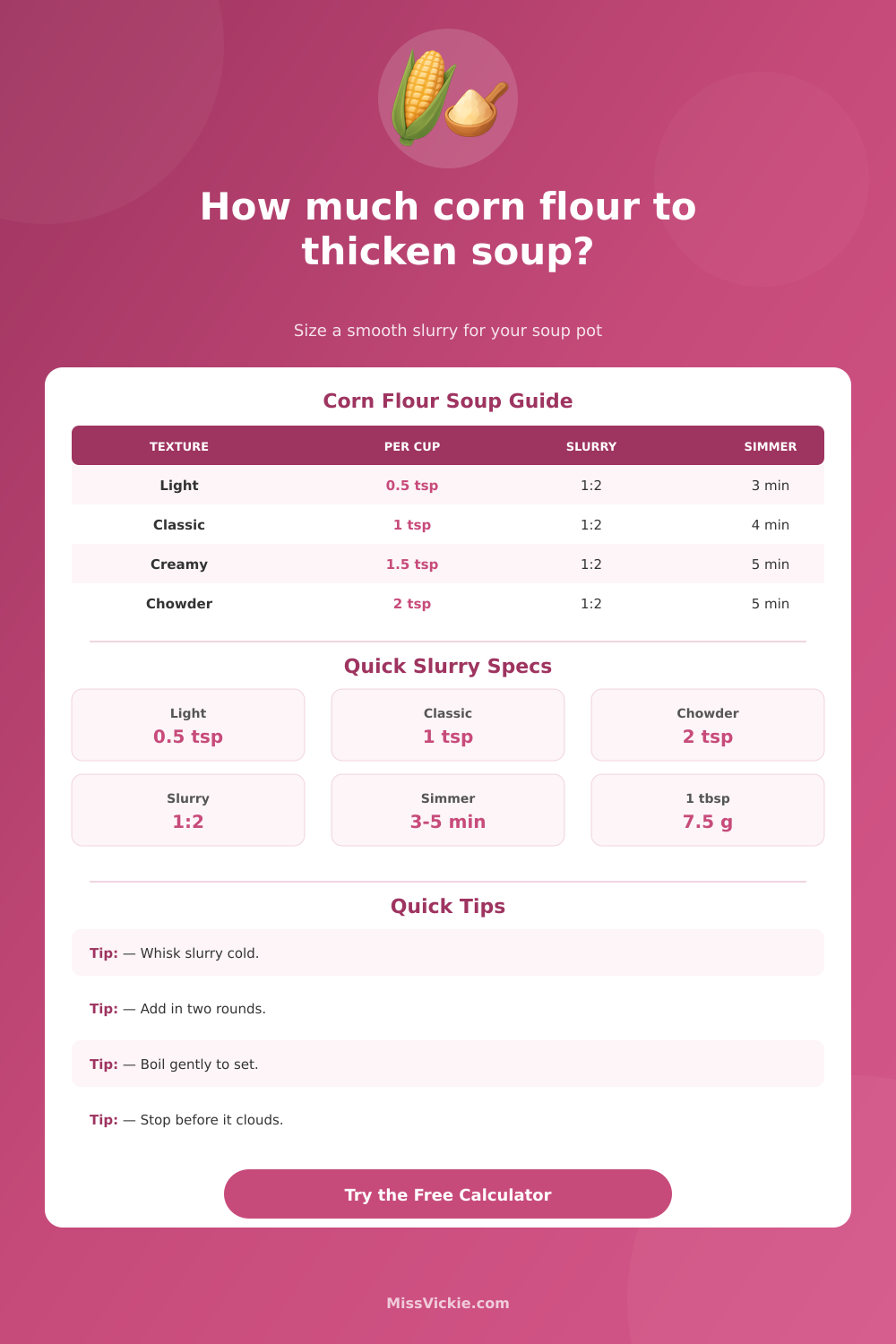
| Desired Texture | Corn Flour Per Cup | Best Soup Style | Clarity Result | How To Add |
|---|---|---|---|---|
| Light glossy body | 0.5 tsp per cup / 2.5 g per L | Clear chicken, vegetable, or wonton soup | Usually clear with a soft sheen | Add half first, then judge after 3 minutes |
| Silky spoon sheen | 0.75 tsp per cup / 3.8 g per L | Brothy soups that need a little cling | Slight haze, still glossy | Whisk in a thin 1:2 slurry |
| Classic lightly thickened | 1 tsp per cup / 5 g per L | Chicken, beef, vegetable, or noodle soup | Noticeable body with mild clouding | Simmer gently until it turns glossy |
| Creamy spoon-coating | 1.5 tsp per cup / 7.5 g per L | Cream soup, coconut soup, and bisque | Opaque base hides the starch well | Use cold milk, broth, or water for slurry |
| Chowder body | 2 tsp per cup / 10 g per L | Corn chowder, potato soup, seafood chowder | Opaque and thick | Add in two rounds to avoid over-thickening |
| Very thick stew-like | 2.5 tsp per cup / 12.5 g per L | Pot pie soup or gravy-style soup | Cloudy and heavy | Use only when a spoon-standing texture is wanted |
| Soup Base | Adjustment | Reason | Best Texture Target | Watch For |
|---|---|---|---|---|
| Clear broth | Use 10% less | Starch haze is easy to see in a clear pot. | Light glossy or silky | Clouding if pushed past 1 tsp per cup |
| Regular stock | Use the normal rate | Stock has enough color and gelatin to carry starch. | Classic lightly thickened | Hard boiling after thickening |
| Dairy or cheese | Use 15% less | Dairy already coats the spoon before starch is added. | Creamy spoon-coating | Scorching if heat is too high |
| Tomato or acidic | Use 12% more | Acid and longer cooking can weaken starch body. | Classic or creamy | Thinning during a long simmer |
| Coconut milk | Use 10% less | Fat and coconut solids add natural thickness. | Creamy or chowder | Adding slurry to a rolling boil |
| Pureed vegetables | Use 25% less | Blended vegetables provide body before starch. | Silky or classic | A gummy finish from too much starch |
| Regional Label | Usually Means | Works Like Cornstarch? | Soup Use | Calculator Setting |
|---|---|---|---|---|
| US corn flour | Fine ground yellow or white corn | No, not the same thickener | Can taste grainy and dull | Choose maize if that is the bag |
| US cornstarch | Pure corn starch | Yes | Best for glossy quick thickening | Use the normal starch result |
| UK cornflour | Pure corn starch | Yes | Same as cornstarch in this calculator | Use the UK/AU setting |
| Australian cornflour | Often wheat-free corn starch | Yes, check label | Good for gluten-free soup thickening | Use the UK/AU setting |
| Maize flour | Finely milled whole corn | No | Better as flavor and body, not slurry | Calculator warns and reduces trust |
| Masa harina | Nixtamalized corn flour | No | Thickens tortilla soup with corn flavor | Use only for masa-style soups |
| Slurry And Timing Choice | Cold Liquid Amount | When To Use | Simmer Time | Texture Risk |
|---|---|---|---|---|
| 1:1 thick slurry | 1 tbsp liquid per 1 tbsp starch | Small rescue batches | 3 to 5 minutes | Can clump if poured fast |
| 1:1.5 pourable slurry | 1.5 tbsp liquid per 1 tbsp starch | Medium pots and cream soups | 3 to 5 minutes | Good balance of control and speed |
| 1:2 easy whisk slurry | 2 tbsp liquid per 1 tbsp starch | Most soups and clear broth | 3 to 5 minutes | Reliable and easy to drizzle |
| 1:3 loose slurry | 3 tbsp liquid per 1 tbsp starch | Large kettles or staged thickening | 4 to 6 minutes | Adds extra liquid to the pot |
| Short simmer | Any cold slurry | Last-minute serving | 1 to 2 minutes | May taste slightly raw or thin |
| Long hot hold | Thin slurry preferred | Buffet, catering, or meal prep | 15 minutes or more | Can thin after holding hot |
Use a small dose per cup when transparency matters more than spoon-coating body.
The safest starting point for chicken, vegetable, and stock-based soups.
Works well when dairy, coconut milk, or puree already hides starch haze.
Use for a thick bowl, then stop simmering once it turns glossy.
Thickening a soup with corn flour rely on various factors that will determine how the soup thicken. Corn flour thickens the soup by undergoing a process call gelatinization, wherein the corn flour reach the right temperature within the liquid. Cooking the corn flour will activate it, as it need to be cooked to remove any raw taste associate with the corn flour.
Simmering the soup with the corn flour will activate the corn flour, but overheating or simmering it for too long will cause the corn flour to loosen. If the soup will be cooked later, adding more corn flour than soup that will be served as they are cooked is necessary due to the risk of the corn flour loosening due to reheating. The base of the soup will change the amount of corn flour need to thicken the broth.
How to Thicken Soup with Corn Flour
If the broth is clear like a chicken stock, cloudiness from the corn flour will be visible, thus requiring less corn flour to thicken the broth. Broths that contain dairy product or coconut milk will thicken the broth before adding corn flour, so less corn flour will be needed. Broths that contains tomatoes are acidic, and the acidity will reduce the thickening power of the corn flour, so more corn flour will be needed to help thicken the broth.
If the broth contain pureed vegetables, the vegetables will provide the thickness, so adding the full amount of corn flour to such soups may make the broth too thick. Corn flour must be prepare correctly before adding it to the soup. To prepare corn flour, mixing the corn flour and cold liquid together will have to make a slurry.
Mixing the corn flour and cold liquid together before adding it to the soup will prevent the formation of lumps in the broth. A ratio of one part corn flour to two parts of cold liquid will make a slurry. Adding the corn flour slurry in stages will allow the soup maker to avoid adding too much corn flour to the broth.
Adding half of the corn flour slurry will activate the corn flour, and the soup maker will simmer it again to allow the soup to thicken. At this point, the soup maker will be able to decide whether the soup require the rest of the corn flour slurry to be added. The current state of the broth will play a role in the amount of corn flour that must be added.
If the broth was reheated, more corn flour will be required because the starch from the corn flour will have loosen. If the broth naturally thicken due to the ingredients that were use to make the broth, less corn flour will be needed. If the broth contains pure corn starch, it will thicken the broth and have a glossy texture to it.
If the broth contains whole grain corn flour, it will add thickness to the broth but will also add flavor and color to the broth. The soup will not become as glossy if whole grain corn flour is use instead of pure corn starch. Clarity in the broth is another attribute to consider when choosing how much corn flour to add to the soup.
For soups that are required to be clear, a small amount of corn flour will be used, and the addition of corn flour should be stop as soon as the broth has a soft sheen to it. For soups that are already opaque like broth with cream or tomatoes in it, more corn flour can be added to thicken the broth. Adding the corn flour all at once will make the broth too thick.
Boiling the broth too vigorously will break down the corn flour starch, thus reducing the thickness of the broth. Using a calculator to decide how much corn flour to add to the broth is a start, but using judgment to adjust the amount of corn flour need for a specific type of soup is necessary.