How Much Pectin for Fig Jam Calculator
Estimate pectin for fig jam by prepared fruit weight, pectin type, sugar ratio, fig ripeness, acid level, added liquid, pot depth, texture goal, and jar yield.
Load a fig jam scenario, then adjust the pectin type and sugar plan to match the package you are using.
Calculation Breakdown
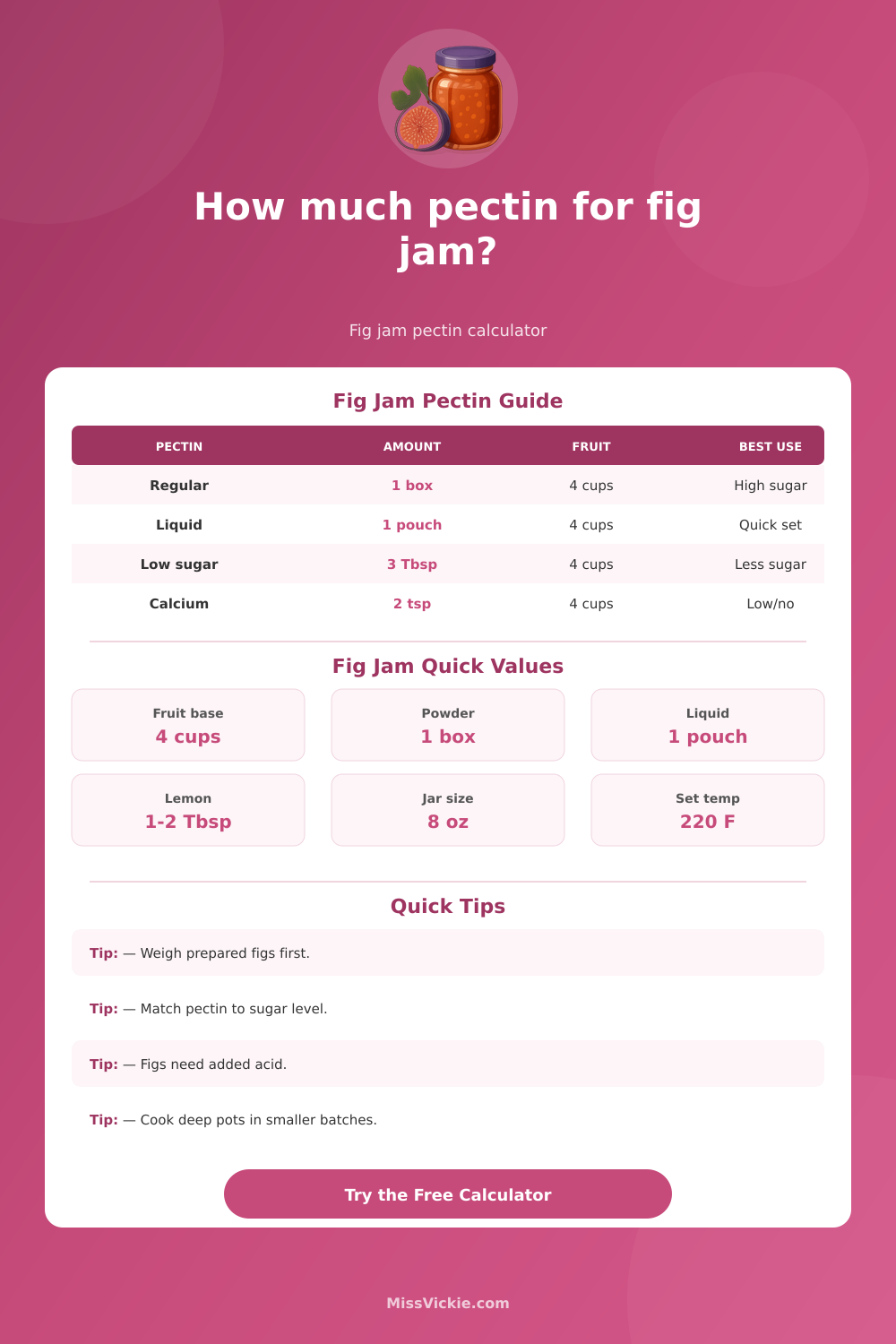
| Pectin Type | Home Batch Baseline | Sugar Match | Fig Jam Note | Calculator Treats As |
|---|---|---|---|---|
| Regular powdered pectin box | 1 box for about 4 cups prepared figs | Best with classic high sugar | Add before full sugar unless your package says otherwise | 49 g box baseline |
| Liquid pectin pouch | 1 pouch for about 4 cups prepared figs | Best with classic or 75% sugar | Usually stirred in after sugar reaches a hard boil | 85 ml pouch baseline |
| Low-sugar powdered pectin | About 3 Tbsp for 4 cups prepared figs | Designed for reduced sugar | Good choice for ripe figs with less sweetener | 30 g baseline |
| No-sugar calcium pectin | About 2 tsp pectin plus calcium water for 4 cups fruit | Works with little or no sugar | Follow the calcium water instructions on the package | 6 g pectin baseline |
| Pure high-methoxyl pectin | About 0.8% to 1.0% of fruit weight | Needs sugar and acid | Best for experienced cooks weighing ingredients | 9 g per kg baseline |
| Homemade apple pectin stock | About 1/4 to 1/2 cup per pound fruit | Needs testing by spoon or freezer plate | Strength varies, so the calculator gives a practical range | 120 ml per lb baseline |
| Fig Condition | Natural Pectin | Common Sugar Ratio | Acid Support | Set Adjustment |
|---|---|---|---|---|
| Just-ripe mixed figs | Moderate for figs | 75% to 100% | 1 to 1.5 Tbsp lemon per lb | Standard pectin math |
| Fully ripe soft figs | Low to moderate | 75% to 100% | 1.5 Tbsp lemon per lb | Add about 10% support |
| Very ripe or weepy figs | Lower and more watery | 50% to 100% | 1.5 to 2 Tbsp lemon per lb | Add about 18% support |
| Dried rehydrated figs | Concentrated solids | 25% to 75% | Use lemon to brighten flavor | Less water but watch texture |
| Chunky preserves | Uneven gel contact | 75% to 100% | Standard lemon works well | Add about 15% support |
| Prepared Figs | Regular Powder | Liquid Pectin | Low-Sugar Powder | Approx 8 oz Yield |
|---|---|---|---|---|
| 2 cups / 300 g | 1/2 box | 1/2 pouch | 1.5 Tbsp | 2 jars |
| 4 cups / 600 g | 1 box | 1 pouch | 3 Tbsp | 4 jars |
| 6 cups / 900 g | 1.5 boxes | 1.5 pouches | 4.5 Tbsp | 6 jars |
| 8 cups / 1.2 kg | 2 boxes | 2 pouches | 6 Tbsp | 8 jars |
| 12 cups / 1.8 kg | 3 boxes | 3 pouches | 9 Tbsp | 12 jars |
| Jam Style | Cook Loss | Texture Cue | Set Temperature Cue | Best Jar Size |
|---|---|---|---|---|
| Loose spoon fig jam | About 18% | Glossy and soft | 218°F to 219°F | 4 oz or 8 oz |
| Classic spreadable jam | About 22% | Sheets from spoon | 220°F near sea level | 8 oz half-pint |
| Firm toast spread | About 26% | Holds a mound | 220°F to 221°F | 8 oz half-pint |
| Chunky fig preserves | About 20% | Fruit pieces suspended | Use spoon and plate test | 8 oz or 12 oz |
| Thick fig paste | About 35% | Very thick drag line | Temperature can lag in solids | 4 oz gift jars |
Best when fig jam uses near-equal sugar and fruit, with lemon juice added for acidity.
Good for quick high-sugar batches, but timing matters because it is usually added late.
Better for ripe figs when you want less sugar but still need a clean spoonable gel.
Best for very low sugar jam, as long as the calcium step is measured from the package.
Fig jam require a specific balance between various ingredients for the jam to hold its shape on toast. Because figs contains low levels of natural pectin, the jam must contain enough pectin to enable the jam to hold its shape. If there is too little pectin in the jam, the jam will turn into a syrup.
However, if there is to much pectin in the jam, the jam will become a rubbery block. A pectin calculator will allow you to calculate the correct amount of pectin for the jam you are making. A pectin calculator consider the variables of the type of jam you are making, the weight of the jam ingredients, the type of pectin, the sugar levels, and the ripeness of the fruit.
How to Use a Pectin Calculator for Fig Jam
The ripeness of the figs will change the amount of natural pectin that is in the figs. A just-ripe fig will contain a small amount of pectin in the skin and the seeds of the fig. However, a very soft fig will contain less pectin because it have released some of its water. If you use a pectin calculator, you can adjust the amount of pectin you need in the case that your figs are overripe.
If they are overripe, it means they have released more water, and you must add more pectin. The amount of sugar in your jam recipe is a critical element since both powdered and liquid pectin require sugar in addition to acid to enable the pectin to form a jelly. In the case that you use less sugar than the recipe indicate for your batch of jam, you will have to use a low-sugar pectin to enable the jam to maintain its structure.
The way in which you prepare the figs will change the amount of pectin you need for your jam. A chopped fig will contain more structure than a smooth puree of the figs. Additionally, a chopped fig will release less water than a smooth fig puree.
Using large pieces of fig in your jam will require the jam to be firmer so that the pieces of fig remains suspended in the jam. Any good pectin calculator will take into account the different ways of preparing figs to provide you with a recommendation for the amount of pectin required to make your jam without having to remember different amounts of pectin for different preparation methods. The chemistry of jam require the addition of acid to help the pectin in the jam to set because figs do not contain the acidity needed for this process.
The acid can be lemon juice or citric acid. When using a pectin calculator, you can select the level of acidity for your jam: light, standard, and bright. The pectin calculator will change the amount of pectin that it shows as the amount of acid that you use in the jam.
Canning uses require a higher level of acidity than jam that you will eat fresh. The amount of liquids that you add to your jam or the depth of the cooking pot will change the amount of pectin you need. If you add liquids like water or wine to your jam, the concentration of solids will change.
If you use a deep pot, it will take longer for the jam to boil because the deep pot will prevent the jam from reaching the required temperature. In both instances, you will need to add more pectin to help the jam maintain its structure. A good pectin calculator will allow you to account for the amount of liquids in the jam and the depth of the cook pot.
The pectin calculator will give you a number. You can use this number to buy the amount of pectin for the jam. Jam recipes will give you a baseline recommendation.
This will be the amount of pectin needed for a specific amount of fruit. However, the adjusted pectin amount will be the amount required for your specific amount of sugar and your specific type and amount of figs. If you ignore the adjustments that the pectin calculator provides, the jam will be a syrup.
If you overcorrect the amount of pectin, the jam will be to stiff to eat. You can use tables to verify the amount of pectin that the calculator suggests. The tables will show the type of pectin; powdered or liquid pectin, sugar levels, cook loss, and the number of jars the batch of jam can fill.
These tables will allow you to decide if you can make enough jars of jam with the amount of fruit that you have. The tables do not replace using the spoon to taste the jam, but they can provide you with an idea of what the jam will taste like when cooked. Common errors when making jam include using the wrong type of pectin for the amount of sugar in your jam.
If you are using less than 25% sugar, you should not use regular pectin because regular pectin requires more sugar to set. Another common error is using dried figs instead of fresh figs. Dried figs will absorb the water that you add when you soak them, and as a result, the water will be released when you cook the jam.
If you use a pectin calculator that has a dried figs setting, you will need to weigh the amount of dried figs after soaking them in water. Finally, you can use the pectin calculator to account for the size of the batch that you are making. Small batches made in a wide pan will evaporate quickly.
Large batches made in a deep stockpot will take longer to cook. A deep stockpot will require more pectin because the jams surface will be crowded with steam. Finally, you can use the pectin calculator to include a setting margin for jam recipes that require the jam to be firmer.
The setting margin will allow for additional time for the jam to set. However, this is an optional feature in the calculator that you can turn off.