How Much Pectin for Plum Jam Calculator
Size powdered, liquid, low sugar, freezer, or calcium pectin for plum jam using prepared plum volume, ripeness, sugar level, lemon juice, batch shape, and target set.
Load a realistic plum jam batch, then adjust the fruit prep and pectin format to match the recipe on your counter.
Plum Jam Pectin Breakdown
| Plum Condition | Pectin Support | Calculator Factor | Best Use | Jam Cue |
|---|---|---|---|---|
| Mostly firm, tart plums | Less added pectin needed | x 0.88 | Wild plum or early harvest jam | Natural tartness helps the gel |
| Mixed firm and ripe plums | Balanced support | x 0.95 | Classic plum jam batches | Good flavor with reliable set |
| Ripe, juicy plums | Standard support | x 1.00 | Everyday red or black plums | Use the pectin label ratio |
| Very ripe or soft plums | More added pectin needed | x 1.15 | Soft fruit, quick jam, puree | Lower natural pectin and more water |
| Thawed frozen plums | More support after thawing | x 1.08 | Stored summer fruit | Drain only if the recipe expects it |
| Dark skin, high tannin plums | Slightly stronger natural set | x 0.94 | Damson and prune plum styles | Skins add body and color |
| Pectin Type | Working Ratio | Package Basis | Sugar Style | Use When |
|---|---|---|---|---|
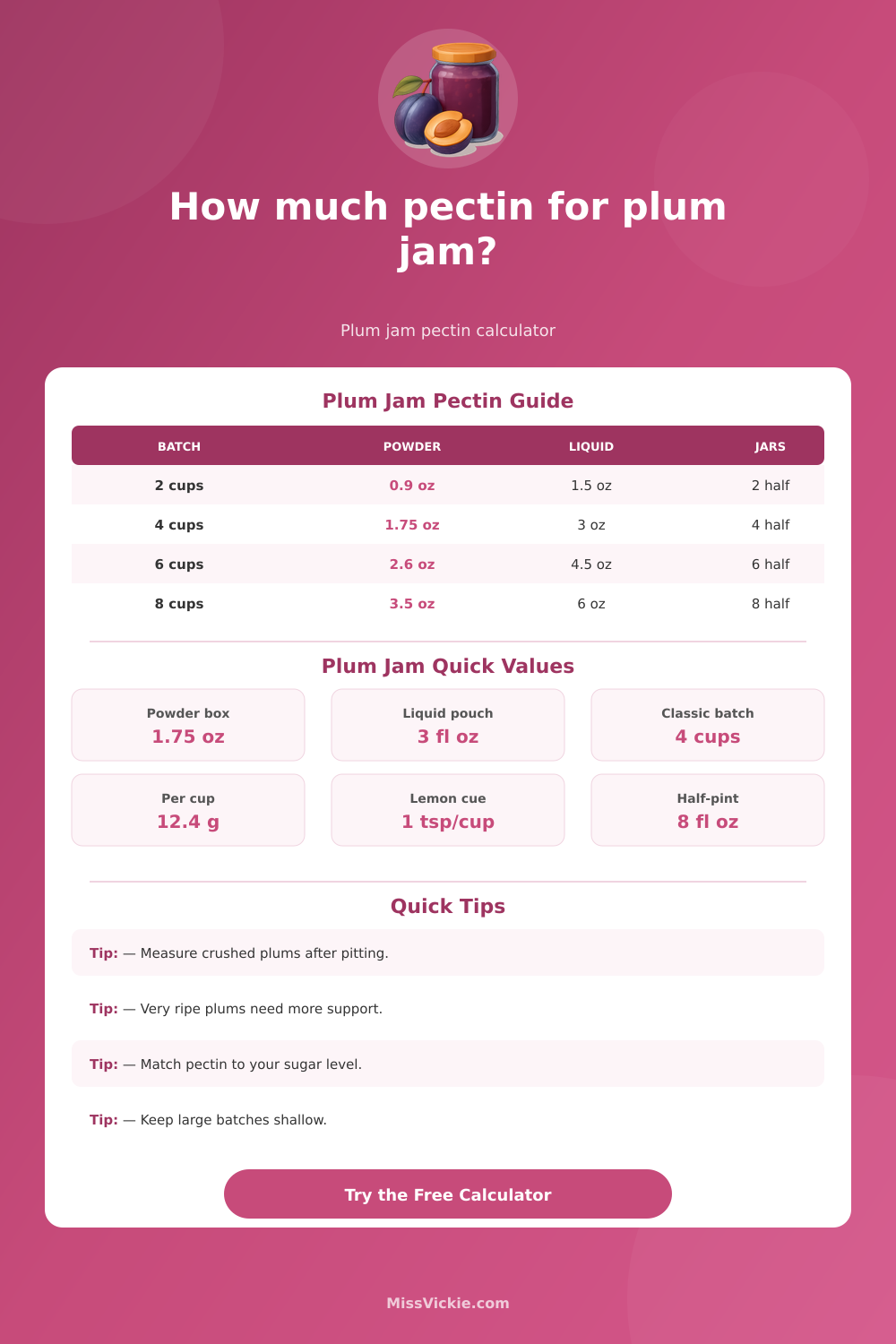
| Regular powdered pectin | 1.75 oz per 4 cups plums | 1 box equals 49.6 g | High sugar | You want a familiar cooked jam set |
| Regular liquid pectin | 3 fl oz per 4 cups plums | 1 pouch equals 3 fl oz | High sugar | Your recipe adds pectin after sugar boils |
| Low sugar powdered pectin | 1.75 oz per 4.5 cups plums | 1 box equals 49.6 g | Reduced sugar | You want less sugar but a cooked set |
| No sugar flexible pectin | 1.75 oz per 5 cups plums | 1 box equals 49.6 g | Low or no sugar | Your pectin label allows sweetener changes |
| Calcium-set pectin | 1/2 tsp pectin per cup plums | Use calcium water too | Flexible sugar | You are using universal calcium pectin |
| Instant freezer jam pectin | 1.59 oz per 4 cups plums | 1 pouch equals 45 g | Freezer jam | You are not cooking the jam to gel |
| Prepared Plums | Regular Powder | Liquid Pectin | Low Sugar Powder | Half-Pint Yield |
|---|---|---|---|---|
| 2 cups / 490 g | 0.88 oz / 24.8 g | 1.5 fl oz | 0.78 oz / 22.0 g | 2 to 3 jars |
| 4 cups / 980 g | 1.75 oz / 49.6 g | 3.0 fl oz | 1.56 oz / 44.1 g | 4 to 5 jars |
| 6 cups / 1.47 kg | 2.63 oz / 74.4 g | 4.5 fl oz | 2.33 oz / 66.1 g | 6 to 8 jars |
| 8 cups / 1.96 kg | 3.50 oz / 99.2 g | 6.0 fl oz | 3.11 oz / 88.2 g | 8 to 10 jars |
| 10 cups / 2.45 kg | 4.38 oz / 124 g | 7.5 fl oz | 3.89 oz / 110 g | 10 to 12 jars |
| Formula Choice | Low Setting Risk | Medium Setting Risk | High Setting Risk | Calculator Response |
|---|---|---|---|---|
| Sugar level | 0.85 to 1.15 cups sugar per cup plums | 0.45 to 0.84 cups per cup | below 0.45 cups with regular pectin | Adds support or warns to switch pectin |
| Lemon juice | 1 to 1 1/2 tsp per cup plums | 1/2 tsp per cup plums | none added to low-acid ripe plums | Adjusts acid help in the final factor |
| Batch shape | wide shallow pan | normal single batch pot | overfilled deep pot | Changes cook concentration support |
| Set target | soft spoon jam | classic spreadable jam | firm filling or travel jam | Raises or lowers pectin dose |
| Fruit texture | skin-on crushed plums | chopped plums | smooth puree or peeled fruit | Accounts for skins, water, and pulp |
Best for a traditional cooked plum jam with a firm spread and full sugar recipe.
Works well when your method boils fruit and sugar first, then stirs in pectin near the end.
Better match for ripe plums when you want more fruit flavor and less sweetness.
Useful for very low sugar jam because calcium activates the pectin network.
Making jam with plum requires the addition of a specific amount of pectin so that the jam will set into a gel. Some batches of jam that are make with plums will set correctly while other batches will not reach the necessary level of pectin to create the set. The plums that contain the most natural pectin are the ripe plums, which are the softest type of plum.
Soft plums has less of the natural pectin that firm plums naturaly contain. Thus, people must account for the pectin content of the plums that are used in the jam to ensure that the jam reaches the desired consistency. The amount of pectin that is necessary for making jam with plums is dependent upon a few different factors.
How Much Pectin Do You Need for Plum Jam
The factors includes the ripeness of the plums that are used, the amount of sugar that is included in the jam recipe, and the size of the pan that is used to cook the jam. Plums that are firmer and contain more natural pectin will require less pectin to be added to the jam recipe than plums that are soft and contain less of that natural pectin. The amount of sugar that is used in the jam recipe is another critical component because pectin generally requires high levels of both sugar and acid to set into a gel.
Therefore, if you reduce the amount of sugar in the jam, another type of pectin will have to be used. Finally, the size and shape of the pan in which the jam is cooked will impact the rate at which the water evaporate from the jam. The faster that the liquid evaporates from the jam, the more concentrated the pectin will be.
The pectin calculator allows individuals to input the various factors related to making plum jam into the calculator to determine the amount of pectin that will be required for that specific batch of jam. The factors that must be entered into the calculator may include the volume of the prepared fruit, the type of pectin that will be used, the ripeness of the plums, the ratio of sugar to fruit, and the target setting time for the jam. Additionally, the calculator may also ask for information regarding the use of plum skins in the jam, whether the plums were frozen prior to simmering, and the depth of the cooking vessel that will be used.
For example, pans that are wide and shallow will allow the water to evaporate at a faster rate than deep and narrow pots; thus, a wide and shallow pan may require less pectin than a deep and narrow pot. Many people may believe that all types of pectin will work the same way in the making of jam. However, each type of pectin requires different conditions to efficiently perform its function in the jam.
For instance, regular powdered pectin works best in jams that contain a high ratio of sugar. Thus, if the sugar levels in the jam are too low, the regular powdered pectin will not perform as well as it should. Additionally, you typically add liquid pectin to the jam mixture after the plums and sugar are boiled.
However, like regular powdered pectin, liquid pectin will also require the same amount of sugar in the jam. Finally, low-sugar pectin and calcium-set pectin are used in jams that contain less sugar than other jams. Thus, using these specific types of pectin will allow jams to reach the required setting without requiring high levels of sugar.
If you use the wrong type of pectin for your sugar level, your plum jam may be either soft or weep. The skins of the plums will affect the pectin levels in your jam. If you leave the skins in the jam maker when you cook your jam, the skins will contribute to the pectin and the tannins in the jam.
These components will aid in the ability of the jam to form a gel. If you are peeling the plums, you will be removing the natural pectin from the jam, so you will have to add more pectin to the jam to make up for this loss. Additionally, if you puree the plums, you will be adding more water to the jam, which will dilute the pectin.
Thus, this will impact the way you calculate the pectin for your plum jam. You add lemon juice to your plum jam because lemon juice contains the acid necessary to make the pectin form a gel with the sugar in the jam. Additionally, pectin, sugar, and acid are the three ingredients that must be combined to make a jam.
If you do not add enough lemon juice, the jam will not set properly. If you add too much lemon juice to your jam, the flavor will be too sharp. The pectin calculator factors in the amount of lemon juice you will need because the acid from the lemon juice and the pectin react with each other.
If you choose to make your jam in large jars, the volume of your jam will change based on the texture you choose for your jam. If you choose a texture that is soft for your jam, it will produce more volume than jam that is allowed to set to firm texture because the jam released less water during the jam making process. Similarly, if you use large jars to store your jam, it will take longer for your jam to cool.
Thus, the jam will continue to set on the edge of the jam jar as it cools. A common error in making jam is measuring the weight of the whole plums before removing their pits. However, you should measure the volume of the prepared plums (after removing pits and chopping) to determine how much pectin to add to the jam.
Additionally, do not change the type of pectin you are using without changing the amount of sugar and pectin to the jam. Both of these problems can be avoided if you use the pectin calculator to determine how much pectin and sugar your jam should contain. After calculating the amount of pectin needed for your plum jam, you should also watch the jam while it cooks.
Jam can go from liquid to overcooked very quickly. To test the jam, place a small amount of jam on a cold plate to ensure the jam has the proper texture. While the pectin calculator will find the right amount of pectin for your jam, you must watch the jam while it is cooking to ensure the jam reaches the proper texture.