Raspberry pulp, seed straining, pectin type, sugar level, acid balance, and jar yield
How Much Pectin for Raspberry Jam Calculator
Estimate pectin for red, black, golden, frozen, or seedless raspberry jam from crushed fruit, sugar, lemon juice, pulp style, desired set, cook loss, and jar size.
Choose a raspberry jam situation, then adjust the berry form, seed handling, pectin family, sugar plan, acid, and jar target.
Calculation Breakdown
| Pectin type | Raspberry base | Calculator unit | Sugar behavior | Best raspberry use |
|---|---|---|---|---|
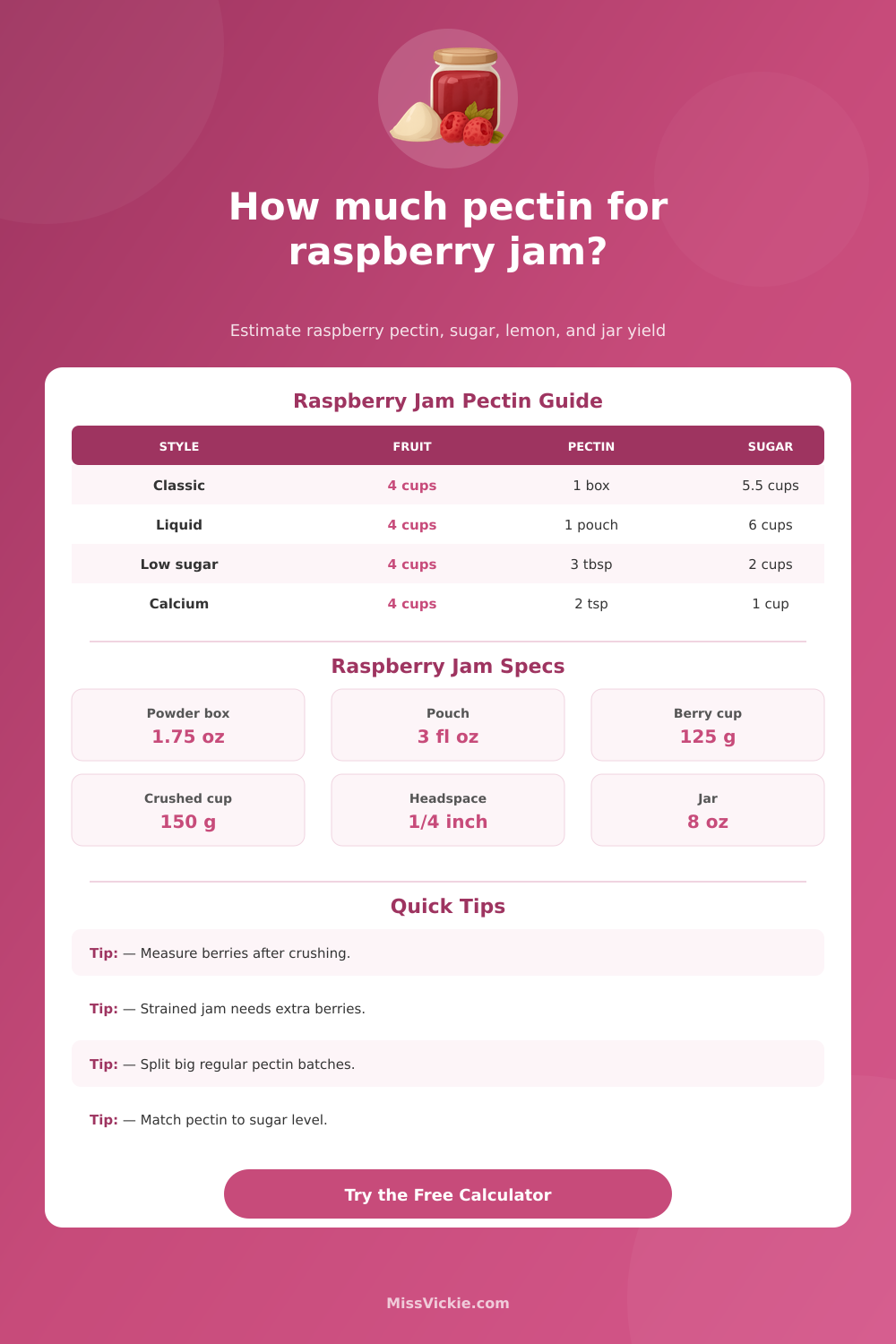
| Regular powdered pectin | 4 cups crushed raspberries | 1 box, about 1.75 oz | Needs high sugar for a firm gel | Classic red raspberry pantry jam |
| Regular liquid pectin | 4 cups crushed raspberries | 1 pouch, about 3 fl oz | Often uses slightly higher sugar | Glossy jam when a recipe calls for liquid timing |
| Low or no-sugar pectin | 4 cups crushed raspberries | 3 tbsp powdered pectin | Built for lighter sugar ratios | Fruit-forward jam that still sets cleanly |
| Calcium-set pectin | 4 cups raspberry pulp | 2 tsp pectin plus calcium water | Can gel with honey or very low sugar | Seedless, honey, or specialty sweetener batches |
| Bulk high-methoxyl pectin | Fruit plus sugar weight | 0.75% to 1.0% by weight | Needs sugar and acid balance | Scaled production with a gram scale |
| Instant freezer pectin | 3 to 4 cups crushed berries | About 0.55 tbsp per fruit cup | Designed for uncooked freezer jam | Fresh-tasting freezer or refrigerator spread |
| Raspberry form | Density used | Seed or pulp allowance | Pectin effect | Kitchen note |
|---|---|---|---|---|
| Whole loose berries | 125 g per cup | Converted to crushed volume | Neutral after crushing | Measure gently, then crush before final recipe scaling |
| Crushed seeded pulp | 150 g per cup | No straining loss | Natural seed body supports set | Best baseline for classic jam recipes |
| Half-strained jam | 145 g per cup | About 10% mass removed | Adds modest pectin support | Good compromise between smoothness and raspberry texture |
| Fully seedless pulp | 140 g per cup | About 22% mass removed | Adds stronger pectin support | Plan extra berries because seeds stay in the sieve |
| Thawed frozen berries | 155 g per cup | Drain included juice into pot | Slightly softer set | Use released juice, then measure the full crushed mixture |
| Thick preserve style | 135 g per cup | Pieces stay more open | May need a firmer set target | Fold gently to protect fruit pieces |
| Crushed berries | Approx weight | Regular powder | Low-sugar pectin | Typical half-pint yield |
|---|---|---|---|---|
| 2 cups | 300 g / 10.6 oz | 0.5 box | 1.5 tbsp | 3 to 4 jars |
| 3 cups | 450 g / 1.0 lb | 0.75 box | 2.25 tbsp | 5 to 6 jars |
| 4 cups | 600 g / 1.32 lb | 1 box | 3 tbsp | 7 to 8 jars |
| 6 cups | 900 g / 1.98 lb | 1.5 boxes | 4.5 tbsp | 10 to 12 jars |
| 8 cups | 1.2 kg / 2.65 lb | 2 boxes | 6 tbsp | 14 to 16 jars |
| 12 cups | 1.8 kg / 3.97 lb | 3 boxes split | 9 tbsp | 21 to 24 jars |
| Condition | What changes | Calculator response | Kitchen check | Processing reminder |
|---|---|---|---|---|
| Very ripe raspberries | Natural pectin softens | Adds pectin support | Cold plate or sheet test | Use tested recipe timing |
| Some tart berries | More acid and natural pectin | Slightly lowers support factor | Taste for sugar balance | Keep bottled lemon if recipe calls for it |
| Seedless pulp | Seeds and body removed | Raises pectin and fruit planning | Weigh pulp after straining | Do not reduce safe acid guidance |
| Freezer pectin | No shelf-stable process | Shows freezer warning | Check package rest time | Refrigerate or freeze only |
| Above 1000 ft | Lower boiling point | Adds altitude note | Confirm full rolling boil | Use altitude water-bath table |
This calculator estimates ingredient scale for planning. For shelf-stable canning, follow tested raspberry jam directions for jar size, acid, headspace, and water-bath processing.
Making raspberry jams requires an correct amount of pectin, as the amount of pectin needed change based on several differents variables. Raspberries naturaly contains pectin, but raspberries also contain juice and seed, both of which can affect how the jam set. Variables to consider prior to making raspberry jam include the ripeness of the raspberries and the method of seed removal from the berries.
Each of these variable has the potential to change the texture of the raspberry jam that result from the jam making process. The ripeness of raspberries will impact the amount of pectin that is need for the jam to properly set. Jam made with very ripe raspberries will usualy take longer to set then jam made with underripe raspberries.
Things That Change How Raspberry Jam Sets
One reason for this is that freezing the raspberries prior to making jam will release the natural juice of the berries. This added juice will have an effect of diluting the natural pectin contained within the raspberries. As a result, more pectin must be added to raspberry jam that use frozen raspberries.
The presence of the seeds in the raspberry jam can also impact the amount of pectin that should be add to the jam. Jam that include the seeds of the raspberries will naturally contain a “body” to the jam, which will contribute to the jams ability to set into a gel-like substance. Jam that has had the seeds removed will have less of that body to naturally set the jam, thus requiring more added pectin than jams that contains the seeds of the raspberries.
The levels of sugar within the jam and the types of pectin that is used also interact with each other in relation to the setting of the jam. For instance, regular powdered pectin only work well within jams that contain a high level of sugar; jams that use less sugar will fail if regular powdered pectin is used. Low-sugar pectin and calcium-set pectin work well in jams with lower ratio of sugar to jam ingredients, and each of these two type of pectin has different requirement regarding the amount of acid to use within the jam.
Thus, the cook must chose the type of pectin prior to beginning to measure the ingredient for the jam. The volume of the raspberry jam will change during the cooking of the jam. Jam loss occur due to the evaporation of the water during boiling, as well as the removal of the foam that forms on the surface of the jam while boiling.
Thus, the final volume of the jam will be less than the total initial volume of the ingredient. You should of account for jam loss to ensure that enough jars are available to store the jam once it is prepare. Finally, the variety of raspberries that are use in the jam will also affect the pectin content of the jam.
Black raspberries are denser than red raspberries, and golden raspberries contain different amount of acid than red raspberries. Additionally, wild raspberries tend to contain more natural pectin than cultivated raspberries. Because each variety of raspberries contains a different amount of natural pectin, the cook should adjust the amount of pectin that is add to the jam according to the variety of raspberries that are to be use in the jam.
Lastly, the altitude at which the jam is made and the size of the batch to be prepare will also impact the raspberry jam. At higher altitude, water boil at a lower temperature. This impacts the amount of time required to properly process the jam for safe storage.
In large batches of jam, it is more difficult to boil the jam to reach the necessary temperature quickly. A hard rolling boil is required for these larger batches in order to properly activate the pectin within the jam. Planning for these different variable in advance will ensure that the jam set correctly and is safe to store.