How Much Agar Agar for Gummies Calculator
Calculate agar powder for plant-based gummies from batch liquid, gummy texture, fruit solids, acid timing, sugar level, mold size, drying time, and agar strength.
Choose a gummy style to load practical starting assumptions, then adjust the liquid, acid, sweetness, and molds for your exact recipe.
Formula Breakdown
Agar gummies are firmer and less elastic than gelatin gummies. Drying the finished candies increases chew more gently than adding too much agar.
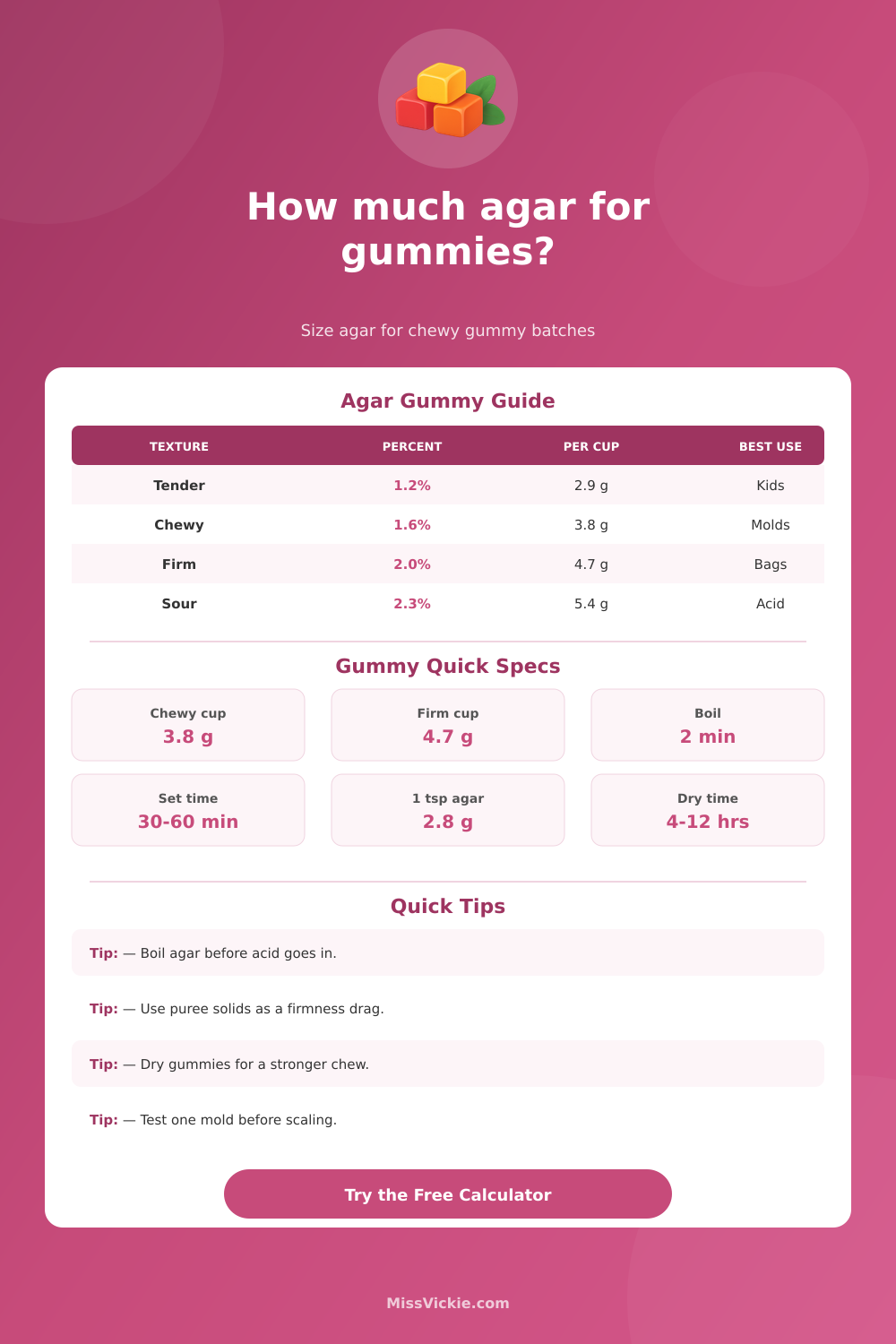
| Gummy Style | Agar Percent | Grams per Cup | Texture Result |
|---|---|---|---|
| Tender snack gummies | 1.10% to 1.35% | 2.6 to 3.2 g | Soft bite, best eaten from a covered container. |
| Classic molded gummies | 1.45% to 1.75% | 3.4 to 4.1 g | Clean mold release with a springy, agar-style chew. |
| Firm baggable gummies | 1.85% to 2.15% | 4.4 to 5.1 g | Better for coating, packing, or lunchbox handling. |
| Sour or high-acid gummies | 2.10% to 2.45% | 5.0 to 5.8 g | Extra agar offsets acid, especially if acid is boiled early. |
| Slab gummies for cutting | 1.70% to 2.05% | 4.0 to 4.9 g | Sets as a sheet that can be dusted and cut into cubes. |
| Ingredient Factor | Typical Case | Agar Adjustment | Best Handling |
|---|---|---|---|
| Low acid juice | Apple, grape, tea | No extra to 5% extra | Boil agar in the full liquid until smooth. |
| Medium acid fruit | Berry blend or mango | 8% to 14% extra | Keep the boil complete and avoid long acidic simmering. |
| High acid citrus | Lemonade, orange, lime | 18% to 28% extra | Dissolve agar first, then add acid late. |
| Citric acid sour candy | Sour drops or coating | 25% to 38% extra | Put most acid in the finishing sugar when possible. |
| Heavy puree solids | Thick strawberry or mango | 10% to 20% extra | Blend smooth and strain seeds for a cleaner set. |
| Cooked Gummy Mix | 2 ml Bears | 5 ml Gems | 10 ml Cubes |
|---|---|---|---|
| 120 ml cooked mix | 60 small pieces | 24 medium pieces | 12 large pieces |
| 240 ml cooked mix | 120 small pieces | 48 medium pieces | 24 large pieces |
| 480 ml cooked mix | 240 small pieces | 96 medium pieces | 48 large pieces |
| 720 ml cooked mix | 360 small pieces | 144 medium pieces | 72 large pieces |
| 1 tsp agar powder | About 2.8 g | Use grams when possible | Level spoon, not packed |
Predictable set, bright flavor, and the cleanest mold details.
More fruit flavor, but pulp and fiber need a stronger ratio.
Needs late acid handling because long acidic boiling weakens set.
Fat and opacity make tender chews; use a modest firmness boost.
| Problem | Likely Cause | Fix Next Batch | Rescue Option |
|---|---|---|---|
| Gummies slump after unmolding | Too little agar or hot room | Add 10% more agar or dry longer | Remelt with extra dissolved agar. |
| Gummies snap instead of chew | Agar ratio too high | Reduce agar 8% to 15% | Cut smaller and sugar coat lightly. |
| Grainy texture | Agar not fully hydrated | Whisk and boil for a full 2 minutes | Remelt, blend, and strain. |
| Sour batch fails to set | Acid boiled too long | Add citric acid after agar dissolves | Use as dessert sauce or remelt. |
| Sticky surface | High syrup or not dried | Dry uncovered 4 to 12 hours | Toss in sugar and cornstarch mix. |
Making gummies without gelatin requires determining the exact amount of agar agar that you need to use. The amount of agar agar that you use will change the texture of the gummies that you make. The amount of agar agar that you need depends on various factor.
These factor include the type of liquid that you use, the amount of fruit pulp that is contained within the liquid, the amount of acid that is contained within the mixture that you prepare, and the amount of time that you allow the gummies to dry. If you dont use the correct amount of agar agar, the gummies may either become a sticky liquid or become too hard to chew. Agar agar works in a slightly different way than the gelatin that is often used to make gummies.
How much agar agar to use for gummies
The type of liquid base from which you prepare the agar agar gummies will change the firmness of the gummies. Using clear juice will produce the best results with agar agar. If you use fruit puree, the gummies will contain the flavor of the fruit, but because the fruit puree contains solid ingredients that interact with the agar agar, you will have to use more agar agar if you incorporate fruit into your recipe.
Using coconut milk will create softer and cloudier gummies due to the fat content in the milk. However, the fat content in the coconut milk will help the gummies release from the molds in which they are prepared. Each of these different base for the gummies will have a significant effect on the agar agar once you have cooled the agar agar.
Another ingredient that can interfere with the process of making agar agar gummies is acid. Acid is a very common ingredient in the ingredient lists for gummies, yet it is also one of the most common sources of mistakes when preparing agar agar gummies. You must boil agar agar to hydrate the agar agar powder.
However, if you add lemon juice or citric acid prior to boiling, the acid will work to weaken the agar agar prior to it setting. To avoid this mistake, you should add acid later in the cooking process. By adding the acid later in the cooking process, you will preserve the strength of the agar agar.
Additionally, you can coat the gummies in sour sugar to avoid adding the acid to the agar agar mixture altogether. The levels of sugar in the gummies and the time that the gummies are allowed to dry will affect the final product of the gummies. Both of these factors must be considered together.
A high level of sugar will create firm gummies, but they may lose there shape if they contain high amounts of sugar and are cooked in a humid area in the kitchen. To firm the gummies that you have prepared, but which are still in molds, you can dry the gummies on parchment paper for several hours. By drying the gummies on parchment paper, you remove the moisture from the gummies without adding more agar agar to the mixture.
Excess agar agar may create brittle gummies when the gummies are finished cooking. The size of the molds within which you prepare the gummies will affect the number of gummies that you can make. The total amount of liquid that the molds will contain will also impact the number of gummies that are prepared, as well as the amount of liquid that evaporates while boiling the ingredients.
If you use small molds, there will be very little liquid that is lost to evaporation. However, if you prepare large batches of gummies, there will be alot of liquid that is lost to evaporation while simmerming the liquid without a lid. The calculator accounts for both of these factors so that you do not find yourself without enough liquid to pour into the molds.
The calculator also accounts for the strength of the agar agar powder that is used. Some brands of agar agar powder are stronger than others. Therefore, if you use a strong agar agar powder, you will need to use less agar agar than if you use an older agar agar powder.
The texture of the gummies can be varied. However, the texture that you select for the gummies will have an impact upon the way in which the gummies are to be used. For example, tender gummies are suitable for young children.
Yet, because the tender gummies are not as strong as firmer gummies, they may not be the best choice if you plan on transporting the gummies in a bag along with other snacks. Firmer gummies are stronger and thus may be better for gummy snacks that are later coated in sour sugar. The difference between the tender and firm texture of the gummies may be as small as a very small percentage of agar agar.
Thus, you must measure the agar agar correctly. Many people create these gummies with the same thought process that they use for making gummies with gelatin. Yet, agar agar and gelatin do not work in the same way.
For instance, people often bloom gelatin in cold liquid. However, agar agar has to be boiled to activate the agar agar powder. If you do not boil agar agar, the agar agar will not dissolve and will create a grainy texture to the gummies.
If you boil the acid for too long, the acid will continue to weaken the agar agar until it is no longer effective in making the gummies firm. To avoid these mistakes, you must again measure the agar agar correctly according to the specific requirements of the recipe that is being prepared. By changing one variable at a time within the preparation of agar agar gummies, you may be able to significantly improve the way in which the gummies are made.
For instance, increasing the amount of fruit puree will require increasing the amount of agar agar that is used in the recipe. If you increase the amount of time that the gummies are dried, you may be able to use less agar agar. Additionally, if you add the acid later in the recipe, you may be able to use less agar agar while still preserving the sour taste of the gummies.
By understanding how each variable relates to the others, you will be able to create agar agar gummies that is consistent in texture and flavor.