Gelatin powder, sheets, bloom strength, liquid weight, texture, acid, sugar, and agar setting behavior
How Much Agar Agar to Use Instead of Gelatin
Convert a gelatin-based recipe to agar agar powder with texture-aware adjustments, because agar is stronger, sets warmer, and feels cleaner and more brittle than gelatin.
Choose a real recipe style, then fine tune the gelatin form, bloom strength, liquid base, acidity, sweetness, desired texture, and safety margin.
Agar Instead of Gelatin Breakdown
| Original Gelatin | Gelatin Equivalent | Soft Agar Swap | Firm Agar Swap |
|---|---|---|---|
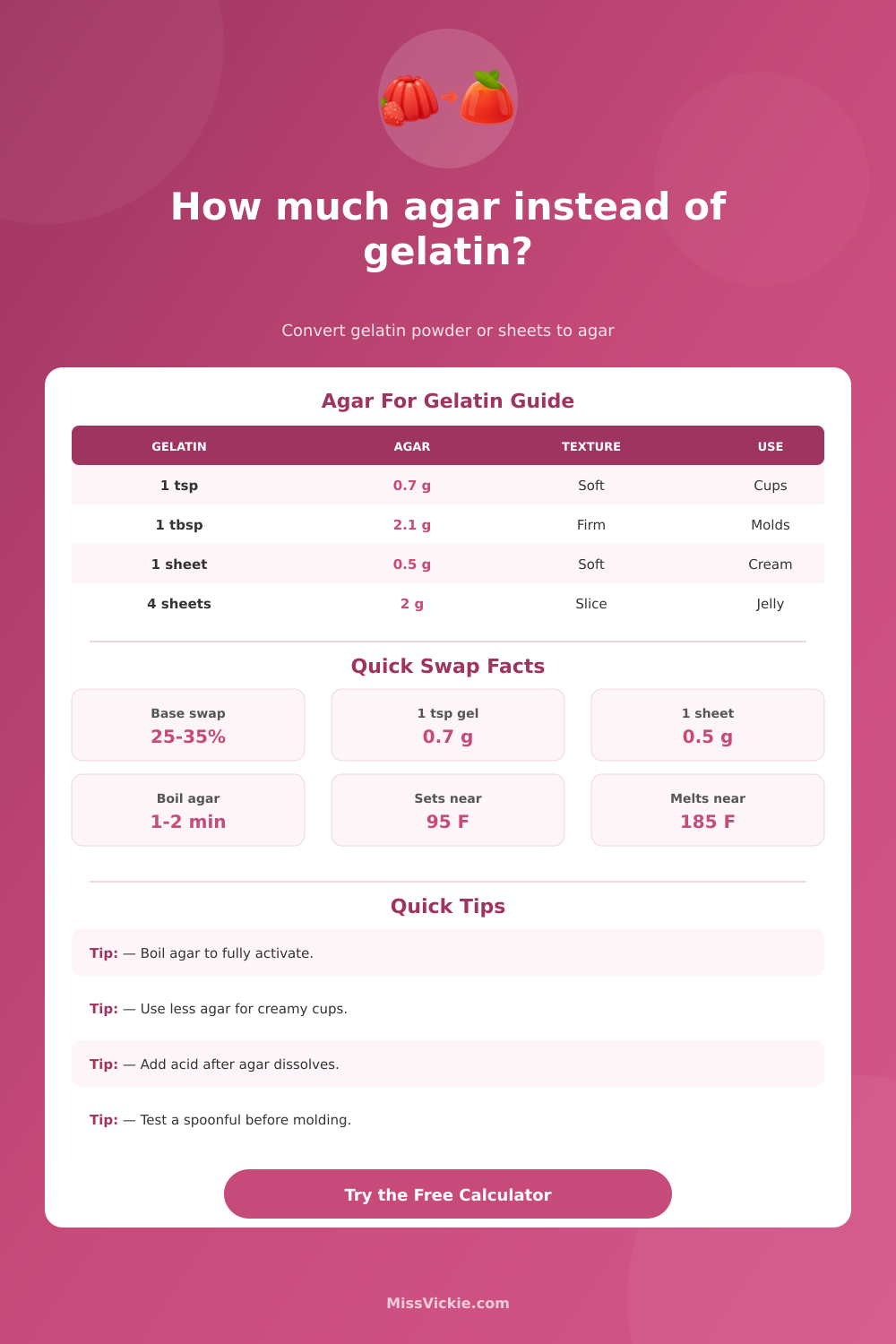
| 1 teaspoon powdered gelatin | About 3.0 g | 0.7-0.9 g agar | 1.0-1.2 g agar |
| 1 tablespoon powdered gelatin | About 9.0 g | 2.1-2.7 g agar | 3.0-3.6 g agar |
| 1 packet powdered gelatin | About 7.0 g | 1.7-2.1 g agar | 2.4-2.8 g agar |
| 1 gold gelatin sheet | About 2.0 g | 0.5-0.6 g agar | 0.7-0.8 g agar |
| 4 gold gelatin sheets | About 8.0 g | 2.0-2.4 g agar | 2.8-3.2 g agar |
| 6 gold gelatin sheets | About 12.0 g | 3.0-3.6 g agar | 4.2-4.8 g agar |
| Recipe Base | Gelatin Behavior | Agar Adjustment | Cooking Note |
|---|---|---|---|
| Milk, cream, or custard | Gelatin gives a soft melt | Use the low end | Agar can turn creamy desserts brittle if pushed too high. |
| Fruit puree | Pulp softens clean slices | Add 8-15% | Strain fibrous puree before dissolving agar. |
| Citrus or tart juice | Acid can weaken gels | Add 10-25% | Dissolve agar first, then add strong acid when possible. |
| Wine or cocktail | Alcohol softens setting | Add 10-20% | Simmer enough to hydrate agar without driving off all flavor. |
| Chocolate base | Fat changes mouthfeel | Use normal to low | Blend well so agar does not set in small threads. |
| Savory stock | Gelatin feels silky | Use normal | Skim fat for a cleaner agar aspic. |
| Trait | Gelatin | Agar Agar | Substitution Impact |
|---|---|---|---|
| Hydration | Bloom in cold water | Boil or simmer to dissolve | Agar must be heated more directly than gelatin. |
| Set temperature | Sets in the refrigerator | Sets near room temperature | Agar firms faster, so pour promptly. |
| Melt feel | Melts around body temperature | Melts much hotter | Agar feels cleaner but less creamy. |
| Texture | Elastic and bouncy | Short and brittle | Use lower agar for panna cotta-style desserts. |
| Diet fit | Animal collagen | Seaweed derived | Agar works for many vegetarian recipes. |
| Reworkability | Can weaken if overheated | Can be remelted and reset | Adjust small test batches before serving. |
| Liquid Base | Tender Agar | Sliceable Agar | Firm Agar |
|---|---|---|---|
| 1 cup / 236 ml | 0.8-1.1 g | 1.5-2.2 g | 2.4-3.0 g |
| 2 cups / 473 ml | 1.6-2.2 g | 3.0-4.4 g | 4.8-6.0 g |
| 3 cups / 710 ml | 2.4-3.3 g | 4.5-6.6 g | 7.2-9.0 g |
| 4 cups / 946 ml | 3.2-4.4 g | 6.0-8.8 g | 9.6-12.0 g |
| 6 cups / 1.42 L | 4.8-6.6 g | 9.0-13.2 g | 14.4-18.0 g |
| 8 cups / 1.89 L | 6.4-8.8 g | 12.0-17.6 g | 19.2-24.0 g |
Agar powder usually starts at about one quarter to two fifths of the gelatin weight.
Use gentle agar percentages for custards, creams, and spooned desserts.
Bars, inserts, and jellies need enough agar to cut without weeping.
Buffet pieces, cubes, and warm-room molds need the higher range.
Gelatin and agar is both gelling agent, yet both substances has different physical properties and heat tolerance. Gelatin is derive from animal collagen and melt at temperature near the temperature of the human body. Because of the relatively low melting point of gelatin, desserts containing gelatin may melt into a liquid if they are serve in a warm setting.
Agar, on the other hand, is derive from seaweed and remain solid at much more higher temperatures than agar will remain solid. Because agar can remain solid at higher temperatures, agar can be a helpful ingredient in recipe in which agar need to remain solid in warm environment. The two ingredient cannot simply be replaced for one another in a recipe.
How to Replace Gelatin with Agar in Desserts
Agar is a more stronger ingredient than gelatin, meaning that agar will require less of the ingredient to perform the same function as an equal amount of gelatin. The amount of agar that should be used in a recipe depend on a variety of variable. The variables that you should take into consideration when using agar include the amount of acid that is within the recipe, the amount of sugar in the recipe, the amount of fat in the recipe, and the temperature of the dessert that are being prepared.
If these variable are ignored, the agar may not achieve the desired texture of the dessert. To determine the amount of agar that should be used in a dessert with these variables in mind, the calculator provided on this page may be of assistance to the baker or dessert chef. The calculator will ask for the form of gelatin that will be used in the recipe.
Powder, sheets, and packets contain different amount of the ingredient of gelatin of each form. The calculator will account for this so that the amount of agar required will be calculated regardless of the form of the gelatin that will be used. The amount of liquid in the recipe must also be entered into the calculator.
The amount of agar that should be used is calculate as a percentage of the total liquid in the recipe. Finally, the calculator will ask for the texture of the dessert that will be produced using the agar. Different texture will require different amount of agar to achieve the desired texture.
Additionally, the calculator will also adjust for the amount of acidity in the dessert, the sweetness of the dessert, the temperature of the dessert, and the type of liquid that will be used. The amount of acid will affect the strength of the agar structure; more acid will require less agar. High amount of sugar in a dessert will lead to a softer texture in the finished product, thus requiring more agar to set the dessert.
High temperatures will require more agar to ensure that the texture of the dessert remain as strong as the structure of the agar can be. The type of liquid will also affect the amount of agar that should be used; liquids like milk or cream will require more agar than liquids like wine or fruit puree. Additionally, alcohol will affect the texture of the agar structure; mixing alcohol with the agar will require more agar to ensure that the structure of the agar remain strong.
If you calculate the amount of agar with these variables in mind, it is still recommended to make a small batch of the dessert to test the texture of the agar structure. Agar set very quickly; if the texture of the small batch of the dessert created with agar is not to your liking, you can easily adjust the amount of agar for the entire batch of the dessert. If the texture of the small batch is too firm with respect to the desired texture of the dessert, then less agar will be required for the entire batch.
If the texture of the small batch is too soft to the desired texture, more agar will be required for the entire batch of the dessert. Beyond the variables that the calculator account for, it is also important to be aware of the different mouthfeel of agar versus gelatin. Agar has a shorter and more “clean” break to the texture of the agar when it is chew on than gelatin does.
In other words, agar can feel somewhat brittle when incorporate into a soft dessert. In this case, agar should be measured out to the lower portion of the agar range calculated by the calculator to provide the best texture for the dessert. Finally, agar will require boiling to set the structure of the agar.
The agar powder must simmer in the hot liquid for one or two minute; agar will not be able to set properly if simmered for less time. If you add agar to a warm dessert without simmering the ingredient together, the texture of the dessert may contain a gritty texture. By using the agar amount calculated by the calculator for the prescribed variable in the recipe, and by simming the agar with the other ingredients, the agar will properly set the dessert to the amount of agar measure.
Thus, the goal of the agar to gelatin calculator is to ensure that the amount of agar is set to the correct amount so that the agar will properly set the dessert to the texture that is envision for the dessert.