How Much Agar Agar to Use for Jelly Calculator
Calculate agar agar powder for jelly using liquid volume, desired wobble, acid level, sugar, fruit solids, alcohol, and your preferred safety margin.
Choose a realistic jelly style to load a starting point, then adjust the formula for your exact liquid and serving plan.
Formula Breakdown
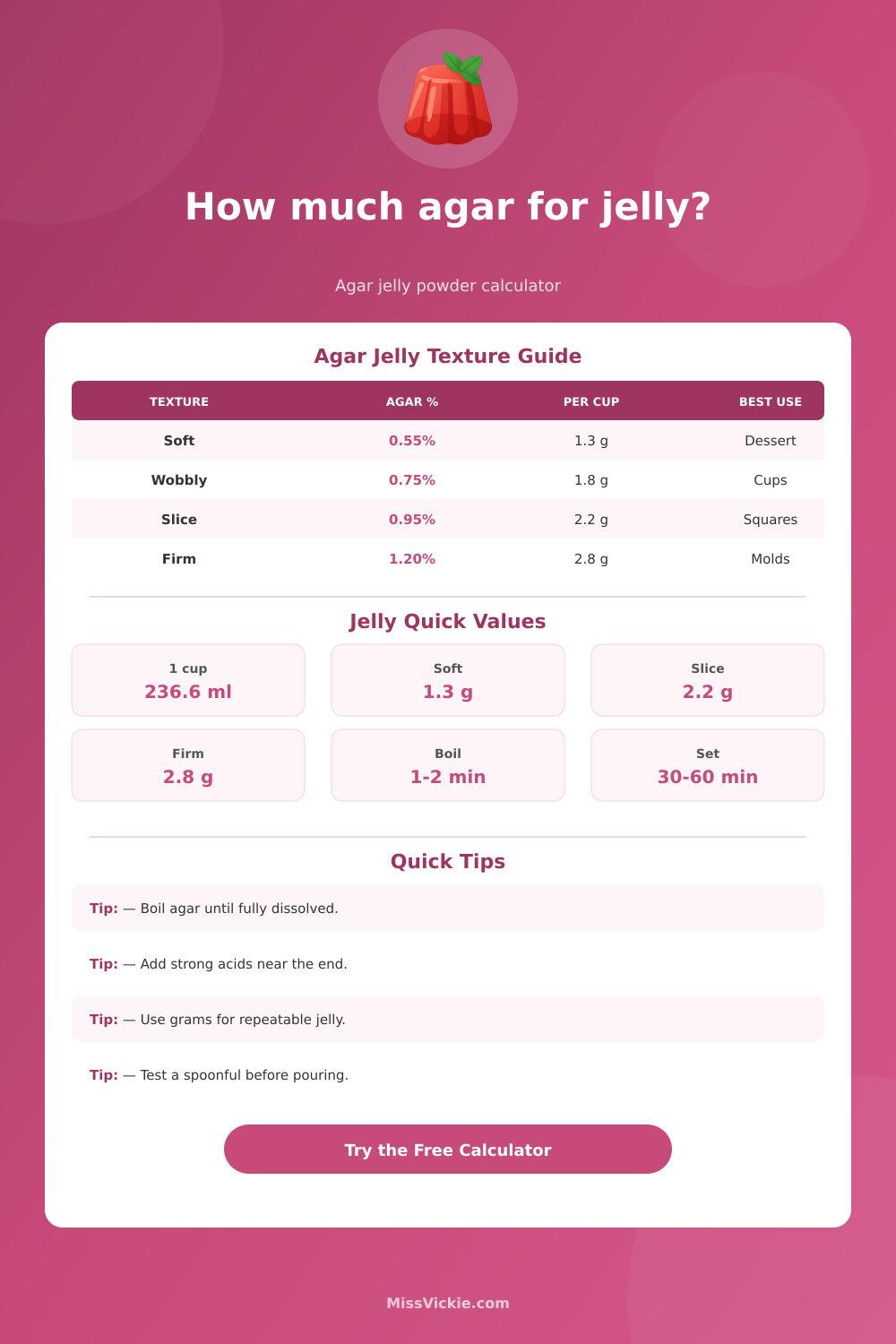
| Texture Goal | Base Agar Percent | Approx Per Cup | Best Jelly Use | Handling Cue |
|---|---|---|---|---|
| Soft spoon jelly | 0.55% | 1.3 g | Delicate dessert cups | Scoopable, not for unmolding |
| Wobbly dessert jelly | 0.75% | 1.8 g | Fruit jelly cups and bowls | Clean spoon break with bounce |
| Clean slice jelly | 0.95% | 2.2 g | Squares, layered desserts | Use for neat knife cuts |
| Firm molded jelly | 1.15% | 2.7 g | Bundt molds and domes | Releases better from molds |
| Extra firm cubes | 1.35% | 3.2 g | Drink cubes and buffet pieces | Holds shape after transport |
| Layered cake insert | 1.05% | 2.5 g | Entremets and cake layers | Firm enough for stacking |
| Formula Factor | Low Impact | Medium Impact | High Impact | What It Means |
|---|---|---|---|---|
| Acidity | pH above 5, x 1.00 | pH 4 to 5, x 1.07 | pH below 3, x 1.28 | More acid weakens the set if agar cooks in it too long. |
| Sugar | unsweetened, x 1.03 | dessert sweet, x 0.98 | heavy syrup, x 0.94 | Sugar can help body, but syrupy liquids still need full dissolving. |
| Fruit solids | clear liquid, x 1.00 | medium puree, x 1.10 | heavy puree, x 1.18 | Pulp interrupts a clean gel, so the calculator adds agar. |
| Alcohol | none, x 1.00 | 5% to 12%, x 1.10 | 12% to 20%, x 1.18 | Add alcohol after agar dissolves when the recipe allows it. |
| Product strength | strong powder, x 0.90 | standard powder, x 1.00 | flakes or weak agar, x 1.35 | Flakes vary widely; grind or weigh them for better control. |
| Batch Size | Soft Jelly | Wobbly Jelly | Slice Jelly | Firm Jelly |
|---|---|---|---|---|
| 2 cups / 473 ml | 2.6 g | 3.5 g | 4.5 g | 5.4 g |
| 4 cups / 946 ml | 5.2 g | 7.1 g | 9.0 g | 10.9 g |
| 6 cups / 1.42 L | 7.8 g | 10.6 g | 13.5 g | 16.3 g |
| 8 cups / 1.89 L | 10.4 g | 14.2 g | 18.0 g | 21.8 g |
| 12 cups / 2.84 L | 15.6 g | 21.3 g | 27.0 g | 32.7 g |
Plant-based, sets at room temperature, and melts only when heated well above warm room conditions.
Animal-based, melts in the mouth, and needs refrigeration for a reliable dessert set.
Best with fruit, sugar, and acid balance rather than clear layered jelly cups.
Useful in milk systems but less common for home fruit jelly recipes.
Agar agar is a substance that turns liquid into a solid form that holds its own specific shape. The amount of agar agar that is used will determine whether the agar agar product will be a soft dessert or a firm slice. Because agar agar react differently from gelatin and pectin, the correct amount of agar agar must be used to achieve the desired texture.
Any changes to the liquid ingredients, the acidity of the liquids, and the solids in the liquid will change the final texture of the agar agar gel. The agar agar calculator will help you find the correct amount of agar agar by performing the calculation necessary to determine the amount of agar agar needed according to the volume of the liquid and the desired texture of the agar agar jelly. By using the agar agar calculator, you can ensure that the agar agar will not be too loose with too little agar agar, nor will the agar agar become too rubbery with too much agar agar.
How to Use the Agar Agar Calculator
The first step in using the agar agar calculator is to enter the base amount of the liquid into the calculator. The amount of liquid can be measured in cups, but additional measurements in milliliters or ounce can also be added to that base amount. Following the entry of the amount of the liquid that is to be used in the agar agar product, you will select the desired texture.
Agar agar products that are to be wobbly will require less agar agar than products that are to be firm. Products that are to be molded will require more agar agar than those that are to be served as cups of agar agar. Following the selection of the texture that is desired, the agar agar calculator will provide the number of grams of agar agar that is to be used in the product.
Another variable that will impact the amount of agar agar that is to be used is the acidity of the product. Ingredients that is acidic, such as lemon and pineapple juice, will weaken the agar agar structure. If high acidity is selected in the agar agar calculator, the calculator will indicate the amount of agar agar to add to the product beyond the agar agar calculated for the liquid and texture.
Agar agar should be dissolved in a neutral liquid first, then you can add the acidic liquid to the agar agar solution. The amount of sugar and solids from fruit will also impact the amount of agar agar required. Light syrups will aid in agar agar gel setting, but heavy syrups may reduce the amount of agar agar that is required.
If medium or heavy amounts of fruit solids are to be included in the agar agar product, the amount of agar agar should be increased in the recipe to counteract the effect that the fruit solids may have on the setting of the agar agar gel. Another ingredient that may need to be adjusted for the agar agar recipe is alcohol. At low levels, alcohol will have a minimal impact on the amount of agar agar required for the recipe.
However, higher levels of alcohol, such as wine, will interfere with the agar agar setting. The agar agar calculator will show the weight of agar agar to add to the agar agar solution to compensate for the alcohol interference. The alcohol should be added after the agar agar solution has boiled to the full boil and cleared.
The strength of the agar agar that is to be used in the product will affect the weight of the agar agar. If the agar agar that is used in the recipe is standard agar agar powder, it will behave in a certain way. However, if agar agar flakes or weaker forms of agar agar are used, more weight of the agar agar will be required.
The agar agar calculator can be set to a specific type of agar agar, allowing the calculator to account for the difference in strength of agar agar. Many people may not account for the type of agar agar that is used in the recipe. This could be the reason agar agar jelly does not behave as the recipe states.
The amount of agar agar that is calculated in grams will also show the amount of teaspoons of agar agar that are required for the product. The amount in grams will also display the number of grams of agar agar in each cup of the finished agar agar product. These measurements are helpful for making more amounts of the agar agar product.
The calculator will also show the chill time for the agar agar product and the target simmer time for the agar agar jelly. Agar agar products will set at room temperature, while products with gelatin require refrigeration to allow the gelatin to set. This is because agar agar will form a firm structure that will remain solid until heated to the temperature of the human body.
Because agar agar is heat stable, you can pour hot liquids over agar agar products without melting the agar agar at the point of contact with the hot liquid. These options are made available for people to use agar agar for applications beyond agar agar jelly with elastic and firm textures. Some of the most common mistakes in the preparation of agar agar products are measured with volume instead of weight.
The other most common mistake is failing to boil agar agar for long enough to dissolve the agar agar completely. To avoid these mistakes, a spoonful test can be performed prior to pouring the liquid containing the agar agar. If the measured spoonful of the agar agar product is still in a liquid form after ten minutes of being refrigerated, it means that the agar agar has not activated properly.
This may be due to not using enough agar agar according to the volume of the liquid and the acidity of the product. The reason to weigh the agar agar is that weighing agar agar in grams will remove the variability in the amount of agar agar according to volume measurements. When the agar agar is weighed, the amount of agar agar will be able to be replicated with precision.
The reference tables show the percentage of agar agar for specific textures, but the agar agar calculator will apply that percentage to the ingredients that is to be used in the product. The most common batch size for agar agar products is between four and eight cups of liquid. The presets for the calculator can be used for setting recipes for products like coconut molds or wine squares.
The presets can be adjusted for the acidity and the solids content in the agar agar product. The amount of agar agar in grams will change immediately when changing the acidity level of the product. The last step in using the agar agar calculator is to make a small batch of the product to test the agar agar settings.
As the juices and solids of the fruit may behave differently in a mixture, it is a good idea to make a small batch and place it in a ramekin to set. If the agar agar is too soft, you will need to add more agar agar to the remaining batches of the product. If the agar agar is too firm, the amount of agar agar will need to be reduced in the remaining batches of the product.
This will allow the person preparing the agar agar product to rely on the agar agar calculator whenever they are changing the ingredients of the product.