Gelatin sheets, powder grams, bloom strength, hydration water, and final set level
How Many Gelatin Sheets Equal Powder Calculator
Convert gelatin sheets to powdered gelatin or powdered gelatin back to sheets using sheet weight, bloom strength, powder bloom, recipe liquid, bloom water, and kitchen risk adjustments.
Choose a real kitchen scenario, then adjust sheet grade, powder bloom, recipe liquid, hydration ratio, acid level, sugar level, and batch scaling.
Conversion Breakdown
Lower bloom and usually heavier sheets, so each sheet can equal more powder by weight than it looks.
Middle strength sheets often used in European dessert recipes and pastry formulas.
Closest to common powdered gelatin math when one sheet weighs about 2 grams.
Higher bloom sheets are lighter but stronger, so fewer grams are needed for a similar set.
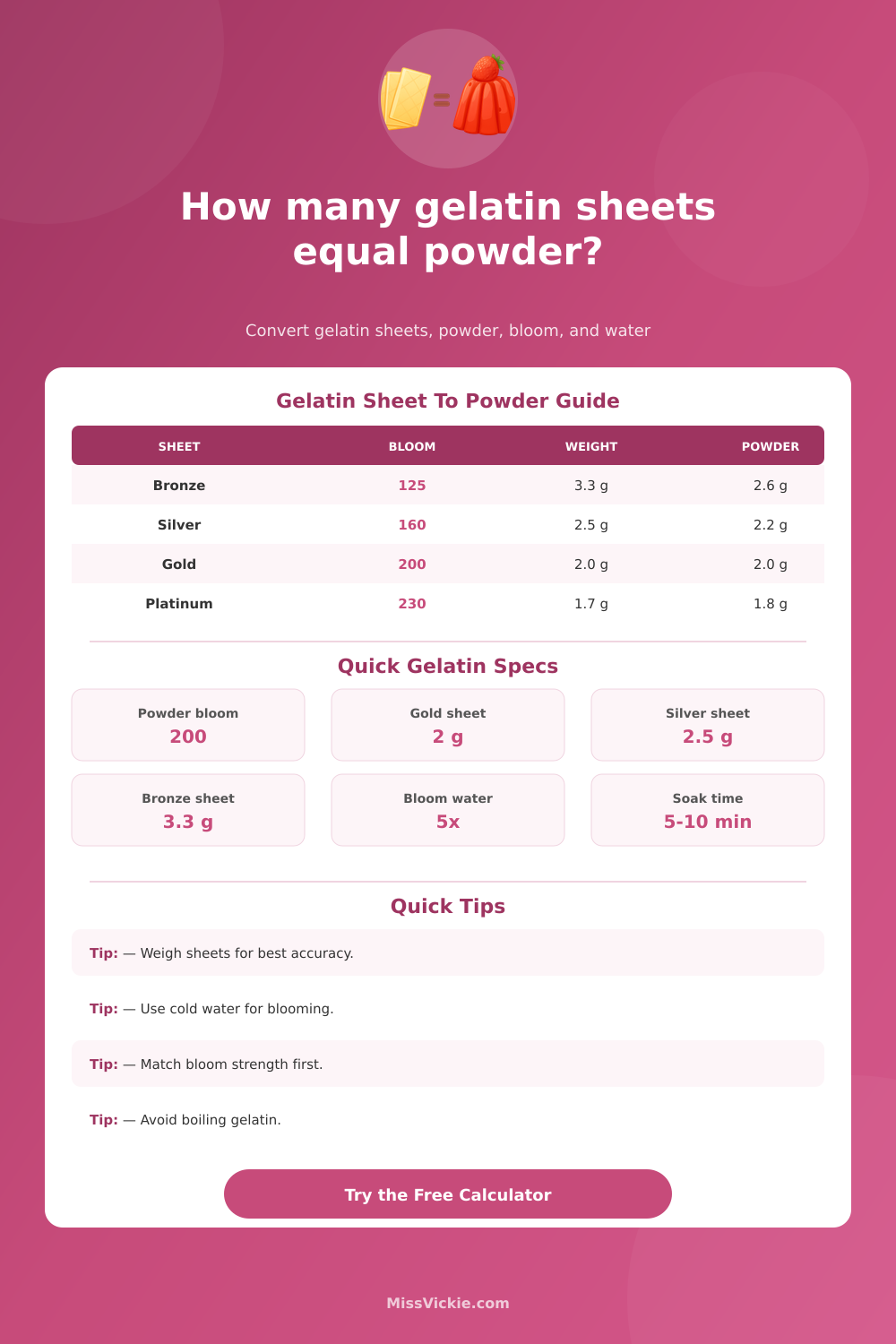
| Sheet grade | Typical bloom | Common sheet weight | Approx 200-bloom powder equivalent |
|---|---|---|---|
| Bronze gelatin sheet | About 125 bloom | 3.3 g per sheet | 3.3 x sqrt(125 / 200) = about 2.6 g powder |
| Silver gelatin sheet | About 160 bloom | 2.5 g per sheet | 2.5 x sqrt(160 / 200) = about 2.2 g powder |
| Gold gelatin sheet | About 200 bloom | 2.0 g per sheet | 2.0 x sqrt(200 / 200) = about 2.0 g powder |
| Platinum gelatin sheet | About 230 bloom | 1.7 g per sheet | 1.7 x sqrt(230 / 200) = about 1.8 g powder |
| Conversion formula | Use it for | What it means | Kitchen note |
|---|---|---|---|
| Powder grams = sheet grams x sqrt(sheet bloom / powder bloom) | Replacing sheets with powder | Adjusts sheet weight to the target powder strength | Best when you know the sheet grade and powder bloom. |
| Sheet grams = powder grams x sqrt(powder bloom / sheet bloom) | Replacing powder with sheets | Finds the sheet weight needed for equal setting power | Divide by one-sheet weight to get the sheet count. |
| Bloom water = powder grams x hydration ratio | Powdered gelatin only | Sizes cold water that stays in the recipe | Subtract this water from recipe liquid if the formula is tight. |
| Effective percent = 200-bloom equivalent gelatin / liquid | Texture check | Compares the conversion to the final dessert base | Useful for panna cotta, jelly, mousse, and cake inserts. |
| Final texture | 200-bloom equivalent percent | Typical use | How the conversion should feel |
|---|---|---|---|
| Soft spoon dessert | 0.5% to 0.8% | Cream cups, soft custards, tender dairy desserts | Delicate wobble, not strong enough for tall unmolding. |
| Panna cotta wobble | 0.8% to 1.2% | Panna cotta, Bavarian cream, light chilled desserts | Clean set with movement and a soft spoon texture. |
| Sliceable layer | 1.2% to 1.8% | Mousse cakes, cheesecake layers, fruit inserts | Holds a cut edge after full chilling. |
| Firm jelly or gummy | 1.8% to 3.0% | Clear jelly, aspic, marshmallow, gummy candy | Firm bite, stronger chew, and less wobble. |
| Ingredient condition | Effect on set | Adjustment to consider | Examples |
|---|---|---|---|
| Low acid dairy or stock | Normal gelatin behavior | Use the direct bloom formula | Cream, milk, custard base, chicken stock. |
| Fruit puree or wine | Can soften the gel slightly | Add a small allowance or target the higher end | Berries, apple cider, wine jelly, fruit mousse. |
| High acid liquid | Can noticeably weaken set | Increase gelatin or reduce acid after testing | Lemon, passion fruit, vinegar, sour cherry. |
| Fresh enzyme fruit | May stop gelatin from setting | Heat fruit first or use canned fruit | Fresh pineapple, kiwi, papaya, guava. |
When using a recipe that call for gelatin sheets but only has powdered gelatin, the user must find a way to convert the gelatin sheets into the equivalent amount of powdered gelatin. The conversion of gelatin sheets to powdered gelatin isnt a simple mathematical process due to the differences in the properties of each form of the ingredient. The properties of the ingredient can include properties like bloom strength of the ingredient, and the weight of the ingredient.
If the user doesnt account for the bloom strength and weight of the powdered gelatin in the conversion of the sheets, the setting of the candy or dessert will not be correctly. Gelatin contains proteins that will create a network that will hold the water in the mixture. The bloom strength of the gelatin is a means of measuring the firmness of the protein network.
How to Convert Gelatin Sheets to Powdered Gelatin
The firmness of the network will change depending on the type of gelatin sheets that are used. For instance, gold gelatin sheets has a bloom strength of 200 bloom, and are similar to powdered gelatin products available in grocery stores. Bronze gelatin sheets have a bloom strength of 125 bloom, and are a heavier product than the gold gelatin sheets.
Finally, platinum gelatin sheets have a bloom strength of 230 bloom, and are a lighter product than the gold sheets. Thus, because platinum sheets have a more higher bloom strength than bronze sheets, it is possible to use a smaller quantity of the sheets with a higher bloom strength than those with a lower bloom strength. The calculator used in conjunction with this article will allow the user to easily calculate the change of gelatin sheets to powdered gelatin.
The user will be required to enter the grade of the gelatin sheets, the bloom strength of the powdered gelatin, the total volume of the liquid to be used in the make-up of the recipe, the texture that is to be achieved by the end product, and any ingredients that will impact the setting of the gelatin. The calculator will output for the user the weight of the powdered gelatin that should be used, the number of sheets of powdered gelatin that will contain that amount of gelatin, and the bloom-water figure for the amount of powdered gelatin that will be used in the recipe. The bloom-water figure will indicate how much water will be required to bloom the powdered gelatin.
This measurement is important for the user to know in that the water that is used to bloom the powdered gelatin will remain in the end product. To bloom the powdered gelatin, it is necessary to add the powdered gelatin to a precise amount of water that will remain within the finished dessert. By contrast, the process of blooming gelatin sheets requires that the user soaks the sheets in water, and then squeezed to remove the excess water from the sheets.
Thus, if someone chooses to use powdered gelatin in place of gelatin sheets as called for in the recipe, it is important to use the bloom-water amount of powdered gelatin to determine whether the water within the recipe should be adjusted to allow for blooming of the powdered gelatin. Ingredients that contain enzymes like proteases will break down the proteins within the gelatin. Ingredients like fresh pineapple, kiwi fruit, and papaya contain these enzymes.
Additionally, the use of high-acid liquids will impact the setting of the gelatin. Ingredients like lemon juice and passion fruit juice is high in acid. The inclusion of these ingredients in the recipe will require an adjustment in the amount of gelatin that is used; the adjustment will require the user to increase the amount of gelatin that is used.
The enzymes and acid will soften the structure of the protein network of the gelatin, so the use of more gelatin will help to ensure that the desired texture is achieved. The level of sugar in the recipe can also impact the setting of the gelatin. If the amount of sugar is high within the recipe, the texture will be firmer than if the amount of sugar is lower.
To accommodate for this difference in texture, the user will adjust the amount of gelatin to account for the high amount of sugar. Thus, if the user decides to use this calculator to determine the amount of powdered gelatin to use in place of gelatin sheets, it is recommended that they use the correction factor for sugar levels to create an accurate measurement. While it is still recommended that the user taste the final product to ensure that the texture is to the desired level, use of the correction factor will aid in the achievement of the desired texture.
Another table included with the calculator will display the amount of powdered gelatin that is equivalent to each type of gelatin sheet. Many individuals may believe that one sheet of gelatin contains the same amount of gelatin as one teaspoon of powdered gelatin. However, this belief is often incorrect.
The belief is only correct for instances when the type of sheets contains the same bloom strength as the powdered gelatin, and when the amount of liquid to be used in the recipe is small and limited. Finally, another variable that can impact the strength of the gelatin is the temperature at which the ingredient is boiled. If the gelatin is boiled for longer than one or two minutes, the strength of the setting of the gelatin will be lost.
An option is provided within the calculator for the user to account for the melting temperature of the gelatin sheets. For instance, warming the gelatin to between 120 and 140 degrees is acceptable, but boiling the liquid will require the use of more gelatin sheets. The size of the batch that is to be prepared is another variable that will impact the use of this conversion table for gelatin sheets to powdered gelatin.
For small batches of desserts that contain the amount of gelatin that is calculated by the conversion table, a slight inaccuracy in the amount of gelatin will not greatly impact the outcome. However, for large batches, even a small inaccuracy in the amount of gelatin sheets will result in an incorrect amount of gelatin being used. Thus, the batch-multiplier box allows for the user to adjust the measurement according to the size of the batch that is to be prepared.
Additionally, this box will indicate if the amount of gelatin sheets that are contained in the packet will be enough to prepare the amount of dessert that is desired to be prepared. The relationship between the weight of the gelatin, the bloom strength of the gelatin, and the amount of the ingredient that is contained within the liquid is the most important relationship to understand regarding the use of the calculator. The other elements of the calculator are a means of determining each of these individual variables.
Thus, the most important input for the user is the bloom strength and grade of the gelatin; these variables should be entered as accurately as possible within the calculator. Any inaccuracies in the measurement of these variables will result in inaccuracies in the setting of the end product.