How Much Vegetable Oil to Melt Chocolate Calculator
Estimate neutral vegetable oil for melted chocolate by chocolate weight, format, thinning goal, serving temperature, and finish priority. This is for soft glossy flow, not a hard coconut-oil shell.
Load a kitchen scenario, then adjust the chocolate type, flow target, temperature, and rounding style before you melt.
Vegetable Oil Chocolate Breakdown
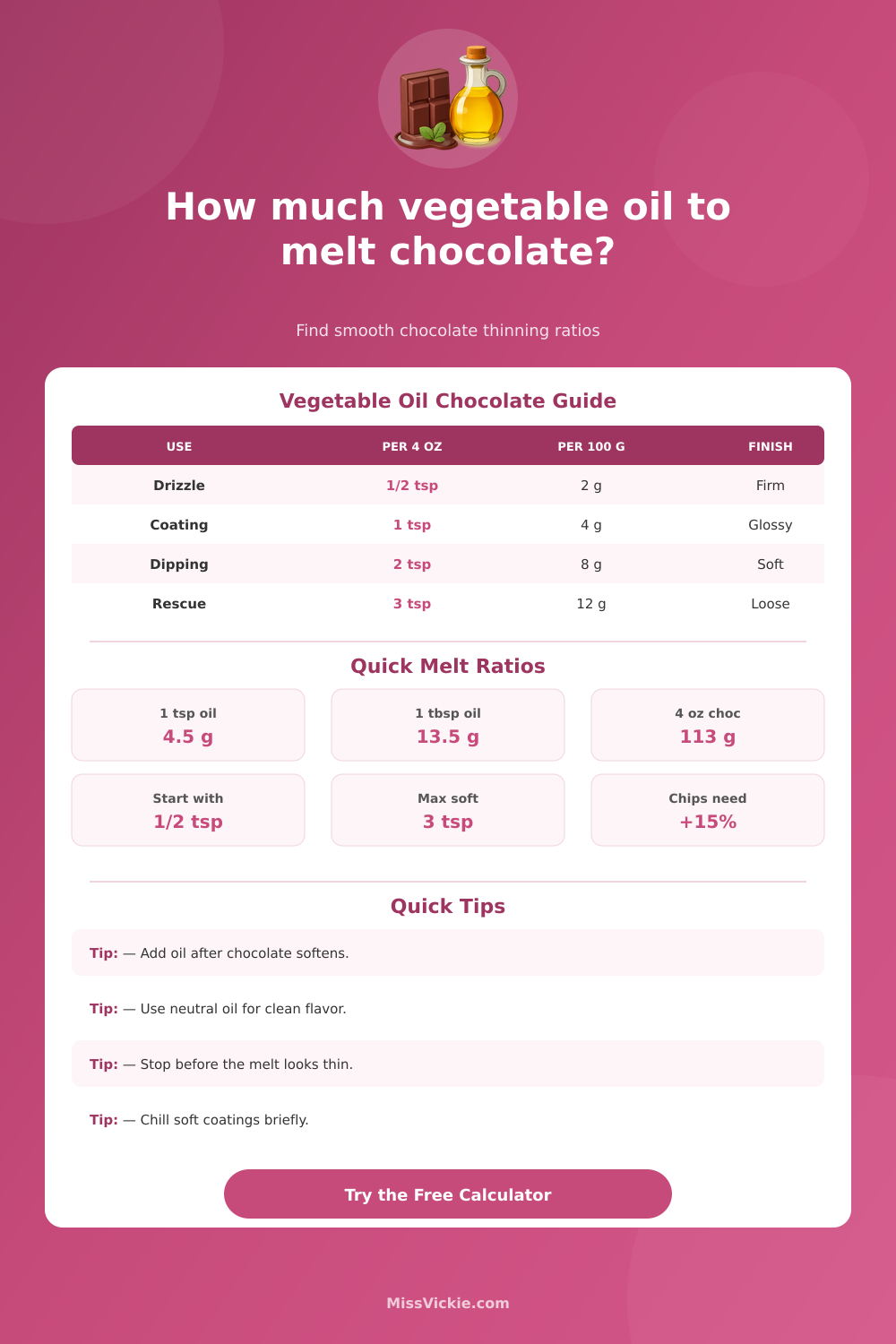
| Goal | Vegetable Oil Per 4 oz Chocolate | Metric Per 100 g | Best Use |
|---|---|---|---|
| Fine drizzle | 1/2 to 3/4 teaspoon | 2 to 3 g | Brownies, biscotti, quick zigzags, and firmer lines. |
| Glossy coating | 1 to 1 1/2 teaspoons | 4 to 6 g | Pretzels, clusters, cookies, and thin spreadable layers. |
| Fruit dipping | 1 1/2 to 2 teaspoons | 6 to 8 g | Strawberries, banana pieces, marshmallows, and soft coatings. |
| Soft glaze | 2 to 2 1/2 teaspoons | 8 to 10 g | Cakes and pastries where a sliceable soft finish is fine. |
| Thick chip rescue | 2 1/2 to 3 teaspoons | 10 to 12 g | Only when melted chips remain stiff after gentle heating. |
| Chocolate Format | Oil Adjustment | Why It Changes | Set Note |
|---|---|---|---|
| Dark baking bar | Baseline | Chopped bar chocolate melts evenly and needs modest thinning. | Best chance of a cleaner set. |
| Semisweet bar | Slightly less | Sugar and cocoa butter balance usually flows well. | Good for drips and coatings. |
| Milk chocolate bar | Less oil | Milk solids and sugar make it naturally softer. | Can turn soft quickly. |
| White chocolate bar | More careful oil | It scorches and thickens easily, so add small amounts slowly. | Keep heat very gentle. |
| Chocolate chips | More oil | Chips may contain stabilizers that resist smooth melting. | Stays softer after thinning. |
| Compound wafers | Less oil | They are already made for coating and flow. | Too much oil can feel waxy. |
| Chocolate Amount | Light Drizzle | Glossy Coating | Soft Dipping |
|---|---|---|---|
| 4 oz / 113 g | 1/2 tsp | 1 tsp | 2 tsp |
| 8 oz / 227 g | 1 tsp | 2 tsp | 4 tsp |
| 12 oz / 340 g | 1 1/2 tsp | 1 tbsp | 2 tbsp |
| 1 lb / 454 g | 2 tsp | 4 tsp | 2 tbsp plus 2 tsp |
| 2 lb / 907 g | 4 tsp | 2 tbsp plus 2 tsp | 5 tbsp plus 1 tsp |
| Serving Condition | Oil Strategy | Expected Texture | Best Handling |
|---|---|---|---|
| Chilled dessert | Full calculated amount | Glossy and sliceable | Set in the refrigerator before serving. |
| Cool room | Normal to slight extra | Soft but stable | Let coating dry on parchment. |
| Normal room | Use a balanced amount | Glossy with a tender bite | Stop once the chocolate flows smoothly. |
| Warm room | Reduce the oil | Softer and slower to set | Chill briefly and avoid stacking. |
Neutral, liquid, and easy to measure, but it keeps chocolate softer after setting.
Firms more when chilled and works well for ice cream shells, but can add flavor.
Thickens less than butter and gives coatings body, though it is heavier than liquid oil.
The best match for chocolate structure, but less common in everyday kitchens.
Melting chocolate can pose a problem in that chocolate often stiffens within a bowl or doesnt coat the foods to which it is added. Adding vegetable oils to chocolate can solve these problem with the melted chocolate. Vegetable oil will interfere with the cocoa butter crystals within the chocolate, and it will lower the viscosity of the melted chocolate.
Lower viscosity means that the chocolate will be easy to pour and coat foods. The amount of vegetable oil that you must add to the melted chocolate depend upon the type of chocolate that is being used and for what purpose. For instance, dark baking bars, milk chocolate, and white chocolate all behave differently when melted.
How to Thin Melted Chocolate with Vegetable Oil
Chocolate chips contains stabilizers that prevent the chips from clumping together when stored in bags, and thus, chocolate chips melt differently than chocolate bars. Additionally, the purpose for which you will use the chocolate will impact the amount of vegetable oil required. For instance, you will add vegetable oil in different amount to thin chocolate drizzles compared to chocolate dipping coatings.
Finally, the temperature of the area in which the chocolate and vegetable oil are melted will impact the chocolate; warm temperatures will produce a softer chocolate than cool temperatures. The calculator tool permit you to enter each of these variables. For instance, you will first enter the amount and the format of the chocolate that you plan to use.
You will then select the use case for the chocolate from the drop down menu. Different uses of chocolate require different amount of vegetable oil to ensure that the chocolate maintains its desired lifespan on the food item. Additionally, you can select flow preference for the chocolate, and you can select the finish priority for the chocolate.
If you set the finish priority to a gloss finish, the chocolate will be softer. However, if you set the finish priority to firmness, the chocolate will harden. A softer chocolate is beneficial for dipping cookies that contain chocolate that sets to room temperature.
However, if the chocolate is too soft, the cookie pieces may stick to one another. The reference tables at the top of the page provide an immediate understanding of the amount of vegetable oil that can be added to chocolate melts of various weight. The tables indicate that four ounces of chocolate will require only half a teaspoon of vegetable oil if it is to be glazed onto food items, but will require two teaspoons of vegetable oil to make chocolate that food items will dip into.
The adjustment table indicate that chocolate chips will require more vegetable oil than chocolate bars because chocolate chips contain stabilizers that prevent them from melting smooth. Finally, you must take care when adding vegetable oil to white chocolate because white chocolate will scorch and thicken quickly if added to overheated chocolate. These variables are accounted for in the calculator so that memory of these factor is not required to use the calculator.
You should avoid the mistake of adding all of the vegetable oil to the chocolate at once. Because vegetable oil is a liquid, adding vegetable oil to the melted chocolate will thin the chocolate almost immediately. Instead, you should begin with a small amount of vegetable oil, add the vegetable oil to the chocolate, and allow the two ingredient to settle.
After allowing the chocolate and vegetable oil mixture to settle, you can always add more vegetable oil to the mixture if the chocolate is too thick to use. However, you should avoid this mistake altogether because adding too much vegetable oil to the chocolate will prevent the chocolate from properly setting, the chocolate will end up tasting grease if you over-thin it. The temperature at which you will serve the chocolate will also impact the type and percentage of vegetable oil that you use in your chocolate.
For instance, if you will be serving your chocolate-coated items when they are chilled, you can use a higher percentage of vegetable oil. The cold temperature will firm the chocolate coating. On the other hand, if you will serve the chocolate to guests in a warm room, you should use less vegetable oil.
The warmth of the room will make the chocolate coated items even softer. The calculator will adjust for these different serving temperature automatically once you have selected your serving condition in the tool. Vegetable oil is only one of several ingredient that can be used to thin melted chocolate.
Other ingredients that may be used include coconut oil, shortening, and cocoa butter. Coconut oil will lead to a firmer shell of chocolate when the chocolate is chilled. The downside to using coconut oil is that it will add a specific flavor to the chocolate.
Shortening will provide body to the chocolate without adding much flavor to the chocolate. However, shortening will feel heavier than vegetable oil. Finally, cocoa butter will preserve the snap and the temper of the chocolate but is less convenient for most people to use.
Most people prefers vegetable oil because it is flavorless and easy to measure. The calculator will perform the mathematics for you once you have selected your type of chocolate, your use for the chocolate, your flow preference, and the serving temperature for the chocolate-coated items. The calculator will convert the ounces of chocolate to grams, or the grams of chocolate to ounces.
Additionally, the calculator will determine the total weight of the chocolate and vegetable oil mixture. Finally, the calculator will determine the percentage of vegetable oil that should be added to the melted chocolate by weight. If the percentage of vegetable oil determined by the calculator is three percent or less, the chocolate will remain firm.
If the percentage of vegetable oil is seven percent or more, the chocolate will be noticeably softer. Using the chocolate calculator will eliminate the guesswork in determining the amount of vegetable oil to add to your melted chocolate. The calculator will consider each of the variables for your specific project.
For example, if your chocolate must be thin, the calculator will suggest using more vegetable oil than if you were to use the chocolate for a project that requires a firm chocolate coating. Additionally, because vegetable oil thin chocolate, you can always add more vegetable oil once the chocolate has been prepared. However, you can not remove vegetable oil once you have added it to the chocolate.
By using the vegetable oil calculator, you can be sure that the amount of vegetable oil that is added to the melted chocolate will lead to a predictable outcome to your specific project.