How Much Tomato Sauce for Pizza Calculator
Calculate pizza tomato sauce from actual sauced surface area, not pasta portions. Choose diameter, pizza count, rim gap, sauce thickness, sauce style, and bake preference for cups, tablespoons, grams, and milliliters.
🍕Pizza Sauce Presets
Pizza sauce is spread thinly over a round or pan surface, so the calculator uses sauce coverage per square inch. Pasta sauce calculators use servings of noodles, which is a different kitchen problem.
🫙Sauce Calculator Inputs
Pizza Shape and Size
Sauce Style and Adjustment
Your Pizza Tomato Sauce Amount
🧂Pizza Sauce Reference Cards
📋Pizza Tomato Sauce Tables
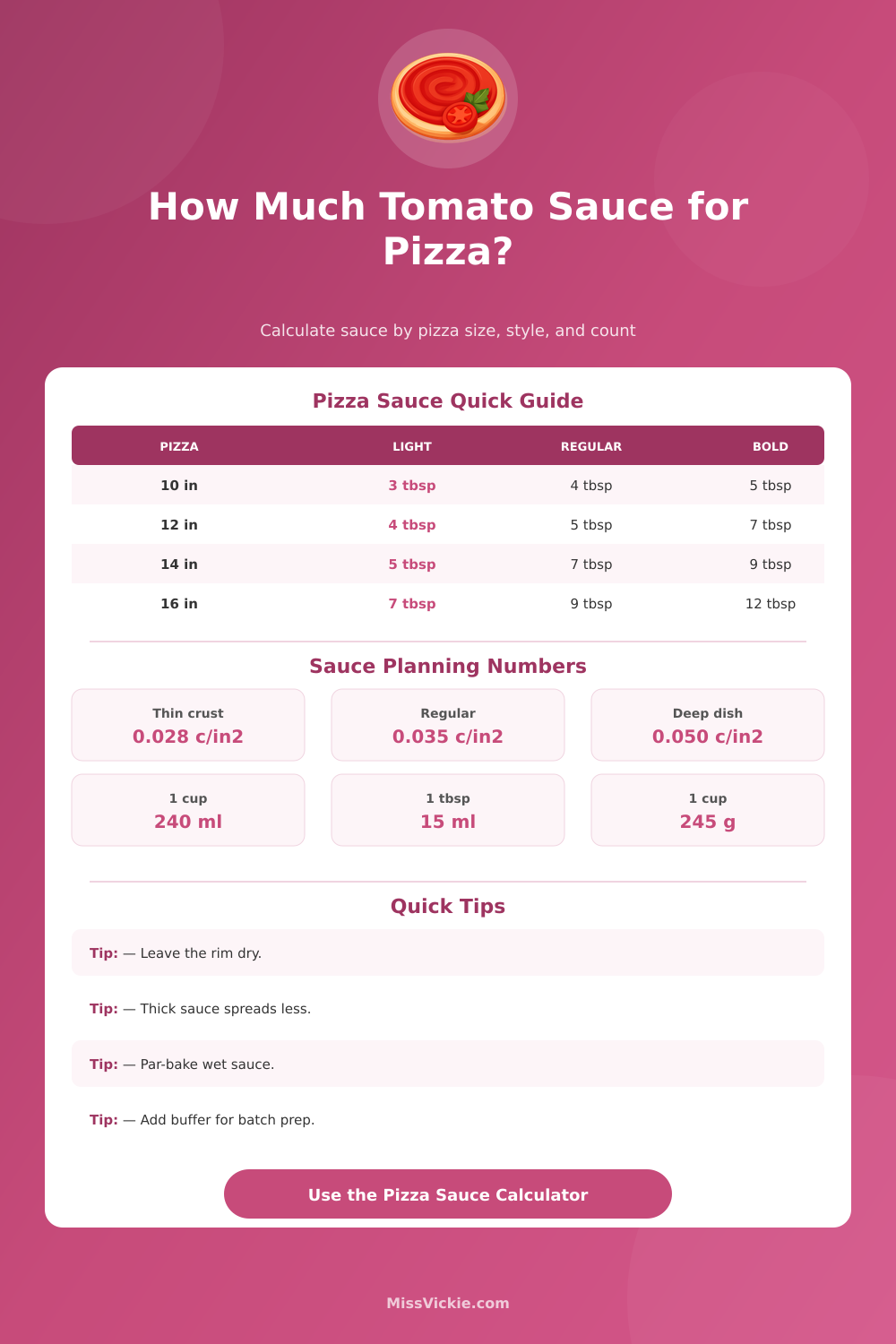
| Pizza size | Sauced area with rim | Light sauce | Regular sauce |
|---|---|---|---|
| 8 inch round | About 38 sq in | 2.1 tbsp | 2.7 tbsp |
| 10 inch round | About 63 sq in | 3.1 tbsp | 3.8 tbsp |
| 12 inch round | About 95 sq in | 4.3 tbsp | 5.3 tbsp |
| 14 inch round | About 133 sq in | 5.8 tbsp | 7.1 tbsp |
| 16 inch round | About 177 sq in | 7.6 tbsp | 9.4 tbsp |
| 18 inch round | About 227 sq in | 9.7 tbsp | 12.0 tbsp |
| Sauce coverage | Cups per sq in | Best pizza use | Kitchen note |
|---|---|---|---|
| Light swipe | 0.0027 to 0.0030 | Thin crust, frozen upgrade, kids pies | Shows cheese and toppings clearly. |
| Regular layer | 0.0034 to 0.0038 | Most home, delivery, and hand tossed pies | Balanced tomato flavor without soggy center. |
| Generous layer | 0.0045 to 0.0050 | Red-sauce-forward cheese pizza | Use thicker sauce or a hotter bake. |
| Deep dish layer | 0.0056 to 0.0065 | Deep dish, Sicilian, grandma pizza | Often applied above cheese or in a thicker stripe. |
| Sauce type | Approx density | Spread behavior | Use this adjustment |
|---|---|---|---|
| Smooth passata | 245 g per cup | Spreads evenly and thinly | Baseline amount. |
| Crushed tomato | 250 g per cup | Chunkier spoon coverage | Add about 4% for gaps. |
| Paste blend | 270 g per cup | Concentrated and clingy | Use 8% less by volume. |
| Cooked marinara | 255 g per cup | Thicker after simmering | Use 2% less for regular crust. |
| Raw tomato sauce | 242 g per cup | Loose and bright | Use less on wet dough. |
| Tomato cream sauce | 248 g per cup | Richer, softer flavor | Keep layer light under heavy cheese. |
| Pizza count | 12 inch regular | 14 inch regular | 16 inch regular |
|---|---|---|---|
| 1 pizza | About 1/3 cup | About 1/2 cup | About 2/3 cup |
| 2 pizzas | About 2/3 cup | About 1 cup | About 1 1/4 cups |
| 4 pizzas | About 1 1/3 cups | About 2 cups | About 2 1/2 cups |
| 8 pizzas | About 2 2/3 cups | About 4 cups | About 5 cups |
| 12 pizzas | About 4 cups | About 6 cups | About 7 1/2 cups |
⚖Pizza Sauce Comparison Grid
Pizza sauce vs pasta sauce
Pizza uses a thin surface layer. Pasta sauce is portioned by bowl or noodles, so the totals are much larger per person.
Round vs sheet pizza
Round pizza loses a dry rim. Sheet pizza often uses nearly the full rectangle, especially Sicilian and grandma styles.
Thin vs pan crust
Thin crust needs restraint because moisture has nowhere to hide. Pan pizza can take more sauce, especially after a par-bake.
Passata vs paste blend
Passata spreads fast and light. Paste blends are denser, so the same spoonful tastes stronger and weighs more.
💡Pizza Sauce Tips
Keep the outer crust mostly dry so it browns instead of steaming. A 1/2 to 1 inch rim gap also keeps sauce from leaking onto the stone or pan.
If a pizza tastes bland but looks watery, simmer the sauce or add tomato paste. More loose sauce can soften the dough before the cheese browns.
Applying the correct amount of pizza sauces is important because the amount of pizza sauce that is used will determine the texture and flavor of the pizza. Using too little pizza sauce will make the cheeses on the pizza taste flat. Using much pizza sauce will make the center of the pizza become soggier before the edges of the pizza have a chance to finish browning.
The amount of pizza sauce that touch the dough is the primary variable that will determine whether or not a pizza is balanced or if it ends up being soggy. Many cooks will attempt to guess the amount of pizza sauce that should be used by simply pouring the pizza sauce from the jars until it appear that the sauce is appropriate. However, guessing the amount of pizza sauce that is needed will often create inconsistent result for the pizzas made using this method.
How Much Pizza Sauce to Use
For instance, a twelve-inch pizza will have less surface area than a fourteen-inch pizza. However, a fourteen-inch pizza will not require twice the amount of pizza sauce as is required for a twelve-inch pizza. This is due to the fact that a portion of the surface area of a large pizza will always have a dry rim.
The rim of the pizza should remain bare of sauce so that the crust of the pizza can become browned during the baking process. Adding sauce to this rim will cause the crust to steam rather than become crispy. The pizza sauce calculator allows cooks to calculate the amount of pizza sauce that should be used in the preparation of a batch of pizzas based off the diameters of each pizza, the rim gap, the number of pizzas that need to be prepared, and the thickness of the sauce layer that is desired.
Furthermore, the calculator also allows for adjustments to be made for the different types of pizza sauce that can be prepared; different types of sauce have different densities. For instance, smooth passata sauce will spread different than crushed tomatoes. Therefore, the sauce calculator accounts for the sauce densities.
The sauce calculator will provide the total amount of sauce that will be needed for all of the pizzas that are to be prepared, as well as the amount of sauce that will be needed for each individual pizza. These two amounts can help cooks to determine whether or not they have enough sauce for the batch of pizzas, or if they will need to purchase additional sauce for the remaining pizzas in that batch. In addition to the factors that the sauce calculator accounts for, the type of crust that is to be used for each pizza will also impact the amount of sauce that should be used.
For instance, thin crust pizzas will not be able to absorb the same amount of sauce as a hand-tossed pizza. Deep-dish crusts, however, can take in more sauce due to the longer amount of time that the center of the crust has to set while baking. These factors are also accounted for in the calculator; cooks can select the type of crust that they would like to use in their recipe, as well as the amount of moisture that they would like to be baked into their crust.
Thus, the result that the calculator provides is not the rule that all cooks should use for their pizzas, but instead is the starting point from which adjustments can be made based upon the type of crust that is to be used. Although the sauce calculator is a helpful tool that accounts for many variables, there are some variables of the recipe that the sauce calculator cannot account for. For instance, the amount of juice that is contained in each batch of tomatoes is not the same; some batches have more juice than other.
Additionally, the passata sauce may behave differently if it was refrigerated overnight, for instance. If you are making many pizzas for a party, you should use a buffer percentage to account for the fact that there will always be some pizza sauce remaining in the bowl and that the cooking process will make it impossible to evenly coat each pizza in sauce. You can always add more pizza sauce to a pizza, but you cant take it off once it has been applied to the crust.
The same logic apply to making more or fewer pizzas. Six small pizzas will require less pizza sauce than two large pizzas. However, each small pizza will need to have enough pizza sauce to provide flavor to the crust.
Using the pizza sauce calculator will prevent you from making the mistake of attempting to divide up a batch of pizza sauce for many small pizzas and end up with dry spots on the small pizzas. Rectangular pizza trays lose less area to the rim than round pizzas of the same length. Therefore, the same percentage of sauce application will produce more total sauce on a rectangular tray of pizzas than round pizzas.
Many cooks use the same measurements for pizza sauce as they use for pasta sauce. This is a mistake with the same logic as using a buffer percentage for pizza sauce. A large amount of marinara sauce can drown a thin crust of pizza.
The measurements from the pizza sauce calculator match with the task of making pizza sauce. The measurement units are in cups, tablespoon of sauce for ease of reading, but the sauce calculator also displays the measurements in grams for those who use a kitchen scale to measure the sauce. The sauce calculator displays a breakdown of the sauce measurements and calculations to show how the number was obtained so that you can make adjustments for the next batch of sauce.
Another factor that could mislead your intuition is the thickness of the sauce. A thicker sauce does not mean that a lot of sauce will be used. A thicker sauce will apply the same amount of sauce to the crust with less liquid.
This is helpful for those who use very wet dough for their pizza crusts. A loose tomato sauce will also require the use of less sauce or the par-baking of the pizza dough so that the center of the pizza does not steam. The sauce calculator provides for a moisture goal for sauce so that this can be accounted for in the sauce measurements.
The sauce calculator will provide you with a number. Using this number, you can make choices about the taste of the pizza. Some recipes call for a layer of sauce under the cheese and another layer of sauce on top of the cheese.
For other recipes, the tomatoes should be visible on the edges of the pizza slice. The sauce calculator cannot decide your taste preferences. However, it will remove the uncertainty of whether you have enough sauce to experiment with different layers of sauce.
Once the sauce calculator is used and you have a number, you can focus on the flavor of the sauce. The goal of the sauce calculator is to provide you with a number that accounts for the shape of the pizza, the type of crust, and the type of tomatoes to be used in the sauce.