Lasagna Sauce Calculator
How Much Pasta Sauce For Lasagna?
Estimate red sauce, white sauce, jar count, layer coverage, and bake moisture by pan size, servings, noodle type, layers, meat, ricotta, vegetables, and leftover buffer.
1.Choose a lasagna preset
Presets load common pans and sauce styles; edit any field to match your recipe.
2.Enter pan, noodle, and sauce details
Calculation breakdown
3.Core lasagna sauce references
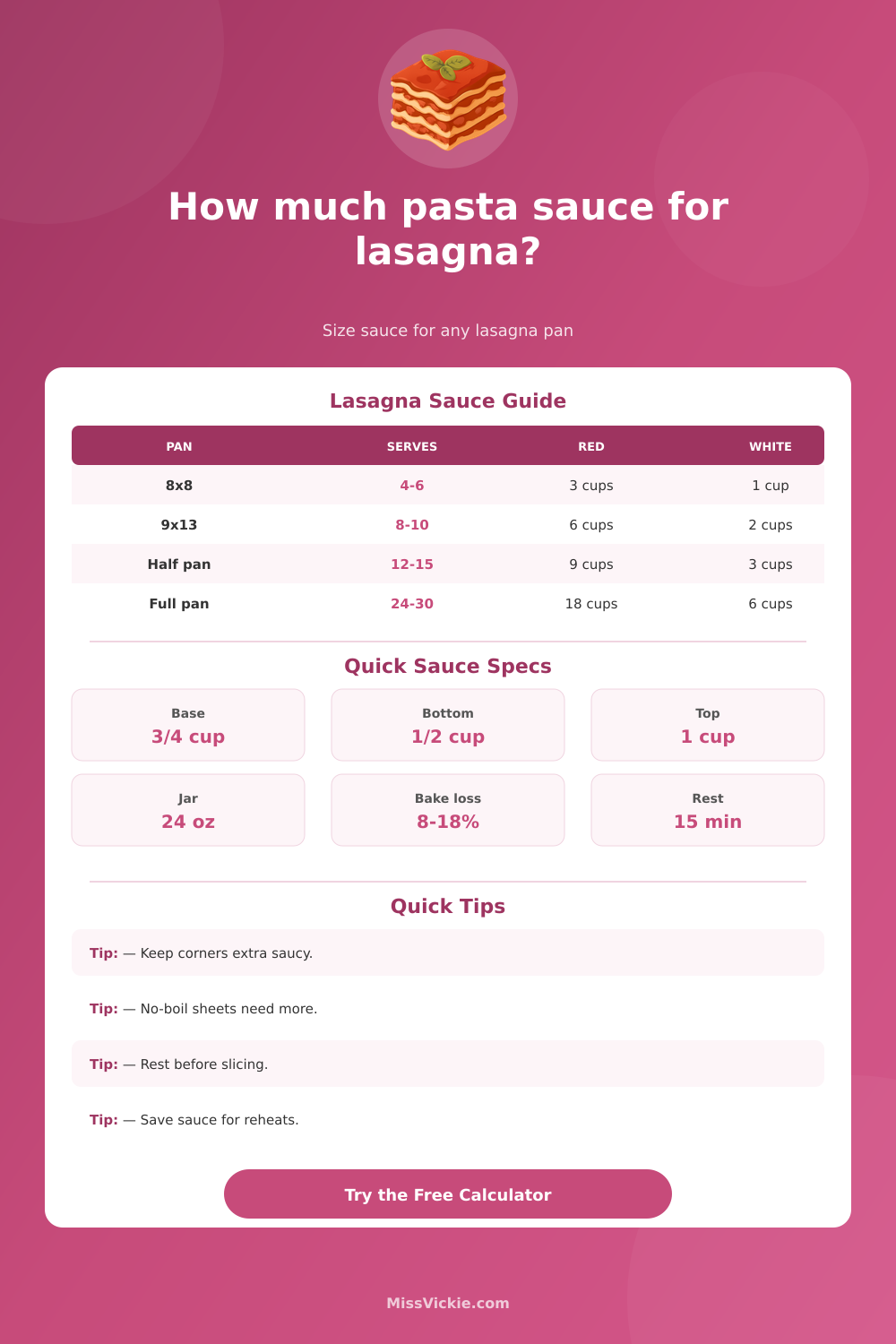
4.Pan size sauce table
| Pan | Typical servings | Total red sauce | White sauce option |
|---|---|---|---|
| 8 x 8 inch square | 4 to 6 | 3 to 4 cups / 24 to 32 oz | 3/4 to 1 1/4 cups for a creamy layer. |
| 9 x 13 inch casserole | 8 to 10 | 5 1/2 to 7 cups / 44 to 56 oz | 1 1/2 to 2 1/2 cups when using bechamel. |
| Deep 9 x 13 inch pan | 10 to 12 | 7 to 9 cups / 56 to 72 oz | 2 to 3 cups for a four-layer build. |
| Half steam-table pan | 12 to 15 | 9 to 11 cups / 72 to 88 oz | 3 to 4 cups for catering service. |
| Full steam-table pan | 24 to 30 | 18 to 22 cups / 144 to 176 oz | 6 to 8 cups for a red-and-white pan. |
5.Noodle and layer adjustment table
| Noodle or layer choice | Adjustment | Why it matters | Calculator treatment |
|---|---|---|---|
| Boiled noodles | Baseline | They already carry water, so the sauce only needs to coat. | Uses the standard layer and serving target. |
| No-boil sheets | Add 16% | Dry sheets hydrate from the sauce during baking. | Raises internal layer sauce and top coverage. |
| Fresh pasta sheets | Use 8% less | Fresh sheets are tender and need less liquid to soften. | Trims sauce so the pan does not turn loose. |
| Five or more pasta layers | Add 5% per extra layer | More interfaces mean more sauce disappears between sheets. | Layer multiplier grows beyond four layers. |
| Gluten-free sheets | Add 22% | Many gluten-free noodles absorb quickly and can crack dry. | Uses the highest noodle hydration factor. |
6.Jar and batch table
| Batch | Prepared sauce | 24 oz jars | Kitchen note |
|---|---|---|---|
| Small square pan | 4 cups / 32 oz | 2 jars | Open the second jar for top and corner coverage. |
| Classic 9 x 13 | 6 cups / 48 oz | 2 jars | Works for meat sauce or marinara with ricotta. |
| Extra saucy 9 x 13 | 7 1/2 cups / 60 oz | 3 jars | Useful for no-boil sheets or reheated leftovers. |
| Half catering pan | 10 cups / 80 oz | 4 jars | Hold back a cup for service and dry corners. |
| Full catering pan | 20 cups / 160 oz | 7 jars | Scale with a stockpot or large homemade batch. |
7.Sauce style yield table
| Sauce style | Red share | White share | Best use |
|---|---|---|---|
| All marinara | 100% | 0% | Vegetarian pans, ricotta layers, and simple weeknight lasagna. |
| Meat sauce | 100% | 0% | Ground beef, sausage, or turkey folded directly into sauce. |
| Red sauce and bechamel | 72% | 28% | Northern-style layers where white sauce supplies richness. |
| Sunday red and white | 62% | 38% | Rich holiday pans with both tomato sauce and creamy layers. |
| Vodka sauce lasagna | 82% | 18% | Creamy tomato builds that need less separate white sauce. |
8.Sauce style comparison
Cleaner portions with enough sauce to soften noodles.
Balanced 9 x 13 style with glossy layers.
More spoonable sauce for corners and reheating.
Higher moisture so slices reheat without drying out.
9.Lasagna sauce tips
The amount of sauce to use in lasagna is a significant factor in the lasagna recipe. The amount of sauce affect the lasagna’s ability to hold its shape and the moisture level of the lasagna noodles. If you use too little sauce, the edge of the lasagna will dry out, and the center will remain firmly.
If you use too much sauce, the lasagna will slide off the plate before you can get the lasagna to the plate. Factors such as the amount of liquid in lasagna noodles, interaction of other ingredient with sauce, and the loss of moisture in the oven will affect the amount of sauce needed for the lasagna. The size and depth of the pan will determine the total volume of sauce required for the lasagna.
How Much Sauce to Use in Lasagna
A smaller pan will allow for fewer layer of lasagna to be baked in the pan. Therefore, a smaller pan will require less sauce than a larger pan. If you use a 9 by 13 pan, the lasagna will spread out more, requiring more sauce so that each serving of lasagna will recieve the same amount of sauce.
A shallow pan will lose its moisture more quick than lasagna in a deeper pan. Therefore, if you change the type of pan for your lasagna, you will have to change the amount of sauce to account for the change in surface area and depth of the pan. The type of noodle will change the amount of sauce that is required for lasagna.
If you use boiled noodles, the noodles already contains some of the liquid that is required for the lasagna noodles to finish cooking. Therefore, you will need less sauce if you use boiled noodles. If you use no-boil sheets, the noodles absorb the liquid from the sauce.
Therefore, you will need more sauce than if you use boiled lasagna noodles. If you use fresh lasagna noodles, they will be tender and will require the lasagna to remain glossy, so there must be enough sauce. Lastly, if you use gluten-free lasagna noodles, they absorb the liquid in the lasagna more than regular lasagna noodles, so there will have to be more sauce to prevent the noodles from becoming dry.
The type of sauce for lasagna will also affect the amount of sauce that you must prepare. If you use marinara sauce, it will be thin and will allow the sauce to coat each layer of lasagna. If you use meat sauce, the meat sauce will thicken during the cooking process, so it will cover less surface area than the thinner sauce.
If you use both red sauce and bechamel sauce, the amount of liquid will be the same but the distribution of the sauce will change. The bechamel sauce will remain in the lasagna layers, so there will have to be enough red sauce to coat the lasagna noodles to avoid the noodles from tightening at the edge. Some of the ingredients in the lasagna will change the amount of sauce needed.
Ricotta and cottage cheese will form a barrier between the sauce and the lasagna noodles. Therefore, there will be no sauce reaching all of the noodles’ surface. The raw vegetables will release some of their water when they are cooked, so they will increase the amount of liquid in the lasagna.
Cooked vegetables will have already released their moisture during the cooking process, so they will not add to the amount of liquid in the lasagna. The amount of sauce will change based off whether the lasagna contains raw or cooked vegetables. The conditions in which you cook the lasagna will change the amount of sauce needed.
If you use a pan covered with foil while cooking the lasagna, the lasagna will lose less of its liquid. If you do not cover the pan, the lasagna will lose some of its liquid during the cooking process. If you cook the lasagna for a longer time or keep it covered for an hour once cooked, the lasagna will dry out on the top layer.
Lasagna recipes that are meant to be frozen or reheated will contain more sauce to help prevent the lasagna from drying out while reheated. You can improve the results of your lasagna if you hold back some of the sauce that you will use to prepare the lasagna. While the lasagna is resting, the top layer of lasagna will tighten.
Therefore, there will be the opportunity to use some of the sauce to moisten the corners of the lasagna or to serve it alongside the lasagna. Using extra sauce will also make it easier to reheat the lasagna because you can simply add the sauce to the lasagna portions that you are reheating. To determine the correct amount of sauce to use in your lasagna, you will have to consider the size and type of pan, the type of noodle, the moisture that the ingredients will contribute, and the baking conditions.
If you consider these factors, you can adjust the amount of sauce to the lasagna that you are making. You will obtain the best results if you adjust the amount of sauce according to the situation that you have prepare with the pan, noodles, and ingredients that you are using.