Meat type, sauce ratio, simmer loss, pasta pairing, and jars
How Much Pasta Sauce for Meat Calculator
Estimate how much pasta sauce to add to ground beef, sausage, turkey, meatballs, or mixed meat so the finished meat sauce is hearty, balanced, and saucy enough for pasta.
Choose a common dinner, freezer batch, or party pan. Each preset loads meat weight, sauce style, simmer reduction, pasta needs, and leftover buffer.
Calculation breakdown
One pound ground beef plus one 24 oz jar gives a familiar family-style sauce for about four pasta servings.
Turkey, lean beef, and plant-based grounds benefit from a little extra sauce because they release less fat and moisture.
Lasagna, ziti, and freezer casseroles need extra sauce because pasta absorbs moisture during baking and reheating.
A long simmer concentrates flavor, so start with enough liquid to survive reduction without drying out the meat.
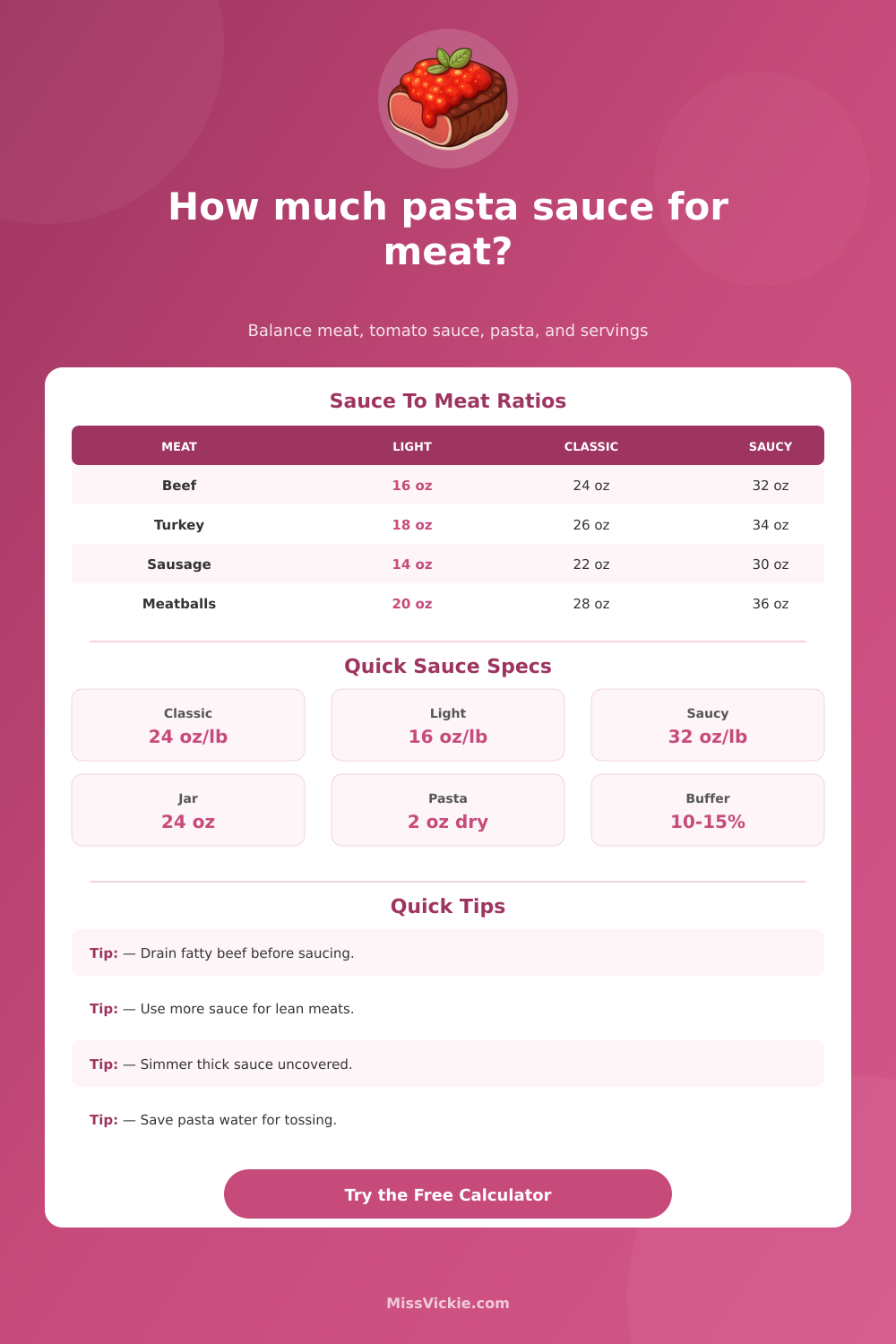
| Meat type | Light ratio | Classic ratio | Saucy ratio |
|---|---|---|---|
| Ground beef, 80/20 | 16 oz sauce per 1 lb meat | 24 oz sauce per 1 lb meat | 32 oz sauce per 1 lb meat |
| Lean beef, 90/10 | 18 oz sauce per 1 lb meat | 26 oz sauce per 1 lb meat | 34 oz sauce per 1 lb meat |
| Ground turkey | 19 oz sauce per 1 lb meat | 27 oz sauce per 1 lb meat | 36 oz sauce per 1 lb meat |
| Italian sausage | 14 oz sauce per 1 lb meat | 22 oz sauce per 1 lb meat | 30 oz sauce per 1 lb meat |
| Cooked meatballs | 20 oz sauce per 1 lb meatballs | 28 oz sauce per 1 lb meatballs | 36 oz sauce per 1 lb meatballs |
| Plant-based grounds | 19 oz sauce per 1 lb grounds | 27 oz sauce per 1 lb grounds | 36 oz sauce per 1 lb grounds |
| Ingredient | Typical kitchen measure | Metric equivalent | Planning note |
|---|---|---|---|
| Pasta sauce | 1 cup = 8 fl oz | About 240 ml, 225 to 250 g | Thick chunky sauces weigh more than thin marinara. |
| Jarred sauce | 1 common jar = 24 oz | About 680 g or 710 ml | One jar is the classic match for 1 lb ground meat. |
| Crushed tomatoes | 1 large can = 28 oz | About 794 g | Good for slow ragu because it can reduce without tasting too salty. |
| Cooked ground beef | 1 lb raw yields 11 to 13 oz cooked | About 310 to 370 g cooked | Yield depends on fat level and whether drippings are drained. |
| Dry pasta | 2 oz per serving | About 56 g per serving | Use more sauce for ridged, baked, or reheated pasta. |
| Batch | Raw meat | Classic sauce | Best use |
|---|---|---|---|
| Dinner for 4 | 1 lb | 24 to 28 oz | Spaghetti, shells, or weeknight meat sauce. |
| Family for 6 | 1.5 lb | 36 to 42 oz | Rigatoni bowls with a little leftover sauce. |
| Meal prep 8 | 2 lb | 52 to 60 oz | Reheatable portions that will not dry out. |
| Lasagna pan | 1.5 to 2 lb | 48 to 64 oz | Layered pasta needs extra moisture at the edges. |
| Party tray 24 | 5 to 6 lb | 160 to 200 oz | Buffet pans, baked ziti, or big rigatoni trays. |
| Cooking style | Reduction range | Ratio adjustment | Why it matters |
|---|---|---|---|
| Quick skillet meat sauce | 5% to 10% | Use the calculator baseline | Short cooking keeps most jarred sauce volume intact. |
| Uncovered 45 minute simmer | 12% to 20% | Add 2 to 6 oz sauce per lb meat | Water evaporates while meat and tomato flavor concentrate. |
| Slow ragu | 20% to 30% | Start saucier, finish thicker | Long cooking needs enough tomato liquid to protect the meat. |
| Baked ziti or lasagna | 10% plus absorption | Add 15% to 25% more sauce | Pasta absorbs sauce in the oven and during resting. |
| Next-day leftovers | 0% cooking loss | Add 10% to 15% buffer | Chilled pasta and meat sauce thicken overnight. |
The ratio of the meat to the tomato sauce determines the consistency of the pasta dish. If the ratio of the meat to the tomato sauce are incorrect, the sauce may be thin or the pasta may sit in a puddle of tomato sauce. The person preparing the sauce must understand how the type of meat will impact the amount of tomato sauce needed for the pasta dish.
The type of meat that people use for the sauce will impact the amount of tomato sauce that are needed. For instance, ground beef that contain fat will require less tomato sauce than leaner meats like turkey. The fat will help to coat the ground beef and prevent the tomato sauce from soak into the ground beef too quick.
How Much Tomato Sauce Do You Need for Pasta and Meat?
Turkey, being leaner, will give up its moisture quickly and the protein will tighten when the leaner proteins sits. Thus, more tomato sauce will be needed for turkey than ground beef with fat. Sausage will also contain some of the seasonings and fat necessary to enhance the flavor of the meat and will require less tomato sauce than lean meats.
Finally, meatballs will contain the same amount of meat as the sauce but will be cooked prior to adding the meat to the tomato sauce. The tomato sauce will need to reach around the meatballs instead of coating the crumble of cooked meat. The shape of the pasta will impact the amount of tomato sauce needed.
For instance, long pasta strands will allow the tomato sauce to coat the pasta strands but not trap the sauce inside the pasta. However, shapes like tube or shell pasta will trap the tomato sauce inside the pasta shape. Finally, baked pasta dishes will require more tomato sauce because the pasta will absorb some of the tomato sauce while it is baking.
Thus, tomato sauce may be dry on the pasta after baking for thirty minute with cheese on top of the pasta. People often need to use an extra jar of tomato sauce in order to account for the pasta that will be baked. The simmer time will impact the amount of tomato sauce needed.
For instance, if the tomato sauce simmers quickly in a pan, very little sauce will be lost to simmering. However, if the sauce simmers for a long time over medium heat, the water will evaporate from the sauce. Thus, people will have to start with extra liquid in order to retain the same amount of sauce after simmerming for an extended period of time.
Many people makes the mistake of adding one jar of tomato sauce for every pound of meat. While this is a convenient shortcut, it does not account for the type of meat that is being used or the type of pasta that will be used in the sauce. For instance, one jar of tomato sauce may not be enough for fatty sausage but may be too much for turkey.
Meatballs may require different amount of sauce than ground meat. Thus, people need to determine how much sauce is needed in total after the meat is browned in the pan. Another mistake is to drain all of the fat from the meat.
While the fat will be rendered during cooking, draining all of the fat from the meat will make the meat dry and more absorbent of the tomato sauce. If the meat is absorbing the sauce, the sauce will become too thin for the pasta dish. Draining the fat will be necessary to remove the large pools of fat but not to the point of removing all of the fat from the meat.
Using vegetables and mushrooms will impact the amount of tomato sauce that is needed for the pasta sauce. Vegetables and mushrooms will take up some of the space in the sauce as well as absorb some of the sauce itself. Thus, the amount of tomato sauce needed will increase to account for these ingredients.
Using the pasta water is a tool in order to even out the tomato sauce if the sauce becomes too thick. The starch in the pasta water will loosen the sauce if the sauce has been simmermed too much. Thus, a small cup of pasta water should be saved prior to adding the pasta to the tomato sauce so that the sauce can be adjusted if necessary.
Using the pasta water will allow for the dish to be finished in the same pan in which the tomato sauce was cooked. There is no number to tomato sauce that will be perfect for every pasta and meat dish. Instead, there will be a range of tomato sauce that will account for the type of meat, the pasta shape, and the number of servings that will be prepared.
After these variables are established, the amount of tomato sauce needed will be calculated through a process of simple arithmetic.